Introduction
Imagine photocopying a photo, then photocopying that copy, and repeating the process ten times in a row. What happens? Each time, fine details fade a little more, contrast turns strange, and eventually what's left is just a blurry ghost of the original image. Now bring that same idea into the world of artificial intelligence: what happens when an AI model, instead of learning from real human data, keeps training on data that it — or similar models — generated itself?
The answer to that question is one of the most concerning, yet fascinating, concepts in
machine learning today:
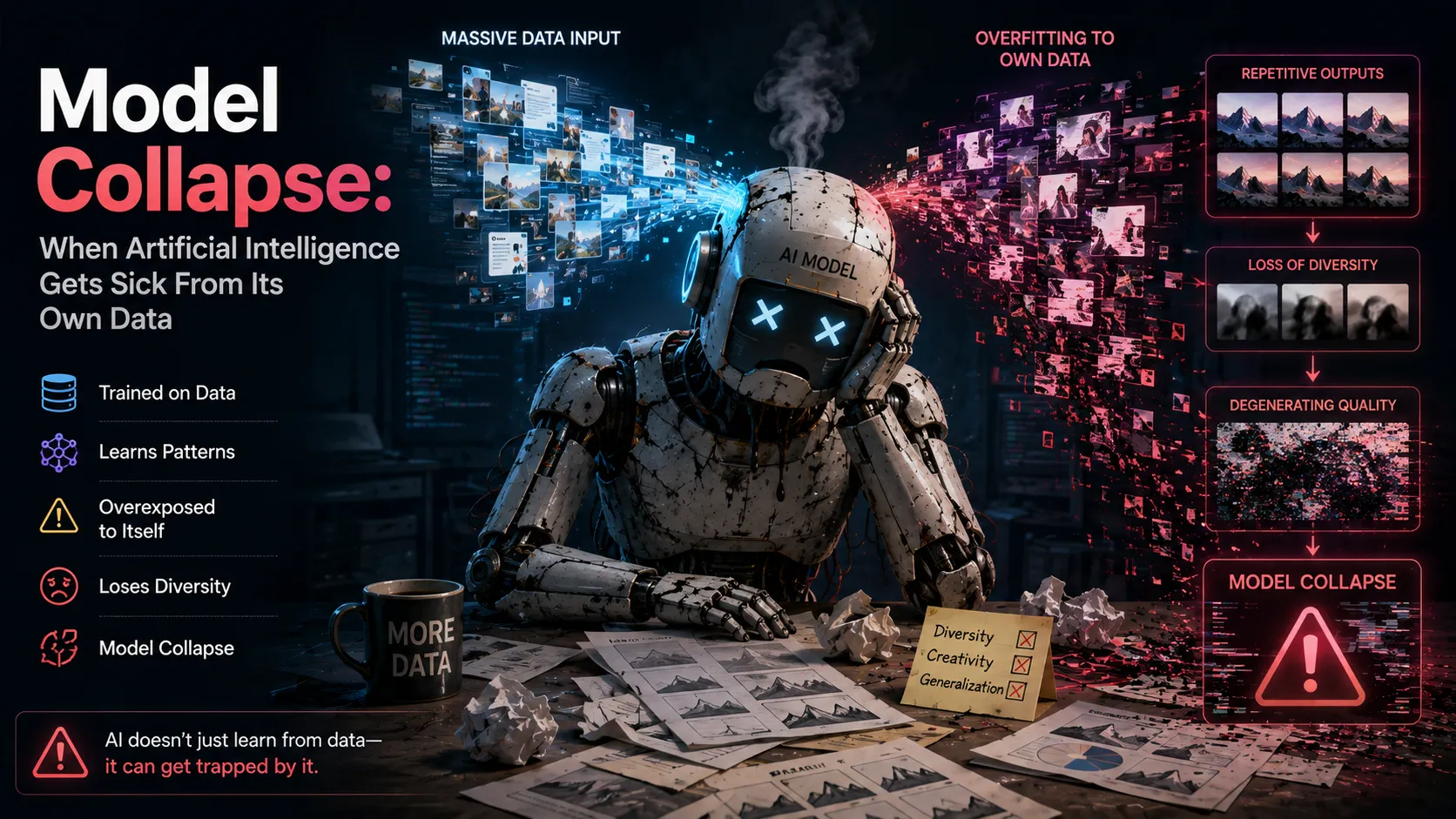
Model Collapse. It's a phenomenon where AI gradually loses its diversity, accuracy, and creativity — much like a photocopy of a photocopy loses quality.
In our previous article about
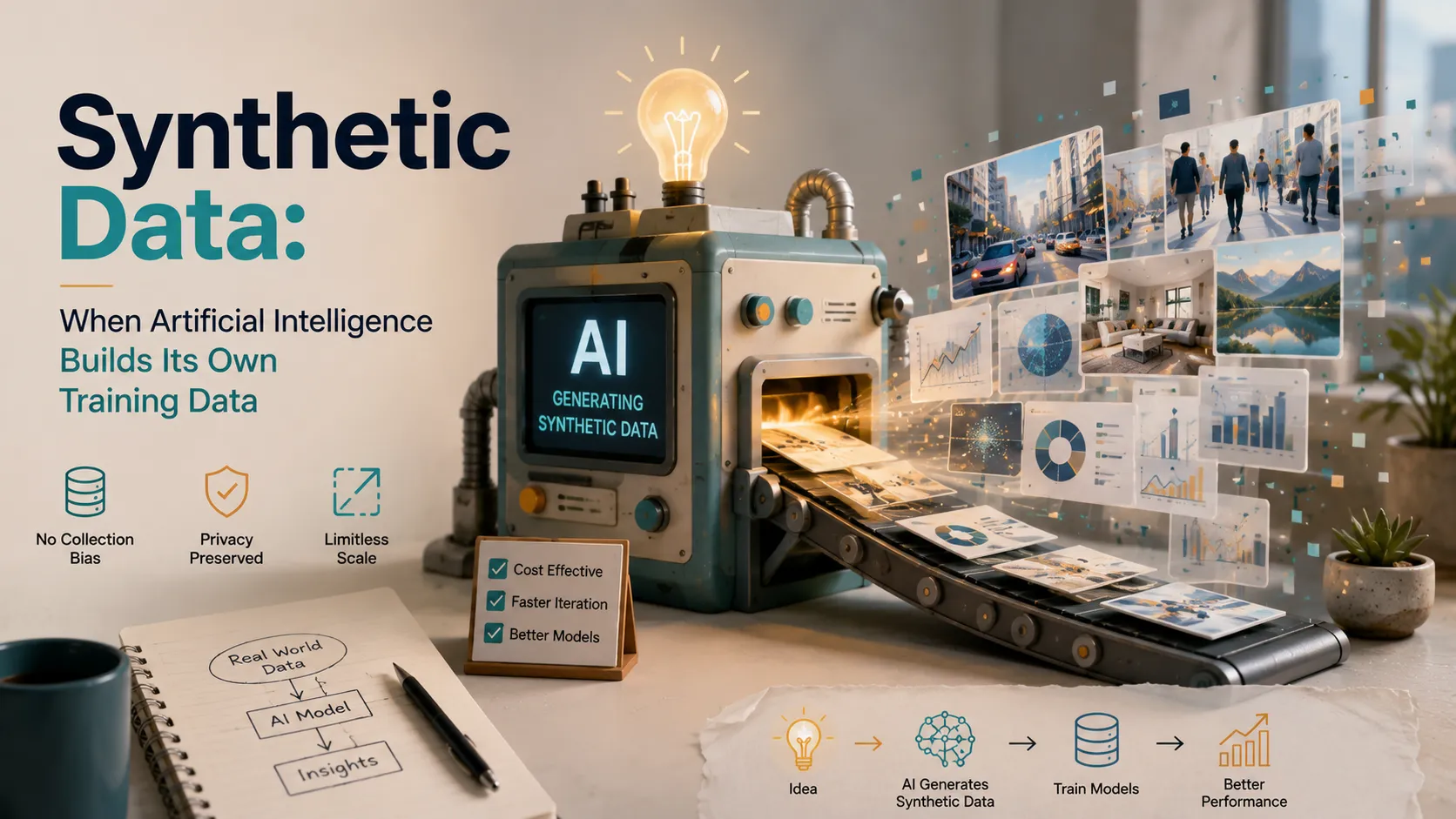
synthetic data, we explained how AI has started generating its own training data to solve the data scarcity problem. Now it's time to look at the darker corner of that same story: what happens when this cycle spins out of control.
What Exactly Is Model Collapse?
Model collapse is a process in which an AI model, generation after generation, is trained on data produced by its own earlier versions or by similar models. In this recursive loop, instead of learning from the real diversity of the world, the model simply learns to imitate the "average" and "safer" outputs of its previous generation.
The result? The model gradually forgets rare cases, subtle nuances, unusual accents, styles, and edge cases, drifting instead toward uniformity and repetition. The images it generates start looking more alike, the text it writes becomes more clichéd, and in the worst case, the model starts producing nonsensical output that has drifted far from reality.
Researchers who studied this phenomenon in peer-reviewed journals have compared it to a genetic disease that intensifies across successive generations — much like a biological species losing its genetic diversity from repeated inbreeding within a small population.
Why Does This Happen? A Look at the Technical Mechanism
To understand this more deeply, we need to peek into the math of machine learning — but in plain terms:
1. Shrinking Tails of the Statistical Distribution
Every real dataset has a statistical distribution that includes common cases (the middle of the distribution) and rare cases (the tails). When a generative model creates new data, it tends to focus on frequent, "safe" patterns and underrepresent rare cases. If the next generation of the model trains on this same data, those already-thinned rare cases get almost entirely erased.
2. Accumulating Error Across Generations
Even the best models carry some small error in how they estimate the true data distribution. When this small error gets passed from one generation to the next and compounds on itself, it behaves like a game of telephone — where a sentence completely changes after passing through several people's mouths.
3. Losing the Collective Memory of Human Data
Real human data is the product of billions of diverse lived experiences. As this original source gets diluted and replaced by machine-generated data, the model effectively drifts away from humanity's "collective memory" — a concept closely tied to the idea of
digital amnesia in the AI era.
When the Theory Left the Whiteboard and Entered the Lab
Until a few years ago, model collapse was mostly a theoretical concern — until researchers at several respected universities proved it in practice. In one of the best-known studies, published in the journal Nature, a team trained a language model on human text, then used that same model's output as training data for the next generation, repeating the cycle several times over.
The result matched the prediction almost exactly: instead of producing coherent, varied text, later generations of the model gradually began repeating nonsensical sentences, sometimes completely unrelated to the original topic. What's more striking is that this quality decline still occurred even when a small portion of real data remained in the training mix — just at a slower pace. The finding showed that model collapse isn't merely a theoretical risk; it's a measurable, reproducible phenomenon in the lab, and as models scale up, managing it becomes only more critical.
Tangible Signs of Model Collapse — Where You Can Actually See It
This isn't just an abstract lab theory; the signs are visible in practice:
- In image generation: If an image-generation model is repeatedly trained on its own output, generated images gradually start looking more alike, background details blur out, and strange distortions (like asymmetric fingers or repetitive textures) become more common. This is exactly the kind of risk to watch for when retraining models discussed in our article on diffusion models for image and video generation.
- In large language models: Generated text converges toward a single, clichéd tone instead of stylistic variety. Long, complex, creative sentences become rarer, and the model drifts toward short, safe, repetitive answers.
- In voice and speech synthesis: Voice-cloning models that repeatedly train on prior synthetic voice output accumulate metallic, unnatural noise in the generated voice.
- In content recommendation: Even the algorithms that select your recommended content, if repeatedly trained on data generated by similar algorithms, drift toward uniform and repetitive taste — a pattern closely related to the filter bubble and algorithmic echo chamber problem.
Healthy Training vs. the Collapse Cycle
| Feature | Healthy Training (diverse human data) | Collapse Cycle (recursive synthetic training) |
| Output Diversity | High and varied | Gradually shrinks toward uniformity |
| Coverage of Rare Cases | Preserved | Gradually erased |
| Long-Term Accuracy | Stable or improving | Degrades generation after generation |
| Creativity and Style | Rich and multi-layered | Clichéd and repetitive |
| Long-Term Risk | Low | High, up to the point of rendering the model worthless |
Why the Internet Itself Is Especially at Risk
One of researchers' most serious concerns is that as more AI-generated content fills the internet, the odds increase that the next generation of models will unintentionally train on that same content. When an article, image, or post written by AI gets published online without any marker, it becomes part of the internet's "raw data pool" — data the next model will learn from without ever knowing whether it was human or machine-made.
This is exactly why the topic of
detecting watermarks in AI-generated content has become so important lately. The only real way to prevent the internet from becoming fully polluted with recursive data is being able to distinguish synthetic content from human content and properly manage it in the training pipeline of future models.
Which Industries Are Most at Risk?
Model collapse isn't an equal risk across every AI domain — some industries are more vulnerable because of the nature of their data:
Search engines and answer generation: Search engines that now build part of their results from AI-generated summaries face real feedback risk — they may end up retraining on the very synthetic summaries they generated, gradually degrading answer quality over time.
Coding assistants: Tools that generate code, if trained on large volumes of code produced by similar tools, risk drifting toward narrow, less optimal coding patterns and forgetting creative, less common solutions.
Scientific research: In fields where AI is used to analyze scientific data or even draft parts of papers, if future analytical models train on conclusions generated by earlier models, scientific errors can be repeated and even amplified instead of corrected.
Medicine and disease diagnosis: In the field we touched on in our
synthetic data article, if synthetic medical images enter the training pipeline without sufficient quality control, the long-term risk of misdiagnosis increases — a domain where error isn't just a technical glitch, it can affect human lives.
How to Prevent Model Collapse
Fortunately, model collapse isn't an inevitable fate. Researchers and major AI labs are pursuing several core strategies:
Preserving a ratio of real human data: Instead of fully replacing real data with synthetic data, a balanced mix of both is maintained so the model always stays rooted in reality — an approach we also emphasized in our previous article on
synthetic data.
Data provenance tracking: Carefully labeling where each piece of data came from — human or synthetic — helps future models assign appropriate weight to each source.
Active diversification: Instead of simply generating more data, some methods deliberately focus on producing rare and edge-case samples to counterbalance the erosion that happens in recursive cycles.
Controlled continual learning: Approaches like
continual learning help models add new knowledge in a controlled way instead of gradually forgetting what they already know.
Human oversight and quality evaluation: Human review of model outputs — especially before they're used as training data for the next generation — remains one of the most effective defenses against model collapse.
The Link Between Model Collapse and Cultural Homogenization
A less-discussed dimension of this phenomenon goes beyond technical accuracy. As AI models that millions of people interact with daily gradually drift toward uniform, clichéd output, that uniformity can spill over into human taste, language, and even collective creativity — a topic directly tied to
AI-driven cultural homogenization.
The Future: Is Model Collapse Controllable?
The good news is that awareness of this phenomenon is already half the solution. Unlike a few years ago when this issue was first discovered, today major AI labs are seriously investing in data provenance systems, synthetic-content detection filters, and architectures more resistant to feedback loops. Combining these efforts with approaches like
federated learning, which keeps data at its original source, can help future models grow without losing their roots in human reality.
Frequently Asked Questions About Model Collapse
Is model collapse actually happening in well-known models right now?
Major AI companies are actively aware of this phenomenon and invest heavily in preventing it, including maintaining large archives of pure human data that never gets mixed with synthetic data. Still, the risk remains serious, especially for smaller models or teams with weaker data quality control.
Should synthetic data be avoided altogether?
No. As explained in our
synthetic data article, this data is essential for solving problems like data scarcity and privacy protection. The problem starts when synthetic data is used recursively and without oversight, with no mixing of real data at all.
How can an everyday user help prevent this?
If you publish AI-generated content, it helps to edit it with a human touch as much as possible, and to disclose when content was AI-assisted where you can — this contributes to keeping future internet data more transparent.
How can you tell if a model has collapsed?
Common early signs include reduced diversity in responses, an increase in repetitive, clichéd answers, and weaker performance on unusual or edge-case questions.
Conclusion
Model collapse is a reminder of a simple but fundamental truth: no matter how advanced artificial intelligence becomes, it still depends on the diversity, depth, and nuance of human experience as its core learning source. Synthetic data is a powerful tool for solving the data-scarcity problem, but when it fully replaces real data and loops back on itself endlessly, it can weaken the very thing it was meant to strengthen. A healthy future for AI doesn't lie in eliminating synthetic data entirely — it lies in striking a smart balance between synthetic and real human data.
If you want to see how AI content tools can help you produce diverse, high-quality content without falling into the repetition trap, check out our
smart content editor.



 AI Fundamentals & Algorithms
 AI Fundamentals & Algorithms
 AI Fundamentals & Algorithms
 AI Fundamentals & Algorithms
 AI Fundamentals & Algorithms
 AI Fundamentals & Algorithms