Blogs / AI and the Fate of Global Cultural Diversity: Homogenization or a New Opportunity?
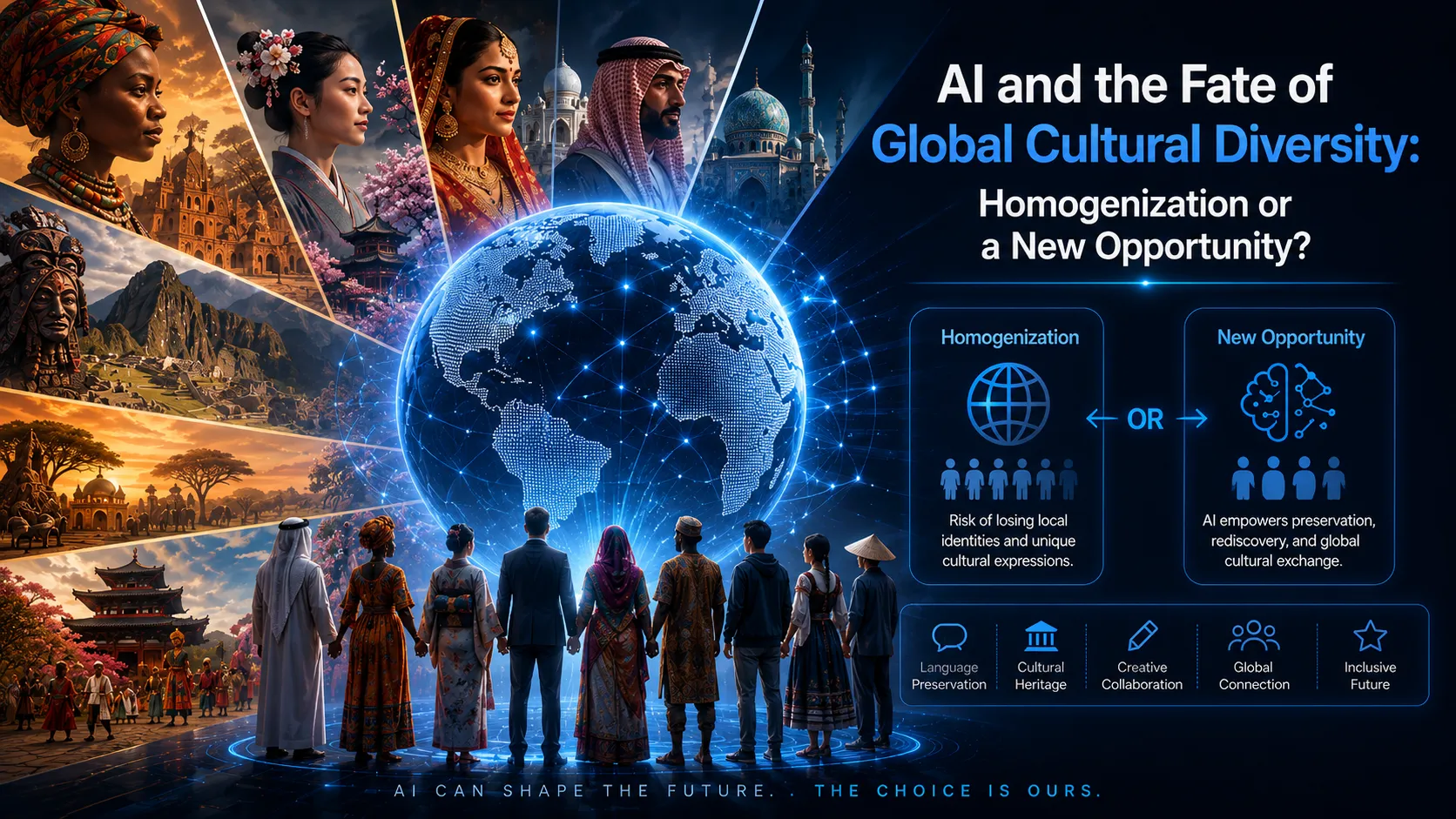
AI and the Fate of Global Cultural Diversity: Homogenization or a New Opportunity?
Introduction
Picture a teenage girl on the edge of the Iranian desert, a boy in a village in Peru, and a student on the outskirts of Jakarta, all using the same artificial intelligence model to write an essay, generate an image, or compose a piece of music. The results, in terms of style, tone, color palette, and even sentence structure, end up looking strangely similar. This is not a thought experiment; it is exactly what is happening today on a billion-user scale.
The question occupying the minds of sociologists, linguists, and cultural activists these days is this: despite all its dazzling capabilities, is artificial intelligence flattening tastes, languages, and local identities across the world? Are we heading toward a world where everything — from music to architecture, from writing style to facial aesthetics — converges into a single global template?
In this article, we'll examine this question from multiple angles, using concrete, everyday examples, and see whether this is a real threat or whether AI could, in fact, become a powerful tool for saving cultures that are fading into oblivion.
What Is Cultural Homogenization, and Why Is This Time Different?
Cultural homogenization is not a new phenomenon. Television, Hollywood, social media, and global brands have promoted similar lifestyles across the globe for decades. What's different this time is the speed, scale, and depth of penetration.
Until a few years ago, a Hollywood film or a global pop song was produced by a studio employing hundreds of people, and the audience consumed it as an "external" product. Today, however, the ordinary user — with no specialized knowledge — creates content in a few clicks that, structurally, follows the exact same dominant patterns; because the language or image model behind that tool was trained on data drawn predominantly from English-language and Western sources.
The result? A user in Tehran using a smart writing tool to generate content may, without realizing it, find their tone and sentence structure drifting toward patterns common in English texts.
Has Something Like This Happened Before?
Looking back at history, we realize humanity has faced waves of cultural homogenization more than once. The Industrial Revolution, radio, television, and later the internet each pushed local lifestyles toward a more global template in their own way. But there's a fundamental difference between those earlier waves and the current one: in previous waves, humans decided what content got produced and broadcast — a producer, a writer, a TV network. In the AI wave, however, the final decision-maker on "what looks good" is an algorithm trained on billions of data points, one that nobody directly controls.
Another key difference is the sheer speed of propagation. A television trend might take months or years to reach different countries; but a visual style generated by AI can spread across social media within hours and be copied and reproduced by millions of people. This means the time needed for "cultural digestion" — adapting a trend to local taste — has effectively dropped to zero.
How Exactly Does AI Affect Cultures?
To keep this discussion concrete, let's break it down into a few tangible areas that we all experience every day.
1. Language: When the Mother Tongue Fades
One of the most astonishing — and simultaneously concerning — capabilities of natural language processing is that it can translate text from any language into any other language in a fraction of a second. This capability is remarkable, but it has a hidden side effect: because the training data behind these models is predominantly English, translated output into other languages often "smells like English"; idioms, sentence structure, and even jokes get copied from the source language rather than drawn from the target culture.
On the other hand, for languages with few speakers — many local languages in Africa, Central Asia, or even regional dialects in Iran — there simply isn't enough data to train models properly. This means the more the world moves toward conversing with smart assistants, the more low-speaker languages get pushed to the margins — exactly the subject we explored in A World Without Language.
2. Art and Imagery: When Everything Becomes One Style
One of AI's truly dazzling capabilities is its ability to generate artistic images in seconds. Just type a few words and receive a stunning visual work. Tools like the smart image generator do exactly this.
But here's the interesting part: if you browse social media today, you'll notice that a large portion of AI-generated images — from fantasy portraits to imaginary landscapes — share a common "visual style": cinematic lighting, a particular color grading, similar composition. This style is a product of the dominant patterns in the training data, not a reflection of the real visual diversity found in Persian miniature painting, Chinese calligraphy, or Indigenous South American art. This is exactly the topic explored in The Impact of AI on Art and Creativity.
3. Music: When Melodies Start to Sound Alike
AI music-generation tools let users create a complete piece in minutes. These tools, part of the broader category of smart audio content generation, are genuinely impressive; but because they're trained mostly on pop, hip-hop, and Western genres, when a user from a country with a rich traditional musical heritage (like the Persian dastgah system or Indonesian gamelan music) asks for a piece, the model tends to pull it toward formats more familiar to it — Western pop.
4. Taste and Aesthetic Preference: Algorithms Deciding What Looks "Beautiful"
Perhaps the most important and most hidden layer of homogenization is the algorithm's role in shaping public taste. Platforms that use AI to rank and recommend content gradually build a "global beauty standard" that everyone ends up measuring themselves against. We covered this in more depth in How Technology Shapes Public Taste.
Interestingly, this process can manifest in two opposite ways: on one hand, global taste homogenization; on the other, the creation of filter bubbles that keep each person confined to their own small world. If this fascinating paradox interests you, don't miss Escaping the Filter Bubble and Algorithmic Echo Chamber.
5. Fashion and Dress: One Style for the Entire Planet?
The fashion industry is no exception. AI-driven design tools, discussed in AI in the Fashion Industry, often treat dominant trends from global fashion capitals (Paris, Milan, New York) as the benchmark for "beauty," reflecting local and traditional attire far less — unless deliberately designed to do so.
6. Beauty Filters: When Everyone Ends Up With the Same Face
Perhaps the most tangible example of homogenization is sitting on your phone right now. Facial-enhancement filters on Instagram, Snapchat, and TikTok all run on machine-learning algorithms that apply one specific "beauty standard" — flawless skin, a narrower nose, larger eyes — to every face, regardless of ethnicity or heritage. As a result, cosmetic surgeons in many countries report that patients no longer bring in photos of celebrities; they bring in the filtered version of their own face and ask to look exactly like that. This phenomenon, informally dubbed "filter dysmorphia," is a vivid, concrete example of AI's impact on the concept of beauty at a global scale.
7. Coding and Software Development: Even Programming Style Is Converging
This gets discussed less often, but homogenization isn't limited to art and music. AI coding assistants, covered in AI Programming Models Comparison, typically suggest one dominant "coding style" — often derived from popular American open-source projects — to developers all over the world. The result is that even the local diversity in how different programming communities structured projects and approached problem-solving is gradually fading.
8. Food and Cooking: When Even Recipes Get Standardized
Even a field that seems far removed from AI, like cooking, isn't exempt. Recipe-recommendation apps powered by smart algorithms tend to prioritize recipes compatible with ingredients readily available in large Western markets. The result is that authentic, local versions of a dish — with region-specific spices and techniques — get sidelined in favor of "simplified, globalized" versions.
Comparison Table: Where Is the Homogenization Risk Highest?
To summarize these areas, the table below shows the level of homogenization risk versus the counter-potential (cultural revival) in each domain:
| Domain | Homogenization Risk | Tangible Example | Cultural Revival Potential |
|---|---|---|---|
| Language | Very High | Machine translation with English structure | Recording and training endangered languages |
| Visual Art | High | Uniform visual style in AI-generated images | Reviving miniature painting and indigenous art |
| Music | Medium to High | Models defaulting to Western pop formats | Digitizing traditional music |
| Public Taste | High | Uniform beauty standards on social media | Personalizing content based on user culture |
| Fashion & Dress | Medium | Dominance of global fashion-capital trends | AI-driven design rooted in local dress |
The Other Side of the Coin: When AI Becomes a Culture's Savior
Now it's time for a balanced look at this issue, because AI is exactly the kind of tool that can play a reverse role too.
Recording languages on the brink of extinction: Numerous projects around the world are using language models to record, transcribe, and train languages that have only a few hundred elderly speakers left. With tools like smart speech-to-text, the voices of a local language's last speakers can be recorded and preserved forever — something that was previously nearly impossible or prohibitively expensive.
Reviving indigenous art: Local designers and artists can now train image models on samples of their own art (rather than generic internet data), creating works that are both modern and rooted in local culture — directly counteracting the homogenization trend.
Local-scale dubbing and voice-over: With voice cloning technology, global content can be reproduced in local accents and dialects, rather than being limited only to dominant languages.
Equal access to storytelling: Previously, producing a professional-quality film or animation required large studios typically concentrated in a handful of countries. Today, tools like text-to-video generation give an independent artist anywhere in the world the ability to tell their own local story at high quality — without depending on Western studios.
So What's the Verdict? Is Homogenization Inevitable or Manageable?
The reality is that AI itself is neither inherently a homogenizer nor inherently a guardian of diversity; these are two possible paths, and the choice between them depends on a few factors:
- Diversity of training data: The more data companies building these models collect from different languages and cultures, the more diverse the output will be.
- User awareness: A user who knows that a tool's default output leans toward dominant global patterns can steer the output toward their own cultural identity through deliberate prompting — a skill covered in Prompt Engineering in Artificial Intelligence.
- Local investment: Communities and governments that invest in local language models and tools — a topic we explored in National Data as a Strategic AI Resource — stand a much better chance of preserving their cultural identity in the age of AI.
The encouraging part is that human creativity can never be fully removed from the equation. Even when tools offer a default pattern, humans still decide what to accept, what to reject, and how to blend it with their own identity.
A Few Practical Tips for Individuals and Businesses
If you're an individual, a business, or a content creator worried about falling into the homogenization trap, here are a few practical steps:
- Be explicit in your prompts: Instead of a generic request like "make a beautiful image," specify concrete cultural elements (Persian miniature painting, local architecture, traditional dress) so the model doesn't default to a generic global template.
- Use local data for custom training: Businesses and artists who have the resources can fine-tune image or language models on their own local datasets.
- Produce multilingual, multicultural content: Rather than relying solely on default English output, use tools like the smart writing assistant to create properly localized versions of your content.
- Use AI for archiving, not just generating: Recording audio, text, and imagery related to fading traditions is one of this technology's most valuable applications.
Frequently Asked Questions
Does AI completely destroy local cultures?
No; what we're seeing today is more of a "pull" toward dominant patterns rather than outright destruction. With awareness and the right tool choices, this pull can be managed.
Which languages are most at risk?
Languages and dialects with few speakers and limited digital resources — many indigenous languages in Africa, Latin America, and parts of Asia — are the most vulnerable, simply because there isn't enough data to train dedicated models for them.
Is there a way to reduce this risk at an individual level?
Yes; deliberate prompting, choosing tools that allow cultural customization, and consuming AI-generated content mindfully are three simple but effective approaches.
Conclusion
Artificial intelligence is, without question, one of the most powerful tools humanity has ever built, and its capabilities — from instant translation to generating images and music in seconds — are genuinely astonishing. But that same power, if applied without regard for cultural diversity, could quietly push the world toward a single global template.
The good news is that the reverse path is also possible. With awareness, targeted investment, and the thoughtful use of these very same tools, we can turn AI into a bridge that carries cultures forward to future generations, rather than a force that erases them. The final choice still rests with us.