Introduction
A photo from a controversial political event spreads across social media. It takes hours before anyone realizes the event never happened — the image was generated by an AI model. An analytical article goes viral under a post, and it later turns out a chatbot wrote it, not a real journalist. These are no longer hypothetical scenarios; they've become part of everyday internet life.
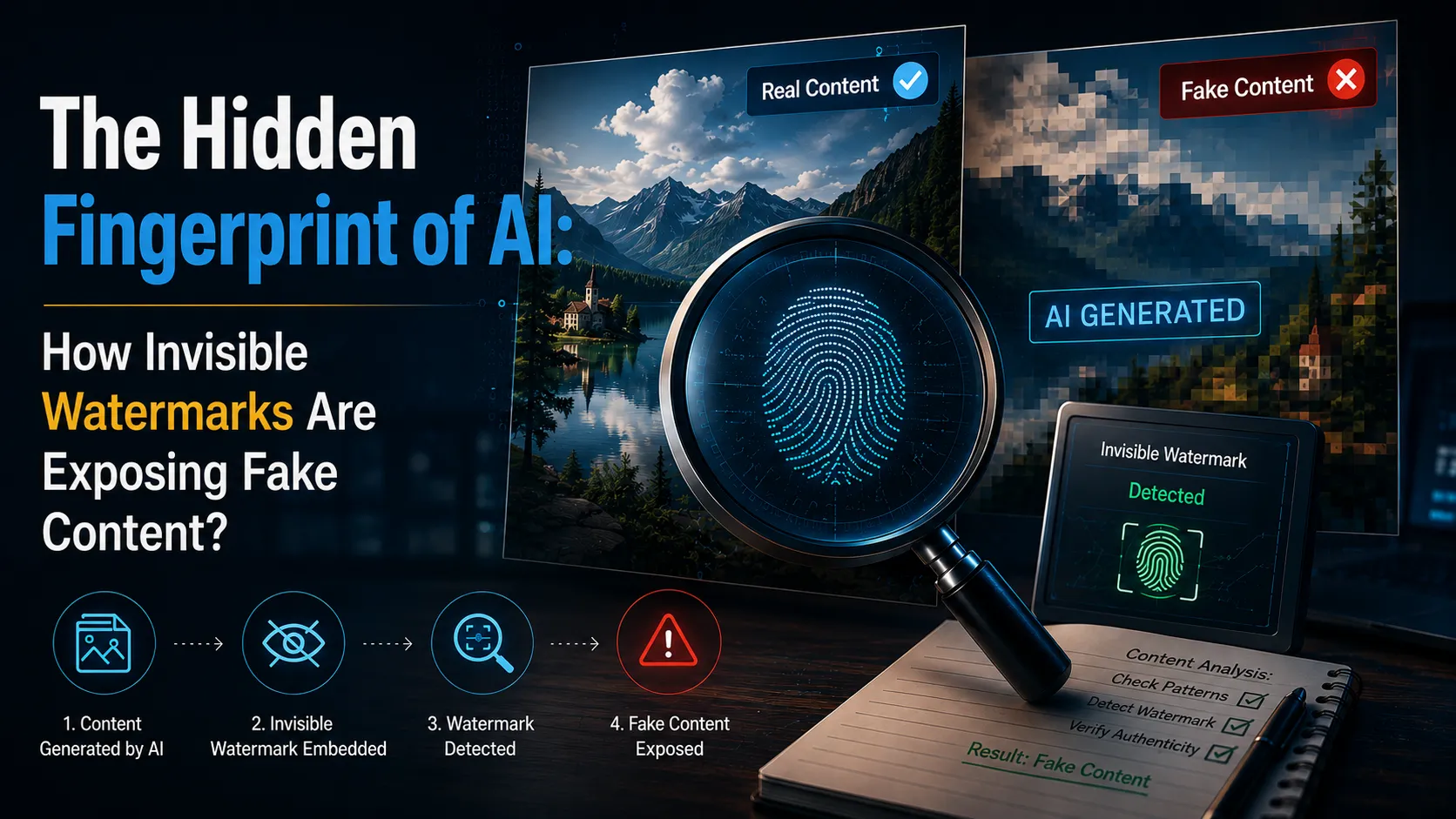
This is exactly where AI content watermarking technology steps in. Unlike traditional watermarks that slap a semi-transparent logo in the corner of a photo, next-generation watermarks are completely invisible — embedded in the texture of the pixels themselves, in the pattern of word choices, even in the waveform of an audio file. The goal? To let anyone, from a journalist to an automated detection algorithm, figure out whether a piece of content was genuinely made by a human or produced by an AI model.
This article dives deep into the topic: how invisible watermarking actually works, what text and image detection tools can and can't do, and why serious regulations around this exact issue have just become enforceable across the world.
Why Did AI Watermarking and Detection Suddenly Become So Important?
Until a few years ago, spotting fake content wasn't hard — hands looked strange, text had a robotic tone, images had obvious inconsistencies. But tools like
AI image generation tools and models built on
diffusion architectures have reached a point where the naked eye simply can't tell the difference anymore. The same is true for text; modern language models write so fluently and naturally that an average reader has no obvious clue to raise suspicion.
This remarkable progress comes with a serious side effect:
the erosion of trust in digital content. When any photo, video, or piece of text could be fabricated, the entire information ecosystem takes damage. That's exactly why the conversation around
AI trustworthiness in the digital age has shifted from a niche technical debate to a mainstream public concern.
Three main forces have shaped this shift:
- Political and financial deepfakes: fabricated videos of public figures designed to manipulate elections or financial markets.
- The flood of low-quality AI content ("AI slop"): a massive volume of AI-generated articles, images, and videos crowding search engines and social platforms.
- Regulatory pressure: governments and major regulatory blocs are no longer waiting for voluntary industry action — they've written it into law.
How Does Invisible Watermarking Actually Work?
The core idea behind AI digital watermarking is to embed an extremely subtle pattern, invisible to humans, into content at the moment it's generated — a pattern that only a specific detection algorithm can later read back out.
Watermarking Images and Video
In images, this is typically done by making tiny adjustments to the brightness or color values of certain pixels — changes so small the human eye never notices, but that a trained algorithm can trace as a statistical pattern spread across the whole image. What's remarkable is that this kind of watermark survives compression, cropping, resizing, and even screenshots, because the pattern is distributed throughout the entire texture rather than concentrated in one corner.
The most prominent example of this technology is
SynthID, built by Google DeepMind. Originally limited to Imagen images, it now runs by default across
Gemini, Imagen, Lyria (audio), and
Veo outputs, and has already tagged more than ten billion pieces of content. More importantly, this standard is no longer Google-exclusive — OpenAI, Kakao, and ElevenLabs have all adopted it, and NVIDIA has been watermarking video from its Cosmos world foundation models with it since earlier this year. For the first time, several major competitors have converged on a shared watermarking standard — a rare event in the history of the AI industry.
Watermarking Text
Text watermarking is trickier, since any change to the wording can alter meaning. The solution language models use is to follow a subtle, predetermined mathematical pattern when choosing the next word — instead of picking purely at random among likely candidates — a pattern completely imperceptible to a reader but detectable through statistical analysis. Google even open-sourced its text implementation of SynthID on Hugging Face, so any developer can bolt this capability onto their own model without retraining it.
One important caveat: detection results are never absolute. The system typically reports one of three states — "watermarked," "not watermarked," or "uncertain." Very short snippets of text fall into the "uncertain" bucket far more often, simply because there isn't enough statistical signal to work with.
Content Credentials (C2PA)
A parallel approach that has grown alongside invisible watermarking is attaching cryptographically signed metadata to a file — essentially a digital ID card stating when, with what tool, and by whom the file was created or edited. The C2PA standard (backed by Adobe, Microsoft, and major news organizations) does exactly this, shipping as "Content Credentials" attached to images and video.
The key difference between the two approaches: an invisible watermark survives even when metadata is stripped, because it's baked into the content itself; C2PA metadata provides much richer detail (like the exact tool used and the edit history), but a simple screenshot can wipe it out entirely. That's why most major platforms now deploy both methods side by side.
Tools for Detecting AI-Generated Text and Images
Alongside the watermarks that model makers themselves embed, an entirely independent detection industry has emerged, trying to spot fabricated content without needing any cooperation from the model's creator.
Text Detection
Tools like GPTZero and Originality.ai lean on two statistical concepts:
- Perplexity: human writing tends to include a fair number of unexpected, creative word choices; language models gravitate toward the statistically most likely next word, which makes their output feel more uniform.
- Burstiness: human writers unconsciously vary sentence length — a short sentence, then a long, complex one, then short again. Machine-written text tends to be more consistent in this regard.
But these methods carry a real error rate, especially when a non-native writer composes in a second language, or when AI-generated text gets edited by a human afterward. This ties directly back to the broader issue of
hallucination and error in language models: no detection tool is perfectly reliable, and its output should always be read with caution.
Image and Video Detection
For images and video, detection tools go beyond just scanning for a watermark — they also look for physical and optical inconsistencies: light reflections that don't match the scene's light source, unnatural compression artifacts, or irregular blinking patterns in video. Platforms like Deezer now screen up to seventy-five thousand AI-generated tracks per day at the moment of upload, and YouTube has rolled out automatic labeling for AI-generated video content. Still, these systems carry real false-positive risk — occasionally flagging completely authentic content as AI-made.
If you've worked with tools like
Nano Banana for image editing or
Flux for image generation, you've probably already noticed that output quality has reached a point where a casual glance can no longer distinguish it from real photography — which is precisely why this entire detection industry has become necessary.
Comparing the Major AI Watermarking and Detection Technologies
| Technology | Content Type | How It Works | Resilience to Editing |
| SynthID (Google) | Text, image, audio, video | Invisible watermark embedded in content texture | High (survives cropping, compression, filters) |
| C2PA / Content Credentials | Image, video, documents | Cryptographically signed ID-card-like metadata | Low (lost with a simple screenshot) |
| GPTZero / Originality.ai | Text | Statistical analysis of word and sentence patterns | Medium (weakens after human editing) |
| Forensic image analysis | Photo, video | Checking light, reflections, compression patterns | Medium (requires expert-level analysis) |
Examples You Can Actually Try Yourself
To keep this from feeling too abstract, here are a few very concrete examples:
- If you upload an image generated with Imagen or Gemini to Google's SynthID Detector portal, the tool doesn't just say "yes or no" — it pinpoints exactly which part of the image carries the watermark. That means even if only a face in an otherwise real photo has been swapped by AI (a partial deepfake), the tool can flag that exact region.
- When you generate text with a tool like ChatGPT and copy it directly, even if the tone reads completely naturally, that same invisible pattern in word selection remains — something your eyes will never catch, but a trained algorithm can trace with ease.
- On the audio side, tracks generated with AI music tools are now automatically screened and labeled the moment they're uploaded to platforms like Deezer — a process that simply didn't exist a few years ago.
These examples show that this technology is no longer a lab experiment; it's become part of the everyday infrastructure of the internet.
Real Limitations and Challenges
Despite all this progress, intellectual honesty demands we say this technology is no silver bullet:
- Incomplete coverage: watermarking only works on content whose generating model actually implements the standard from the start. Content from models that haven't adopted it stays completely in the blind spot.
- Possible to circumvent: Google itself acknowledges that text watermarking, especially after content is rewritten or translated, can be defeated.
- False positives and false negatives: genuine content can get mistakenly flagged, and fabricated content can slip through undetected — especially with short text snippets.
- Lack of cross-company alignment: Microsoft, Meta, and OpenAI each maintain their own watermarking technologies that don't always interoperate, though recent months have shown growing convergence.
The Legal Framework: From Voluntary Guidance to Legal Mandate
What has turned this from a purely technical discussion into a hard business requirement is the arrival of regulation. The EU AI Act entered full enforcement precisely around these very days, on August 2. Under Article 50 of the regulation, any generative AI system producing content for EU users is required to mark that output in a machine-readable format, and companies must clearly identify chatbots so users know they're talking to a machine rather than a human. Penalties for non-compliance reach up to fifteen million euros or three percent of a company's global annual turnover, whichever is greater — a figure that makes clear this is no longer an ethical suggestion but a serious legal obligation.
This regulatory shift ties directly into the broader conversation around
privacy in the age of AI, since the same infrastructure built to identify synthetic content could, if poorly designed or misused, become a surveillance and tracking tool. That's exactly why balancing transparency against privacy has become one of the hottest topics running alongside this new regulation.
Where Is This Technology Headed?
Current trends point to this space evolving in a few clear directions:
- Convergence among competitors: OpenAI, ElevenLabs, Kakao, and NVIDIA all adopting the SynthID standard signals the industry is moving toward a shared language for content labeling, rather than each company going its own separate way.
- Direct integration into browsers and search engines: watermark detection now running natively inside Google Search and Chrome means this capability is no longer a standalone specialist tool — it's becoming part of everyday browsing.
- Specialized tools for media professionals: portals like SynthID Detector are rolling out first to journalists and researchers, exactly where rapid content verification matters most.
- Legal mandates replacing voluntary action: as transparency laws like Article 50 of the EU AI Act take effect, other countries are likely to follow a similar path.
This trajectory aligns with a broader pattern also visible in the rise of
multimodal AI models: as models grow more powerful and more general-purpose, the trust and verification infrastructure around them has to scale right alongside them.
Conclusion
Invisible watermarking and AI content detection tools are no longer a lab concept — they're infrastructure quietly running underneath many of the platforms you use every single day. From SynthID, which has already tagged billions of pieces of content, to the C2PA standard giving images a digital ID card, to the statistical tools used for text detection — all of these represent an effort to preserve some minimum level of transparency in a world where the line between real and fabricated keeps getting blurrier.
But the crucial point is that none of these tools are perfect. The best approach is a layered one: trust in the source of the content, checking metadata and watermarks where possible, and always keeping a healthy dose of skepticism toward anything that seems a little too flawless — or a little too sensational — to be true.



 Social Impact & Future
 Social Impact & Future
 Social Impact & Future
 Social Impact & Future
 Social Impact & Future
 Social Impact & Future