Introduction
In today's world, artificial intelligence has become an inseparable part of our daily lives. From the moment we open our eyes until we go to sleep,
ChatGPT writes our emails,
Claude summarizes our work reports, and Gemini answers our complex questions. This growing dependency on intelligent tools raises a fundamental question: has this technology made us smarter or more dependent?
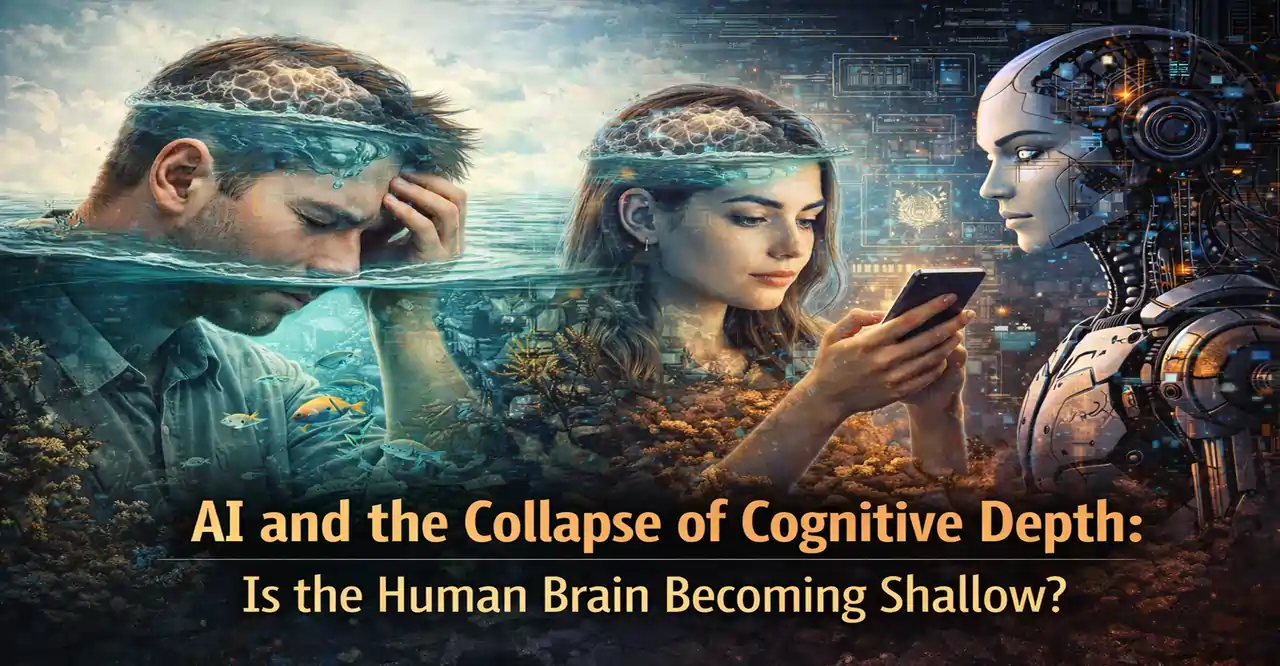
But beyond this, there's a deeper question that few people pay attention to: what's happening to our cognitive depth? Are we really thinking faster or just more superficially? Is the human brain transforming into a "surface processor" that merely shuffles information without deeply contemplating it?
Recent research shows that continuous use of artificial intelligence can lead to structural changes in the brain - changes that may not be reversible. This article delves deep into examining how
artificial intelligence is changing the cognitive structure of the human brain and whether we are on the path to cognitive depth collapse.
Understanding Cognitive Depth: How Does the Human Brain Work?
Before understanding AI's impact on us, we need to know what cognitive depth is. Cognitive depth refers to the brain's ability to process multilayered information, critical analysis, logical reasoning, and creating complex connections between concepts.
Layers of Deep Thinking
When you solve a complex problem - like designing a business strategy or writing an analytical article - your brain goes through different stages:
- Information Reception: Your senses gather data
- Initial Processing: The prefrontal cortex categorizes information
- Deep Analysis: The hippocampus and other areas recall previous memories and identify patterns
- Synthesis and Creativity: The brain creates new connections and innovative solutions
- Reflection and Review: You think about the result and evaluate it
This process is time-consuming, requires energy, and needs
deep focus. But it's precisely this process that causes the growth of the brain's
neural networks and increases cognitive capacity.
The Entry of AI: Convenience or Cognitive Laziness?
Now imagine instead of going through all these stages, you just give a prompt to
ChatGPT and within seconds, receive the complete answer. Your brain no longer needs to perform stages 2 through 5. What consequences does this "cognitive shortcut" have?
Tangible Example: Writing a Work Email
Without AI: You spend 15-20 minutes thinking about what to write, design the email structure, choose the appropriate tone, and review it several times. In this process, your writing, communication, and strategic thinking skills are strengthened.
With AI: You write "write a formal email requesting a salary increase" and in 10 seconds, the text is ready. You just copy-paste it.
What's the difference? In the first case, your brain is practicing and growing. In the second case, you are a passive consumer of information.
Scientific Evidence: How Does AI Change the Brain?
Recent research shows that continuous AI use can lead to structural changes in the brain:
1. Reduced Working Memory Capacity
Working Memory refers to the brain's ability to hold and manipulate information for a short period. Studies show that people who repeatedly use AI tools for problem-solving have lower working memory capacity.
Real Example: Previously, you could keep 7-10 phone numbers in mind. But now that all numbers are saved in your phone, this ability has decreased. AI repeats this same occurrence on a larger scale.
2. Weakened Critical Thinking
When you always trust AI's ready-made answers, your critical evaluation ability of information decreases. You no longer ask "Is this answer correct?" or "Does it have a reliable source?"
3. Decline in Deep Focus Ability
Deep Learning in humans requires long-term focus. But AI teaches you to expect quick results. This leads to
"Attention Fragmentation" - a state where you cannot focus on one topic for more than a few minutes.
| Cognitive Aspect | Before AI | After Continuous AI Use |
| Working Memory | High capacity (7±2 items) | Reduced to 3-5 items |
| Focus Duration | 45-60 minutes | 15-20 minutes |
| Critical Thinking | Multifaceted evaluation | Acceptance without doubt |
| Creativity | Original idea generation | Combining existing ideas |
| Problem Solving | Multi-stage approach | Searching for ready solutions |
The Speed Paradox: Faster but Shallower
One of the biggest illusions about artificial intelligence is thinking that by using it, we think faster. But the truth is we don't think at all - we just reach answers faster.
Difference Between "Quick Answer" and "Fast Thinking"
- Quick Answer: You ask a question and AI immediately responds
- Fast Thinking: Your brain processes information at high speed, recognizes patterns, and draws conclusions
In the first case, your brain does nothing. In the second case, your neural networks are strengthened.
Tangible Example: Language Learning
Suppose you want to learn English:
Traditional Method: You practice 30 minutes daily, memorize new words, and learn from your mistakes. This process is difficult but your brain experiences real growth.
With AI: You use
large language models like GPT for instant translation. You never bother memorizing because AI is always there. The result? After a year, your English doesn't improve.
Cognitive Dependency: When You Can't Think Without AI
One of the most dangerous consequences of unrestrained AI use is
cognitive dependency. This is a state where your brain "learns" that it cannot function without AI.
Signs of Cognitive Dependency on AI
Are the following experiences familiar to you?
- Decision Paralysis: You can't even write a simple email without getting help from ChatGPT
- Anxiety Without Access: When the internet is down or AI is unavailable, you feel helpless
- Loss of Cognitive Confidence: You no longer trust your own abilities and always think AI knows better
- Reduced Patience for Thinking: If you don't have an immediate answer, you prefer to ask AI rather than think yourself
This is exactly what happened to our memory after smartphones. No one memorizes phone numbers anymore. And now, no one thinks deeply anymore.
Impact on Creativity: Does AI Make Us More Creative or More Copycat?
One of the claims of AI proponents is that AI increases creativity. But the reality is more complex.
Two Types of Creativity
- Original Creativity: Creating something completely new from scratch
- Combinatorial Creativity: Combining existing ideas in new ways
AI is excellent at combinatorial creativity. For example,
Midjourney can create stunning images by combining different artistic styles. But is this "real creativity"?
Real Example: Graphic Design
Designer Before AI: Hundreds of hours of practice, learning color theory principles, composition, and visual psychology. They create a unique style.
Designer With AI: Uses
AI image generation tools and within minutes, creates beautiful designs. But all these designs look similar because they use the same algorithms.
The result? We have creative homogeneity - everything looks the same.
Impact on Strategic Thinking and Planning
One of the most important human skills is the ability for strategic thinking and long-term planning. This skill requires the ability to envision the future, predict consequences, and design multi-stage paths.
How Does AI Weaken This Skill?
When you get AI help for every small decision, your brain becomes accustomed to receiving ready-made solutions. This leads to:
- Reduced Prediction Ability: You cannot envision long-term consequences
- Short-term Thinking: You only think about immediate solutions
- Dependency on AI Patterns: Your strategies are limited to what AI suggests
AI's Role in Decision-Making: Mental Autonomy at Risk
One of the deepest impacts of artificial intelligence is
changes in human decision-making. When
AI programming models or analytical tools tell you what to do, are you really making decisions or just executing commands?
Tangible Example: Career Choice
Suppose you're deciding to change jobs:
Without AI: You talk to yourself, weigh your values, consult with friends, and after weeks of reflection, make a decision.
With AI: You ask ChatGPT "Should I change my job?" and based on its response, you decide.
The difference? In the first case, you own the decision. In the second case, AI decides and you just accept it.
Generational Comparison: Gen Z and Alpha vs. Previous Generations
Generation Alpha (born 2010 onwards) is the first generation growing up with artificial intelligence from birth. Research shows this generation:
- Reads 40% fewer books than previous generations
- Relies 60% more on digital tools for problem-solving
- Has 30% lower working memory capacity
These statistics are alarming. If this trend continues, future generations might completely lose the ability for deep thinking.
Solutions: How to Preserve Cognitive Depth?
The good news is that the human brain is plastic - meaning it can change and improve. But this requires conscious effort.
1. The 80/20 Principle: Smart AI Use
Instead of using AI for everything, follow the 80/20 rule:
- 80% of tasks: Do them yourself and challenge your brain
- 20% of tasks: Use AI for repetitive and low-value work
Practical Example: If you want to write an article, do the initial outline, research, and writing yourself. Only use AI for final editing or grammar checking.
2. Daily Mental Exercises
Just like the body needs exercise, the brain needs training too:
- Solve puzzles: 15 minutes daily
- Read challenging books: Instead of superficial social media content
- Handwriting: Note-taking with pen and paper (not typing)
- Meditation and mindfulness: To strengthen focus
3. Creating "AI-Free Zones"
Determine which parts of your life should be completely AI-free:
- Mornings: First 2 hours of the day without any smart assistant
- Creativity: When you want to be creative, don't use AI
- Human Relationships: Never use AI to write personal messages
4. Deliberate and Slow Learning
In today's world, everything is fast. But real learning
takes time. Instead of using
Claude to summarize a book, read it yourself - even if it takes a month.
5. Asking "Why?" Before Using AI
Before hitting the "Generate" button, ask yourself:
- Can I really not do this myself?
- Is this AI use making my brain lazy?
- Am I learning something with this or just saving time?
AI and the Future of Human Thinking: Possible Scenarios
If the current trend continues, we have three possible scenarios:
Scenario 1: Complete Collapse of Cognitive Depth (Pessimistic)
In this scenario, future generations become completely dependent on AI and lose the ability for independent thinking. Society divides into two groups:
- Intellectual Elite: Those who know how to think deeply
- Passive Consumers: Those who only use AI output
Scenario 2: Balanced Coexistence (Optimistic)
In this scenario, society creates
appropriate rules and education to balance AI use. Schools include
teaching children for the AI era in curricula and people learn how to use AI as a tool, not a replacement.
Scenario 3: New Evolution of Thinking (Futuristic)
Perhaps humans will
evolve to create a new type of thinking - thinking that combines human and artificial intelligence. This
hybrid thinking might be more powerful than either alone.
Education's Role in Preserving Cognitive Depth
Wrong Approach (Unfortunately Common)
- Using AI to do all assignments
- Complete reliance on ChatGPT for writing essays
- Removing mental challenges from the learning process
Right Approach (Less Common)
- Using AI as a personal coach that asks questions, not gives answers
- Designing assignments that cannot be solved with AI (e.g., critical thinking and creativity)
- Teaching the skill of optimal AI use without brain damage
Cultural and Social Impact
Shallow thinking isn't just an individual issue - it has broad social impact:
Decline in Public Discourse
When people don't think deeply, social discourse becomes superficial. Instead of deep discussions about complex issues, we have short slogans and superficial opinions often generated by AI.
Democracy's Decline
Democracy needs aware and thoughtful citizens. If people cannot think deeply about social, economic, and political issues, democratic decision-making is at risk.
Case Studies: People Who Have Preserved Deep Thinking
Case 1: Cal Newport
Author of the book "Deep Work" who himself implements its principles. He:
- Checks email only at specific times
- Doesn't use social media
- Does 4-6 hours of deep work daily
The result? He is one of the most productive writers and researchers.
Case 2: DeepMind Research Teams
Even in companies that build AI, researchers have limitations on AI use. They know that deep human thinking is still essential.
30-Day Challenge: Return to Deep Thinking
Want to restore your cognitive depth? Try this challenge:
Week 1-2: Awareness
- Every time you want to use AI, note it down
- Analyze what percentage of these cases were truly necessary
Week 3: Reduction
- Reduce AI use by 50%
- For tasks where you previously used AI, think yourself
Week 4: Replacement
- For each AI use, do a mental exercise
- For example, if you used ChatGPT to write an email, write an analytical paragraph about another topic
Conclusion: The Choice Is Yours
Artificial intelligence itself is not bad. The problem is how we use it. We are at a historical turning point - a point that determines whether future generations preserve the ability for deep thinking.
The answer to the question "Are we thinking faster or more shallowly?" is: both. We reach answers faster, but we think more shallowly. And this is a losing deal.
If you want to remain human in the future - a human who can think deeply, be creative, and make meaningful decisions - you must choose now:
Do you want your brain to be AI's tool or AI to be your tool?
The choice is yours. But hurry - because every day that passes and you use AI thoughtlessly, your cognitive depth decreases.



 Social Impact & Future
 Social Impact & Future
 Social Impact & Future
 Social Impact & Future
 Social Impact & Future
 Social Impact & Future