Introduction
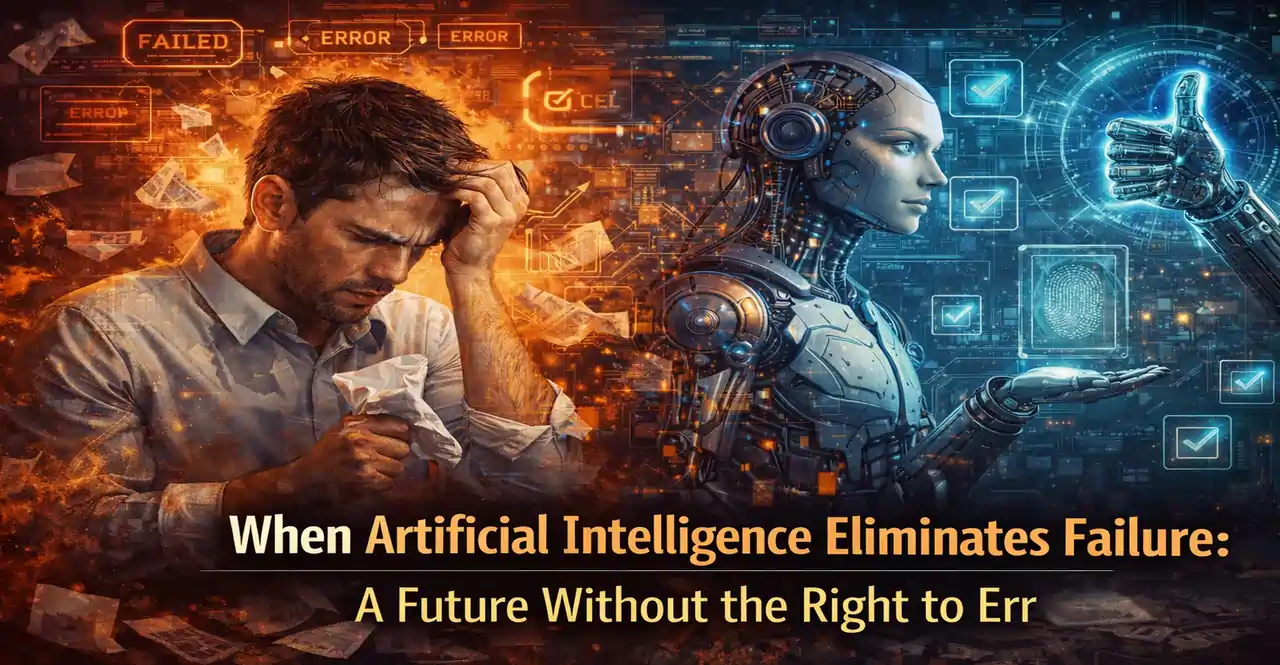
If never being able to cook with your own hands and experience burning food. If never taking the wrong path and feeling the confusion of finding the right way. If never writing bad code that crashes your program. Is this an ideal future? Perhaps at first glance, yes - but deep down, this means losing humanity's most powerful learning tool: failure.
Artificial intelligence is becoming an "overprotective coach" that doesn't allow us to make mistakes at all. While this seems good on the surface, we're losing something that has shaped humanity for thousands of years:
learning through trial and error.
Failure in the Traditional World: Ruthless but Effective Teacher
The Natural Cycle of Human Learning
Throughout human history, learning has always worked like this:
Action → Failure → Analysis → Deep Understanding → Better Action
This cycle has existed everywhere in our lives. A child learning to walk falls dozens of times. Each time they fall, their brain learns: this foot angle is wrong, this speed is too much, this balance isn't enough. No book or tutorial can give them this knowledge - only the experience of failure can.
Thomas Edison failed 10,000 times in making the light bulb. But he didn't say he failed 10,000 times - he said he found 10,000 ways that don't work. Each failure was a deep lesson that brought him closer to the solution.
Walt Disney went bankrupt several times, was fired from a newspaper for "lacking creativity," and his early ideas were rejected. But each failure made him stronger and more experienced.
Steve Jobs was fired from Apple - the company he founded. This bitter failure forced him to build new companies (Pixar and NeXT) that later gave him new skills and perspectives. When he returned to Apple, it was this failure that had transformed him into the leader who revived Apple.
The Neuroscience of Failure
Neuroscience research shows that the human brain activates uniquely during failure:
- Emotional Response: Failure creates emotions like frustration, anger, or shame that cause the experience to be more deeply recorded in memory.
- Cognitive Review: The brain is forced to re-examine the decision-making process - "Why did this happen?" This review leads to deeper learning.
- Building New Neural Pathways: When we face failure and find a new solution, the brain builds new neural pathways that increase cognitive flexibility.
- Strengthening Resilience: Each time we overcome failure, the amygdala (brain's fear center) responds less and our stress tolerance capacity increases.
This neuropsychological process doesn't happen by reading books or watching videos. Only the lived experience of failure can create these transformations.
Artificial Intelligence: The Failure Eliminator
AI as "Predictor and Preventer"
Today's
AI systems are designed to
predict and eliminate failure before it occurs. At one level, this seems like a good idea - why should we allow people to make mistakes? But reality is more complex.
Let's see how this works in practice:
Example 1: Programming with AI - Code Without Understanding
Past:
Programmer: writes code
↓
Bug occurs
↓
Spends hours debugging
↓
Understands the reason for the bug
↓
Gains deep understanding of programming language
Today with GitHub Copilot / ChatGPT:
Programmer: makes a request
↓
AI writes optimized, bug-free code
↓
Code works ✓
↓
But why does it work? Doesn't know ✗
A young programmer who codes today with
ChatGPT might never:
- Understand why a for loop needs to break at a specific point
- Experience how memory leaks slow down a system
- Comprehend why an O(n²) algorithm is slow on large datasets
Because AI has already eliminated these problems. The result? Developers who write code but don't know programming.
| Learning Aspect | Traditional Method | AI Method |
| Bugs Experienced | Hundreds to thousands | Nearly zero |
| Deep Understanding | High - from direct experience | Shallow - without experience |
| Production Speed | Slow but with learning | Fast but without learning |
| Problem-Solving Ability | Strong - from accumulated experience | Weak - dependent on AI |
| Crisis Response | Creative and flexible | Paralyzed and dependent |
Example 2: Writing with AI - Writers Without Voice
Past:
Writer: writes text
↓
Reader gives negative feedback: "It's boring"
↓
Writer gets discouraged
↓
Analyzes: why was it boring?
↓
Changes their style
↓
After months, finds their voice
Today with ChatGPT / Claude:
Writer: gives the topic
↓
AI writes fluent, professional text
↓
Text is published and receives good feedback ✓
↓
But this isn't the writer's voice, it's AI's voice ✗
- Feel that readers don't enjoy their writing
- Understand which sentences are long and tedious
- Learn how to control text rhythm and flow
- Find their unique voice
The result? Writers who manage, but don't write.
Example 3: Decision-Making with AI - Loss of Choice Power
Past:
Person: sees all options
↓
Makes wrong decision
↓
Experiences bad outcome
↓
Understands what criteria matter
↓
Makes better decision next time
Today with Recommendation Systems:
Person: consults the system
↓
AI filters out "weak" options
↓
Only 3 optimal options are shown
↓
Person chooses one ✓
↓
But never knows what other options were ✗
Prediction systems are everywhere: Netflix decides what movie you watch, Amazon decides what you buy, LinkedIn decides who you connect with.
The problem is we no longer see bad options. And when we don't see bad options, we never learn how to distinguish good from bad.
Example 4: Design and Creativity - Artists Without Style
In the past, a graphic designer had to:
- Create dozens of weak designs
- Get negative feedback
- Cultivate their visual taste
- After years, find their unique style
- Designer writes a prompt
- AI creates professional image
- But this is no longer the designer's creativity, it's the AI model's creativity
Young artists are learning how to write better prompts, not how to be better artists.
The Dangerous Paradox: More Efficient but More Immature
The Productivity Illusion
Artificial intelligence has trapped us in a great illusion:
- We work faster ✓
- We produce more ✓
- But we don't learn deeper ✗
- And we don't become stronger ✗
Imagine an athlete who always uses steroids. They look powerful, break records, but:
- Their muscles aren't real
- When steroids are cut off, they collapse
- Their body never learned how to become naturally strong
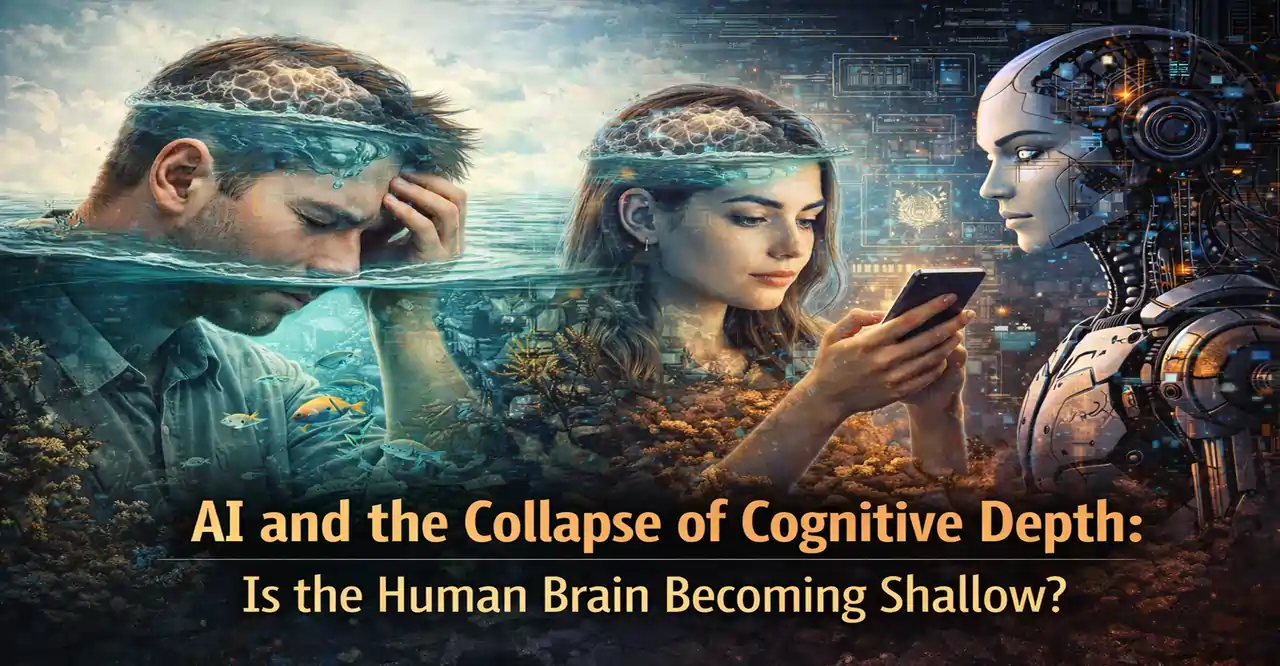
AI does exactly this to our minds. We use cognitive steroids that make us appear intelligent, but our mind's actual capacity doesn't grow.
The First Generation Without Failure
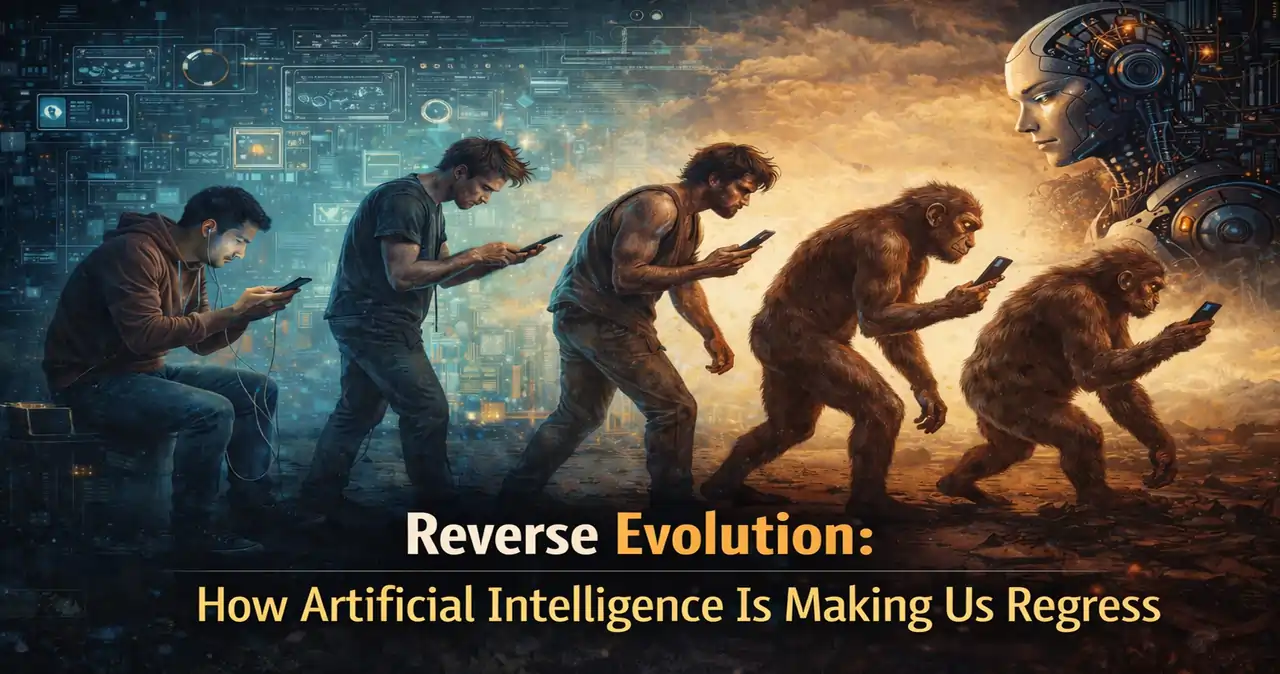
We're raising the first generation that:
- Has never really gotten lost (Google Maps always gives directions)
- Has never really memorized anything (Google always has the answer)
- Has never really built something from scratch (AI always gives templates)
- Has never really struggled with problems (AI always gives solutions)
This generation when faced with a real crisis - where AI can't help, where they must think for themselves - becomes paralyzed.
Real Experiment: When AI Isn't Available
A few years ago, a university conducted an experiment. They asked students to complete a project without using any digital tools:
The results were shocking:
- 78% of students didn't know where to start
- 65% felt "severe anxiety"
- 89% said "I feel like my brain doesn't work"
- 45% abandoned the project
These students were all excellent students - with great grades. But when AI wasn't available, they realized they never learned how to think.
Hidden Costs: What Are We Losing?
1. Loss of Psychological Resilience
Psychological resilience is like a muscle - you must exercise it. Every time you face failure and overcome it, this muscle gets stronger.
But when AI eliminates all failures, this muscle never gets exercised. The result? A generation with zero resilience.
The statistics are alarming:
- Anxiety levels in Gen Z (first digital generation) are 3 times higher than previous generations
- Depression rates in today's teenagers have doubled
- The ability to cope with stress has drastically decreased
Why? Because they never learned how to deal with disappointment.
2. Loss of Real Creativity
Real creativity comes from limitation and failure. Picasso concluded he must break style - after years of trying realistic painting and failing to reach perfection. Steve Jobs found the iPhone idea - after failing at several previous products.
Generative AI produces "good" content. But this content is always:
- Predictable
- Safe
- Optimized
- But never revolutionary
Because real creativity comes from breaking rules - and AI always follows rules.
3. Loss of Critical Thinking
When AI always gives the "right answer," we no longer learn to question:
- Is this really the best solution?
- Is there another way?
- Why does this work?
We become approval operators - people who just click "confirm" without understanding what's happening.
4. Loss of Personal Identity
One of the deepest costs is loss of personal identity.
We know ourselves through our failures:
- I know I'm weak in math because I failed at it many times
- I know I'm good at writing because I tried many times and improved
- I know I communicate well with people because I was very shy at first and learned
But when AI does everything, we no longer know who we are.
5. Loss of Meaning
Ultimately, failure gives life meaning. When we achieve something without effort and without failure, that thing has no value.
Imagine a video game where you never die and always win. It's boring, right? Because it has no challenge, it has no meaning.
Life with AI is like this game - everything is easy, everything is successful, but nothing is meaningful.
The Scary Scenario: Hollow Humans
Let me create a realistic scenario of the near future:
Year 2030:
- Ali is a 25-year-old programmer. He's been coding with Claude Code and GitHub Copilot since he was 15.
- He's never really debugged a hard bug - AI always found it before him.
- He writes on his resume that he has 10 years of programming experience.
Interview Day:
Interviewer: "Tell me about the last hard bug you solved?"
Ali: "Well... AI usually solves bugs..."
Interviewer: "But if AI isn't available? For example, the service goes down?"
Ali: (long silence) "I... don't know how to work without AI."
This is no longer a hypothetical scenario. This is happening.
Major tech companies report that young programmers:
- Have excellent coding speed (with AI)
- But are severely weak at solving complex problems
- And when under pressure, become paralyzed
Solutions: How to Create Balance?
1. The "Intentional Failure" Rule
We must intentionally create failure opportunities. Like an athlete lifting heavier weights to grow muscles, we must put ourselves in challenging situations.
Practical principles:
- AI-free day: One day a week, use no AI tools
- From-scratch project: At least one project per month completely without AI help
- Hard learning: Learn a new skill without using AI tutorials
2. Smart AI Use: Coach Not Replacement
Wrong use:
Me: "Write this code for me"
AI: [complete code]
Me: [copy-paste]
Right use:
Me: "I wrote this code [my code]"
AI: "Some points for improvement..."
Me: "Why is this better?"
AI: [deep explanation]
Me: [I learn and change it myself]
AI should be a coach not a replacement. It should help us learn, not do the work for us.
3. Changing the Education System
Traditional education:
- Teacher: "Memorize this formula"
- Student: [memorizes]
- Exam: [writes it back]
AI era education:
- Teacher: "You can use AI, but must explain your thinking process"
- Student: [gets help from AI but must understand why]
- Exam: "Explain why this solution works"
The goal is no longer memorizing knowledge (AI has knowledge). The goal is learning how to think.
4. "Respected Failure" Culture
We must change our culture. Failure shouldn't be shame, it should be honor.
Some pioneering companies:
- Give "best failure of the year" awards
- Hold "lessons from failure" sessions
- Create an environment where experimenting and failing is safe
5. "Crisis Drills"
Like firefighters training for fires, we must practice for situations without AI:
- Monthly drill: Work one day without any digital tools
- Skills challenge: Do something you always do with AI, without it
- Crisis scenario: Assume all AI systems have failed - what do you do?
Conclusion: Our Choice
We're at a historic turning point. For the first time in human history, we can eliminate the experience of failure from life. The question isn't whether we can - but whether we should?
Humanity has always progressed through failure:
- Fire was discovered through trial and error
- The wheel was invented after thousands of unsuccessful attempts
- Flight was achieved after hundreds of crashes
If we allow AI to break this cycle, if we let the next generation grow without experiencing failure, we're not just depriving them of learning, we're depriving them of humanity.
Failure is an essential part of the human experience. Its pain, its value, and its lessons - all of this is what makes us human.



 Social Impact & Future
 Social Impact & Future
 Social Impact & Future
 Social Impact & Future
 Social Impact & Future
 Social Impact & Future