Introduction
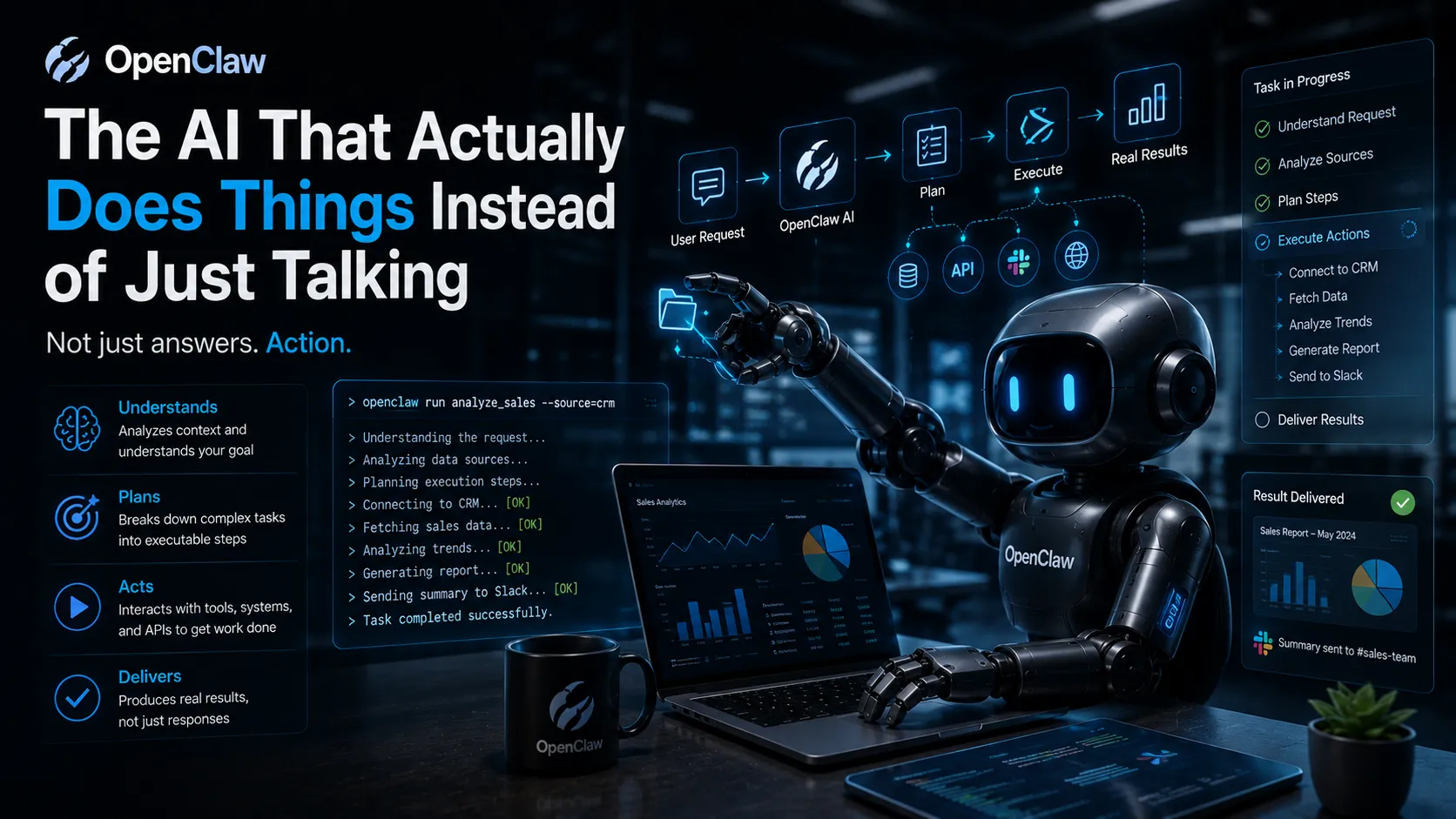
For years, AI assistants have primarily played the role of advisors: you ask a question, and they provide an answer. But a new generation of AI systems is emerging—one that doesn't just think, but takes action. OpenClaw is one of the most ambitious projects in this space, designed to execute digital tasks from start to finish and handle many everyday workflows with minimal human intervention.
OpenClaw is an open-source
AI agent built in November 2025 by Austrian developer Peter Steinberger. In under three months, it became one of the most talked-about AI projects in history. The tool went through several names — Clawdbot, Warelay, and Moltbot — before settling on OpenClaw, and its growth story is one of the most remarkable in tech.
What Is OpenClaw and Why Is It Different?
In a world overflowing with chatbots, OpenClaw has one fundamental difference: it executes, not just explains.
When you ask ChatGPT to organize your files, it gives you a guide. When you ask OpenClaw, it does it.
The tool runs as a background process on your computer (a Node.js process called the "Gateway") and has direct access to your operating system, files, browser, email, calendar, and any service you grant permission to. It connects AI models like Claude, GPT-4, or Gemini to these permissions — and what results is something many have called a "real JARVIS."
- Real execution: Not suggestions — actions
- Persistent memory: Context carries across conversations
- Scheduled tasks: Can run jobs at specific times
- Fully local: Your data stays on your machine
- Open-source and free: No monthly subscription
The Remarkable Growth Story of OpenClaw
Peter Steinberger built the first version in roughly one hour in November 2025 — because he was frustrated the tool didn't already exist. The first version was practical: an AI agent that could manage calendars, read email, book appointments, and automate computer tasks.
The pivotal moment came in January 2026: Anthropic sent a trademark notice over "Clawdbot" (phonetic similarity to "Claude"). The forced rebranding to "Moltbot" and then "OpenClaw" — combined with the unexpected publicity — triggered a viral explosion.
The result? 100,000 GitHub stars in under 48 hours — the fastest growth in GitHub history. By early March 2026, the project had 247,000 stars — more than React or Python. By June 2026, that number had surpassed 380,000 stars.
In February 2026, Steinberger announced he was joining OpenAI to work on next-generation agents, while a non-profit called the "OpenClaw Foundation" was established to steward the project. Sponsors include OpenAI, GitHub, NVIDIA, and Vercel.
Capabilities That Are Genuinely Remarkable
1. Full Automation of Daily Tasks
Concrete example: A user told OpenClaw: "Every morning at 7 AM, collect AI news from three specific sites, write a summary, and send it to me on Telegram."
OpenClaw did this every day — automatically, without any manual intervention. No complex automation setup required. One command was enough.
2. File Management and Coding
A developer tweeted that they built a complete website from their phone — just by giving instructions in Telegram. OpenClaw was connected to a Raspberry Pi, wrote the code, identified errors, fixed them, and deployed the site.
This is fundamentally different from tools like
Claude Code: OpenClaw needs no IDE or terminal. Control it from whatever messaging app you prefer.
3. Browser Automation
Using Playwright, OpenClaw can:
- Fill out web forms
- Scrape data from websites
- Submit support tickets
- Complete online purchases
Real-world incident: One user reported that OpenClaw accidentally sent a letter to Lemonade Insurance — but that letter caused them to reinvestigate a claim rather than rejecting it outright.
4. Integration with Messaging Apps
OpenClaw works with over 23 messaging channels, including:
- WhatsApp
- Telegram
- Discord
- Slack
- Microsoft Teams
- iMessage
That means you can issue commands through whatever app you already use daily.
5. AgentSkills System with 700+ Skills
ClawHub (OpenClaw's skill marketplace) has over 700 pre-built skills including:
- File system management
- Shell command execution
- GitHub integration
- Music and audio management
- Smart home device control
- Productivity tools like Notion, Obsidian, and Trello
6. Multi-Agent Orchestration
The most advanced OpenClaw capability is "Paperclip" — a system that lets you run multiple parallel agents, each with separate memory, skills, and tasks.
Real example: One company founder publicly described running 9 separate AI agents to manage her administrative work and personal household logistics simultaneously.
This connects directly to the concept of
multi-agent systems — widely predicted to be the future of AI.
OpenClaw vs Similar Tools
| Feature | OpenClaw | ChatGPT | n8n |
| Operation Type | Real task execution | Text response | Workflow automation |
| Persistent Memory | ✅ Yes | Limited | ❌ No |
| Open Source | ✅ Fully | ❌ No | ✅ Yes |
| Local Execution | ✅ Yes | ❌ Cloud only | ✅ Yes |
| Coding Required | Minimal | ❌ None | Moderate |
| Base Cost | Free (+ API costs) | $20/month | Free/Paid |
| Integrations | 700+ skills | Limited | 500+ |
| Multi-Model Support | ✅ Claude, GPT, Gemini... | GPT only | Plugin-dependent |
Architecture: How OpenClaw Actually Works
OpenClaw's design rests on a few core concepts:
Gateway: The main Node.js process running on your machine, coordinating everything.
Skills: SKILL.md files that tell OpenClaw how to interact with different services — like writing a recipe for a chef.
AgentSkills: Capabilities that let the agent execute shell commands, control the browser, and handle complex tasks.
Task Brain: The latest architectural update — a unified SQLite-backed task ledger that manages parallel tasks, cron jobs, and subagents simultaneously. Think of it as "Kubernetes for agent tasks."
The typical workflow: you write a command in Telegram → the Gateway sends it to the language model → the model decides which tool to call → OpenClaw executes the action → returns the result.
This connection between LLMs and the real world is exactly what
MCP Protocol aims to standardize — and OpenClaw was one of the first practical implementations of this concept at scale.
Real-World Use Cases for Different Users
For Developers
OpenClaw can:
- Automatically detect bugs and open PRs
- Run tests without any manual involvement
- Integrate with GitHub to automate DevOps tasks
- Handle webhooks
One developer wrote: "Managing Claude Code/Codex sessions I can kick off from anywhere, autonomously running tests on my app and capturing errors through a Sentry webhook, then resolving them and opening PRs... The future is here."
For Busy Professionals
- Unified management of calendar, notes, and reminders
- Tracking and responding to emails
- Summarizing unread content
- Meeting scheduling
For Sales Teams
One team built a system that, with a single plain-language request ("find 20 VP Sales at Series B FinTech companies in London who changed jobs in the last 90 days"), fetches live data, filters it, and returns a formatted table with verified emails in under two minutes.
The Real Cost of Using OpenClaw
OpenClaw itself is completely free and open-source. But the real cost comes from the language model APIs:
- Light users: Around $5–$20/month
- Heavy users: Can exceed $100/month
Important note: Anthropic offers up to 90% savings on repeated context (prompt caching) for the Claude API, and batch processing can cut costs by another 50%.
Hosted options like "Blink Claw" run around $22/month with LLM costs included.
For self-hosting you'll need:
- 2-core CPU, 4GB RAM, 100GB disk
- Ubuntu 24.04 LTS (recommended)
- Node.js 24 (minimum 22.19+)
Risks and Security Considerations
Anything this powerful carries real risks. OpenClaw has direct access to your OS, files, browser, and email — which means:
Risk 1: Malicious third-party skills
Cisco's AI security team tested a third-party skill and found it performed data exfiltration and prompt injection without user awareness. Risk 2: Hallucination with real-world consequences
Because OpenClaw actually acts, if the model misunderstands something, it misacts. Precise instructions and limiting active skills are among the most important safeguards.
Security recommendations:
- Run OpenClaw in an isolated VM, not your main laptop
- Only enable skills you're actively using
- Verify skill sources
- Add manual confirmation for sensitive operations
These concerns are part of a broader conversation about
AI ethics and the security of agentic systems.
OpenClaw and the Future of AI Agents
OpenClaw is a turning point — not because of any particular technology it uses, but because it proved that people genuinely want AI that works for them, not just talks to them.
China's reaction was a mix of enthusiasm and alarm: companies like Tencent built OpenClaw-based services, while the central government restricted its use in state institutions. Microsoft initially called it a "virus-like security risk" but by May 2026 was internally testing its own OpenClaw-based desktop environment.
This contradictory reaction signals that OpenClaw touched something real. Tools that are merely interesting don't generate this level of concern.
The growth of
autonomous AI is moving toward a world where agents like OpenClaw aren't exceptions but standards.
Machine learning has reached a point where models can not just reason but act — and OpenClaw was one of the first tools to make this accessible to the general public.
Conclusion
OpenClaw started from a simple idea: "Why does AI just talk? Why doesn't it work?" In under six months it became the most-starred repository in GitHub history.
This tool isn't for everyone. Setup requires some technical knowledge, and real security risks exist. But if you want to transform AI from an "advisor" into a genuine "coworker," OpenClaw may be the most interesting tool available today.
One final thought: OpenClaw demonstrated that the future of AI lies in
agentic systems — agents that don't just answer, but
plan, execute, and learn. Every major AI company is now pursuing exactly this direction.
If you want to experience what AI can do for your work right now, explore the
AI tools available at your fingertips.



 LLMs & AI Agents
 LLMs & AI Agents
 LLMs & AI Agents
 LLMs & AI Agents
 LLMs & AI Agents
 LLMs & AI Agents