Introduction
Imagine having to re-explain yourself every single time you open an AI tool. Who you are, what project you're working on, what output format you prefer, which terms are standard in your field. You type it all out, the session goes well, you close the tab — and tomorrow, you start from scratch again.
This is the fundamental problem with most AI tools today: impressive capabilities, but no memory.
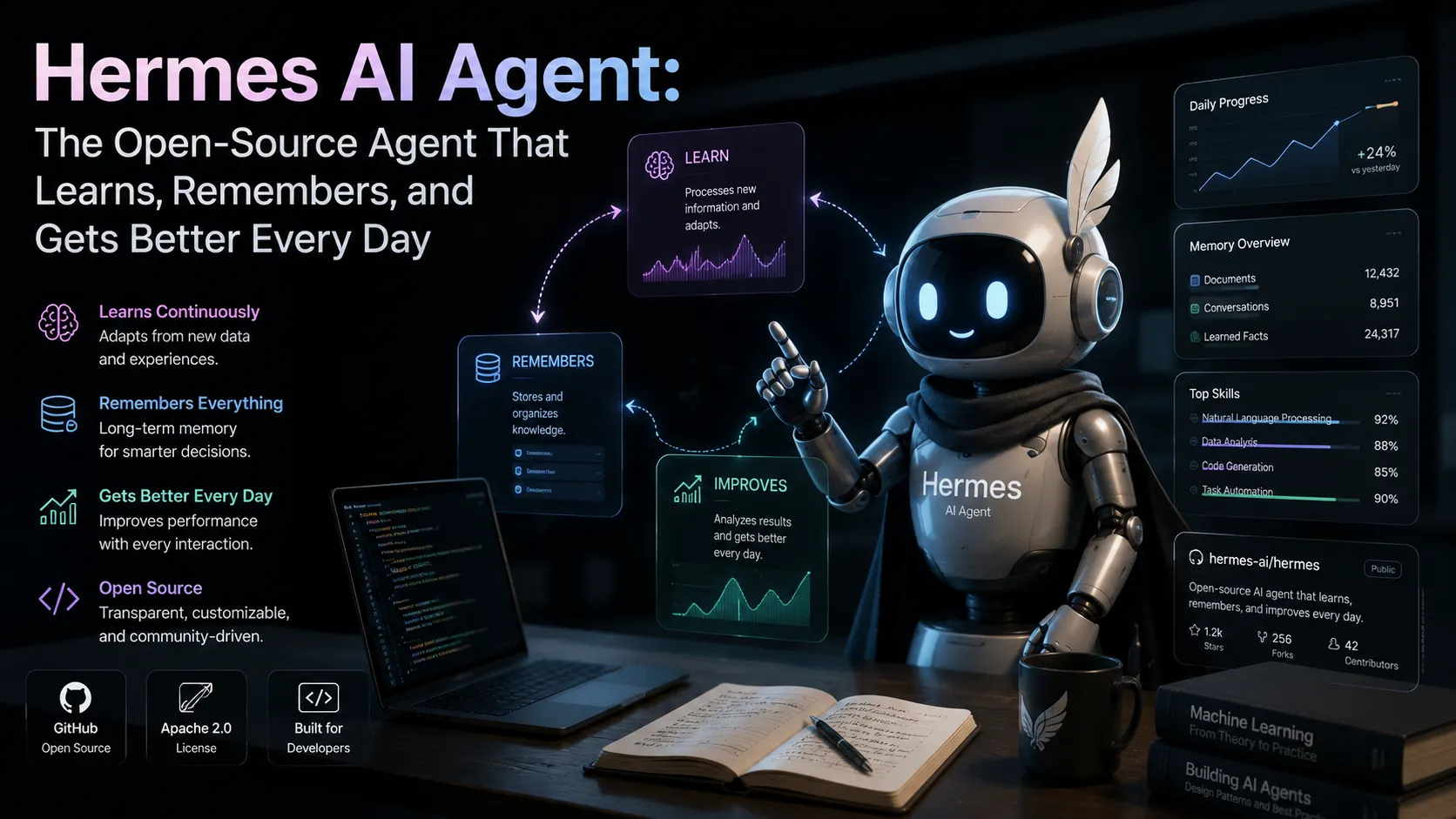
Hermes — the open-source AI agent built by NousResearch — solves this from the ground up. Hermes doesn't just remember; it learns from past experience, builds reusable skills, and genuinely gets better with every use. This article takes a deep look at Hermes — from its language models to Hermes Agent — and explains why this open-source project is rewriting the rules.
Who Is NousResearch and Where Did Hermes Come From?
NousResearch is an AI research collective that has spent years focused on fine-tuning open-source language models. They developed the Hermes model series on top of Llama and Mistral architectures and built a substantial following among developers who want powerful models they can run on their own infrastructure — without sending data to proprietary APIs.
The Hermes family has followed a clear evolutionary path:
- Hermes 2: The early generation that established the foundation of fine-tuning with synthetic data
- Hermes 3: Built on Llama 3.1, available in 8B, 70B, and 405B sizes, focused on deep reasoning, creativity, and advanced function calling
- Hermes 4: A new generation with Hybrid Reasoning capability and 50x more training data than Hermes 3
- Hermes 4.3: The first model trained on the decentralized Psyche network, with a 512K token context window
- Hermes Agent: A complete AI agent runtime released in February 2026
This progression reflects a clear vision: a model that doesn't just answer — it actually works.
Hermes Language Models: From Hermes 3 to Hermes 4.3
Hermes 3: The Foundation That's Still Relevant
Hermes 3 was built by fine-tuning Llama 3.1, and one of its defining capabilities is precise instruction-following — the user's instructions, not a company's internal guidelines. This distinction matters: while commercial models like GPT-4o frequently refuse requests on ethical grounds, Hermes 3 is designed to do exactly what it's asked — from specialized content creation to complex function calling and structured JSON generation.
Key Hermes 3 capabilities:
- Long-context retention (128K tokens)
- Multi-turn conversation management
- Agentic capabilities and function calling via XML tags
- Retrieval Augmented Generation with citations
To understand RAG — one of the key mechanisms in these models — see our article on
RAG in AI.
Hermes 4: When Hybrid Reasoning Changes Everything
Hermes 4 was released in August 2025 and introduced one core new capability: Hybrid Reasoning Mode. This means the model can switch between fast responses and deep, step-by-step reasoning. For complex problems, a <think> tag sends the model into a reasoning phase where it works through the problem before delivering a final answer — much like a human who thinks before speaking.
Hermes 4 benchmark results (405B version) are remarkable:
- MATH-500: 96.3% in reasoning mode
- AIME'24: 81.9% (competing with expensive proprietary systems)
- RefusalBench: 57.1% — the highest score among all tested models
For comparison: GPT-4o scored 17.67% and Claude Sonnet 4 scored 17% on RefusalBench. Hermes 4 answers a dramatically higher proportion of user questions without refusal.
Hermes 4.3: The First Model Trained on a Decentralized Network
Hermes 4.3 is a historical milestone: the first Hermes model trained on the Psyche distributed network. Psyche is a decentralized training network that uses the DisTrO optimizer to coordinate geographically dispersed compute nodes — secured by Solana blockchain consensus — in a single training run.
This is not just technically fascinating; it carries an important message: training large models no longer requires a single massive data center.
Hermes 4.3 Benchmarks (36B):
| Benchmark | Hermes 4.3 (36B) | Description |
| MATH-500 | 93.8% | Complex math problems |
| MMLU | 87.7% | Multi-domain general knowledge |
| BBH (Big-Bench Hard) | 86.4% | Complex reasoning tasks |
| AIME 24 | 71.9% | University math olympiad |
| GPQA Diamond | 65.5% | PhD-level expert questions |
| RefusalBench | 74.6% | Response rate (higher = better) |
A striking fact: Hermes 4.3 at 36 billion parameters outperforms Hermes 4 at 70 billion parameters on several benchmarks. The 512K token context window — made possible by advanced
Attention Mechanisms — means you can feed an entire mid-sized codebase to the model in a single pass.
Hermes Agent: When a Model Becomes a Real Assistant
The difference between a chatbot and an agent, illustrated with one example:
Chatbot: Can explain how to review a GitHub repository.
Hermes Agent: Reviews the repo, searches files, runs tests, edits documentation, creates a follow-up schedule, and remembers what it learned for next time.
Hermes Agent was released by NousResearch in February 2026. With over 32,000 GitHub stars, it has become one of the most popular open-source agent projects in the space.
Three-Layer Memory Architecture
The heart of Hermes Agent is a unique memory system. Unlike tools that reset with every session, Hermes uses three memory layers:
1. Episodic Memory
The agent stores records of past tasks and their outcomes. If it makes a mistake on a task, that failure is logged and it tries a different approach next time. Real example: if on day one it uses the wrong logic for triaging GitHub issues, by day three it has self-corrected.
2. User Model
A USER.md file builds a persistent profile of your preferences: preferred language, desired output format, domain-specific terminology, constraints you work within. This persists across every session.
3. Skill Library
When Hermes completes a complex task, it documents its approach as a reusable Markdown skill file. The next time you give it a similar task, instead of starting from scratch, it loads the saved skill. This means faster execution + lower API costs.
Hermes Agent Capabilities That Genuinely Differentiate It
40+ Built-In Tools
Hermes Agent ships with 40+ built-in tools including:
- Web browser: search, content extraction, full browser automation (click, type, screenshot)
- Code execution: sandboxed environment for safe code execution
- File management: read, write, edit files
- Remote terminal: execute commands on a server
- API calls: connect with external services
- Vision analysis, text-to-speech, image generation
Works With Any Major AI Model
One of the smartest design decisions in Hermes Agent is being model-agnostic. A single change to the .env file switches you between GPT-5, Claude Opus 4.6, local Ollama models, or any OpenAI-compatible endpoint — without changing anything else. Skills, memory, and user model carry over completely.
This flexibility means you can route cheap tasks to local models and complex reasoning to frontier APIs — optimizing cost as you go.
For an introduction to the concept of AI agents, our article on
AI Agents provides useful context.
MCP Protocol Support
Hermes Agent supports the MCP (Model Context Protocol), which enables
AI connection to real-world tools. This means Hermes can communicate directly with external platforms like Asana, Slack, GitHub, and other services.
Messaging Platform Integration
Hermes connects to CLI, Telegram, Discord, Slack, WhatsApp, Signal, and Email — all through a shared session architecture. You can give a task via Telegram, Hermes executes it, and returns the result to the same channel.
Real Examples: Hermes Agent in Practice
Example 1: Daily Developer Automation
One developer set up this workflow:
Every morning, pull new GitHub issues, classify them by severity, write short summaries, and post them to the team's Slack channel.
This task is defined once and runs automatically via cron. If the classification logic is wrong on day one, episodic memory logs it and by day three it's self-corrected.
Example 2: Research Literature Review
A researcher uses Hermes for literature review:
- Hermes remembers which papers have already been read
- Summarizes each paper in a consistent format
- Surfaces earlier findings when returning to a related topic
- Identifies contradictions and research gaps across sources
Example 3: Full Software Project Build
One user reported giving Hermes the instruction: "Build a full-stack todo app with authentication and deploy it." Hermes wrote the code, ran tests, debugged issues, handled deployment — and stored the skills acquired throughout the process for similar future projects.
Example 4: Personal Assistant on Raspberry Pi
A user runs Hermes on a Raspberry Pi 4 as a central brain across all their devices. User preferences are shared across devices, and Hermes performs tasks with full awareness of the user's complete digital context.
This type of usage aligns closely with
Edge AI, which brings processing to the network edge.
Hermes vs. the Competition
| Feature | Hermes Agent | LangChain/CrewAI | Claude Code / Cursor |
| Persistent cross-session memory | ✅ Built-in, three-layer | ⚠️ Requires manual implementation | Limited |
| Automatic learning from mistakes | ✅ Built-in learning loop | ❌ No | ❌ No |
| Model agnostic | ✅ 200+ models | ✅ Yes | ❌ Locked to specific model |
| Setup complexity | Single curl command | ⚠️ Complex configuration | ✅ Simple |
| Monthly cost | $5 VPS + API usage | Variable | Fixed monthly subscription |
| Messaging platforms | ✅ Telegram, Slack, Discord, ... | ⚠️ Requires development | ❌ No |
| Open source | ✅ Apache 2.0 | ✅ Yes | ❌ Proprietary |
For a more detailed comparison of agent frameworks, see our article on CrewAI, AutoGen, and LangChain comparison.
Limitations You Should Know
To be honest: Hermes Agent is still in early stages.
- Documentation gaps: Some capabilities require trial and error to figure out
- Smaller community: Compared to LangChain or Claude Code, the community is smaller
- Backend model dependency: Output quality depends heavily on which model you connect
- Learning curve: Initial setup may be challenging for non-technical users
The Future: Psyche and Decentralized Training
One of the most fascinating aspects of NousResearch is the
Psyche network. It demonstrates that large models can be trained across globally distributed nodes — without a single centralized data center. This concept connects directly to
Federated Learning and privacy-preserving AI.
If Psyche can prove itself at larger scale, it could permanently shift how large models are developed — from the monopoly of big tech companies to a genuinely distributed model of AI development.
The growing trajectory of
autonomous AI agents also suggests Hermes Agent is moving in exactly the right direction.
Conclusion
Hermes — both as a language model family and as Hermes Agent — is a project that demonstrates open source and commercial-grade capability don't have to be at odds.
Hermes 4 with benchmark scores that rival expensive proprietary systems, and Hermes Agent with its three-layer memory architecture that genuinely learns — this model family offers something you can't find elsewhere: an AI agent that becomes more capable the more you work with it.
If you're a developer, a researcher, or simply someone who wants an AI assistant that actually remembers context — Hermes Agent is worth trying.
For a broader perspective on the AI and large language model landscape, check out our article on
AI Language Models on DeepFA.



 LLMs & AI Agents
 LLMs & AI Agents
 LLMs & AI Agents
 LLMs & AI Agents
 LLMs & AI Agents
 LLMs & AI Agents