Introduction
A computer from the 1990s, when tasked with running modern graphics-intensive games or performing advanced AI computations, quickly reaches its limits: it crashes, freezes, and becomes incapable of functioning effectively. Interestingly, the human brain often finds itself in a remarkably similar situation.
Our brain has been designed through
200,000 years of evolution for an environment where the biggest challenges were finding food, escaping predators, and surviving in nature. But now we live in a world where every day we face
billions of bytes of information,
complex decisions, and
artificial intelligence systems that work at the speed of light.
This is a fundamental design flaw. We have old hardware trying to run modern software. And the result? Anxiety, depression, mental burnout, digital addiction, and a constant feeling that "we are not enough".
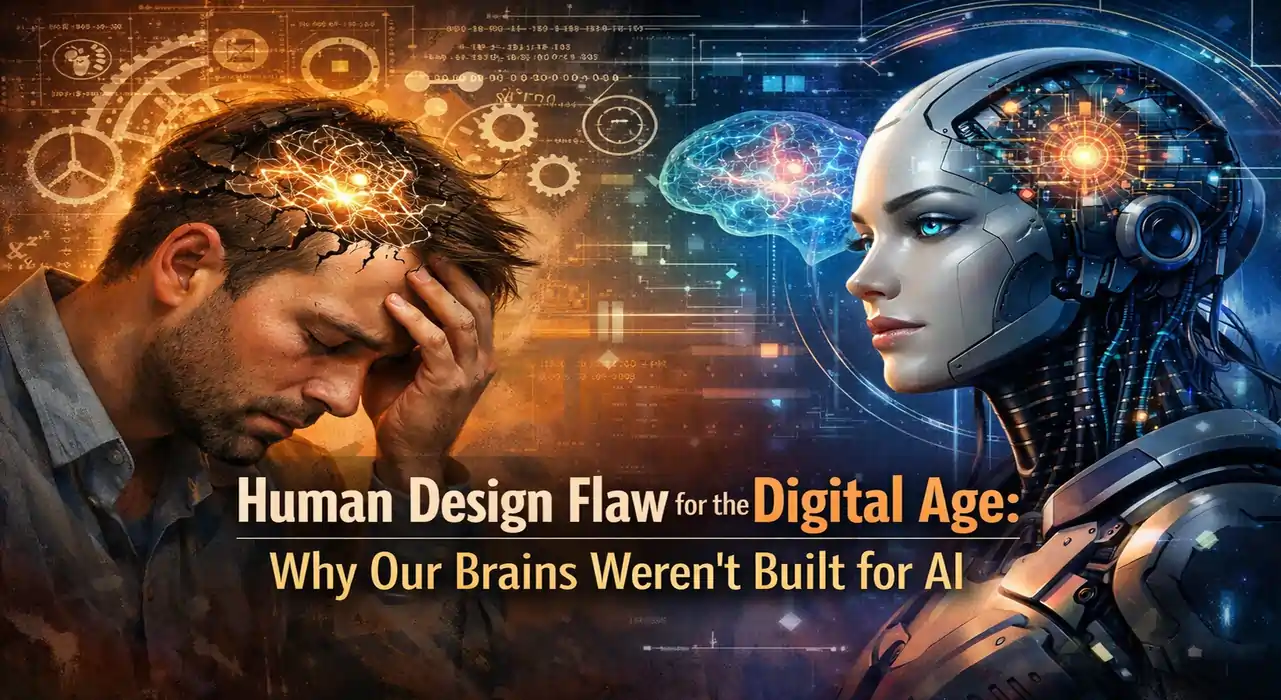
This article deeply explores this paradox: why the human brain, this masterpiece of biological evolution, has become structurally deficient in the digital age and AI era? What biological limitations have turned us into incapable beings in this new world? And the more fundamental question: do we need an "upgrade"?
The Human Brain: A 200,000-Year-Old Operating System
Designed for African Savannas, Not the Metaverse
The human brain is a product of gradual evolution. Each part of it evolved to solve a specific problem in the Stone Age environment:
Hippocampus: This part of the brain was designed for spatial memory - remembering where the fruit tree is in the forest, or what the path back to the cave is. But now we expect this same system to store hundreds of passwords, thousands of faces on social networks, and endless internet information. This is like asking an old GPS to store the entire world map.
Amygdala: This part was built to detect physical dangers - lions, snakes, falling from cliffs. But now our amygdala activates the same danger response every time we receive an office email or see the message "we need to talk urgently." This false alarm system creates chronic anxiety.
Prefrontal Cortex: This part is for decision-making, planning, and impulse control. But it was designed for simple decisions like "what should I hunt today?" not for choosing between 10,000 products on Amazon, or making investment decisions based on hundreds of market variables.
The Speed Processing Problem
One of the biggest limitations of the human brain is its processing speed:
- Human brain: About 120 meters per second (neural signal transmission speed)
- Computer: Near the speed of light (300,000 kilometers per second)
This means that
AI systems can process millions of times faster than us. When you're thinking about the answer to a math question,
ChatGPT or
Claude can simultaneously answer hundreds of complex questions.
Real example: When you ask a
large language model to write a 2000-word article, it does it in seconds. But a human needs several hours to several days for the same task. This speed difference makes us feel
backward and
inefficient.
Memory Limitations: Why We Forget Things
Short-term Memory: 7±2 Items
One of the most famous discoveries in cognitive psychology is George Miller's "magical number seven". The human brain can only hold 7±2 items simultaneously in short-term memory.
What does this mean in the modern world?
- You're working with 20 open tabs in your browser
- Simultaneously have 5 work projects to think about
- 50 unanswered messages in Telegram, WhatsApp, email
- 10 household tasks to do
Your brain is designed for 7 items but you're managing 100 items. The result? Constant forgetfulness, mistakes, cognitive stress, and the feeling that "my brain isn't working".
Personal example: How many times has it happened that you enter a room and forget why you came? Or forget the password for a website you created yesterday? This is because of cognitive overload - your brain is too busy.
Long-term Memory: Selective Filter
The human brain is designed for survival, not for storing everything. Therefore, it only stores information that seems "important" - meaning things that create strong emotions or are necessary for survival.
Problem in the digital age:
- Important work information (like work reports) don't create strong emotions → get forgotten
- But a funny video or social media drama creates strong emotions → gets stored
As a result, you remember all the details of a funny meme, but forget what was discussed in yesterday's work meeting. This seems unfair, but your brain doesn't have a "bug" - it's just designed for a different world.
Attention Limitations: Why Our Focus Is Destroyed
Attention System: Designed for Survival, Not Deep Work
The human brain has a prioritized attention system that's perfect for the Stone Age:
Attention to movement: Anything that moves immediately grabs our attention (might be a predator or prey)
Attention to sudden sounds: Any unexpected sound alerts us (might be danger)
Attention to human faces: We innately pay attention to faces (to recognize friend or foe)
Problem in the digital world:
App designers exploit exactly these biological weaknesses:
- Notifications: The "ding" sound → activates the sudden sound attention system
- Red badge icon: Movement and red color → visual attention grabbing
- Face images in video thumbnails: Activates attention to human faces
These applications are doing biological hacking. They're using our brain design flaws to steal our attention.
Shocking statistic: Studies show that an average person changes their attention every 40 seconds. In the 2000s, this number was 3 minutes. This means in 20 years, our attention span has shortened 4.5 times.
Task Switching: The Most Expensive Mental Operation
The human brain is optimized for single-tasking, not multitasking. Every time you switch between two tasks, your brain must:
- Save the context of the previous task
- Load the context of the new task
- Get back to focus mode again
This process takes 15-25 minutes. But if you receive a notification every 5 minutes, you never reach deep focus.
Daily example: You're writing an important email. Suddenly a Telegram message arrives. You look, respond, and return to the email. But now you don't remember what you were writing, you have to think again, and the quality of your work decreases.
Information Overload: Drowning in the Data Ocean
Stone Age: 1 Bit Per Day, Digital Age: 34 Gigabytes Per Day
In the Stone Age, information was limited: where to find food, how to escape danger, weather patterns. A human in their entire life might meet a few hundred people and have a few thousand experiences.
Today: An average person faces 34 gigabytes of information per day - equivalent to 100,000 words, hundreds of images, and dozens of videos. This is 5,000 times the information our brain was designed to process.
Result: Our brain is in constant emergency mode. It tries to filter, categorize, and process all this information, but it can't. As a result:
- Quick forgetting: You forget 90% of the information you received today by tomorrow
- Becoming superficial: You no longer think deeply, you just scan information superficially
- Dopamine seeking: To cope with this flood of information, the brain seeks "quick rewards" - likes, comments, notifications
Comparison Table: Human Brain vs. Artificial Intelligence
| Capability | Human Brain | Artificial Intelligence |
| Processing speed | 120 m/s (neural signal) | Near speed of light |
| Short-term memory | 7±2 items | Unlimited (limited by RAM) |
| Long-term memory | Limited, selective, forgettable | Up to petabytes, precise, permanent |
| Attention span | 40 seconds (current average) | As long as power is connected |
| Multitasking | Weak, costly | Excellent, parallel |
| Data processing | Few hundred bits per second | Millions of gigabytes per second |
| Fatigue | After 3-4 hours of mental work | None (until overheating) |
| Updates | Requires years of learning | Download new data in seconds |
| Errors | Frequent, affected by emotions and fatigue | Rare, only logical errors |
This table shows we're in an unequal competition. The human brain is a biological system living in a silicon age.
Psychological Consequences: Why We Feel Inadequate
Inferiority Syndrome: When We Compare Ourselves to AI
One of the most dangerous consequences of this design flaw is
chronic feeling of inadequacy. When you see that
ChatGPT does in 30 seconds what takes you 3 hours, or
Midjourney creates an image in one minute that you'd need months to learn that skill, suddenly you feel:
- "I'm slow"
- "I'm not smart"
- "I have no place in this world"
Real example: Many programmers, writers, and graphic designers have experienced an
identity crisis after the emergence of
AI tools. They feel that years of effort and learning have become "worthless".
Mental Burnout: When the Brain Overloads
The human brain is like a battery. Every decision, every information processing, every social interaction consumes mental energy. But in the modern world, we make thousands of decisions per day:
- What clothes to wear? (choosing from hundreds of items)
- What breakfast to eat? (choosing from dozens of options)
- What content to watch? (choosing from millions of videos and posts)
- What task to do first? (prioritizing among dozens of tasks)
This decision fatigue causes our mental energy to reach zero by the end of the day. As a result, we go for the "easiest" option: endless scrolling on Instagram or TikTok, which requires no decision-making.
Social Comparison Anxiety
In the Stone Age, you only compared yourself to a few dozen people in your tribe. But today, you compare yourself to billions of people on social networks:
- More successful people
- More beautiful
- Wealthier
- More creative
- Happier
And of course, what you see on social networks is the edited version of people's lives, not reality. But your brain doesn't know this. Your brain thinks everyone else is really better than you.
Result: Depression, anxiety, and a constant feeling that "I'm not enough".
Why We Can't Compete with AI (And Shouldn't Try)
Example 1: Content Writing
Human: 3-4 hours to write a 1500-word article, needs rest, coffee, and motivation
AI: 2 minutes to write the same article, no fatigue, 24/7
Example 2: Translation
Human: 1 hour to translate one page of technical text, with possibility of error
AI: 5 seconds to translate 100 pages, high accuracy
Example 3: Data Analysis
Human: Several days to analyze 1000 rows of data
AI: A few seconds to analyze millions of rows of data
But this is where we need to change our perspective: The goal isn't to compete with AI. The goal is to be a complement to AI.
Do We Need an "Upgrade"?
Solution 1: Brain-Computer Interface (BCI)
- Memory enhancement: Direct connection of brain to external memories
- Processing speed increase: Using chips to accelerate mental calculations
- Direct communication with AI: Information exchange without need for language or keyboard
Current status: Neuralink in human trials, with the goal of helping paralyzed people, then enhancing abilities of normal humans.
Solution 2: Nootropics (Smart Drugs)
Some people have turned to cognitive drugs:
- Modafinil: Increased alertness
- Ritalin: Improved focus
- Microdosing: Using very small doses of psychoactive substances
But warning: These substances can have side effects and are not long-term solutions.
Solution 3: Accepting Limitations and Cooperating with AI
Perhaps the best solution is to accept the reality that we cannot (and should not) think like machines. Instead of competing with AI, we should cooperate:
Human+AI Model:
- AI for repetitive tasks, data processing, and speed
- Human for creativity, emotion, ethics, and final decision-making
Successful example: Many
programmers using Claude Code or GitHub Copilot have increased their productivity 3-5 times - not because AI replaced them, but because it became their
collaborator.
Practical Solutions: How to Survive in the Digital Age
1. Digital Detox: Turning Off to Stay On
Your brain needs rest. This rest doesn't mean sleep, but means not processing new information:
- One day per week without phone: Experience one full day without your phone
- 1 hour in mornings without screens: After waking up, don't immediately look at your phone
- 7-8 hours of sleep: The brain organizes information during sleep
2. Single-tasking: The Lost Art
- Remove notifications: Only essential apps have notification permission
- Time Boxing: 90 minutes of deep work without interruption, then 20 minutes rest
- One tab, one task: Instead of 20 open tabs, only what you're working with
3. Learning Smart AI Usage
Instead of not using AI, learn how to use it correctly:
- AI for repetitive and time-consuming tasks
- Yourself for creative and strategic tasks
- Always maintain your critical thinking and review AI output
Example: Instead of asking
ChatGPT to write the entire article, use it for
research,
brainstorming, and
editing. Creativity and final perspective are yours.
4. Practicing "Deep Work"
Cal Newport's book Deep Work is an excellent guide. Main idea:
- Deep and long-term focus on one task
- Removing all sources of distraction
- Creating specific habits for entering focus mode
Example routine: Every morning from 8 to 11, phone off, room door closed, only one project.
5. Meditation and Mindfulness
Your brain needs to learn to focus again. Meditation is excellent practice for:
- Increasing attention control
- Reducing anxiety
- Improving working memory
Even 10 minutes per day can make a difference.
The Future: What to Expect?
Scenario 1: Enhanced Humans
In this scenario, technologies like BCI, gene therapy, and advanced drugs cause humans to be upgraded:
- Higher IQ
- Stronger memory
- Longer lifespan
- Direct connection to internet and AI
Danger: Gap between enhanced humans and regular humans which can lead to severe inequality.
Scenario 2: Human+AI Symbiosis
In this scenario, humans and AI become completely integrated:
- AI as permanent mental assistant
- Joint decision-making
- Division of labor based on each side's strengths
Scenario 3: Return to Simplicity (Digital Minimalism)
In this scenario, society realizes that more technology isn't better and moves toward:
- Simpler life
- More genuine connections
- Less dependent on technology
Some countries like Norway and Sweden have already started limiting phone use in schools.
Conclusion: We're Not Flawed, Just Living in the Wrong Time
The human brain is a masterpiece - but a masterpiece for another world. We were designed for hunting in forests, living in small tribes, and solving daily survival problems. But now we live in a world where we're expected to:
- Be fast like machines
- Be precise like computers
- Be tireless like AI
But these expectations are unrealistic.
We don't need to "fix" ourselves. We need to
redesign the world to be compatible with our biological limitations. We need to
put technology in service of humans, not humans in service of technology.
And perhaps most importantly, we need to accept that being human means having flaws - and these flaws are what make us human:
- Forgetting → makes us appreciate the present moment more
- Fatigue → teaches us to rest
- Emotions → give us meaning and purpose
- Limited attention → makes us focus on important things
So maybe the main question shouldn't be: "How do we upgrade ourselves for the digital age?"
But rather: "How do we design the digital age to be compatible with our humanity?"


 Social Impact & Future
 Social Impact & Future
 Social Impact & Future
 Social Impact & Future
 Social Impact & Future
 Social Impact & Future