Introduction
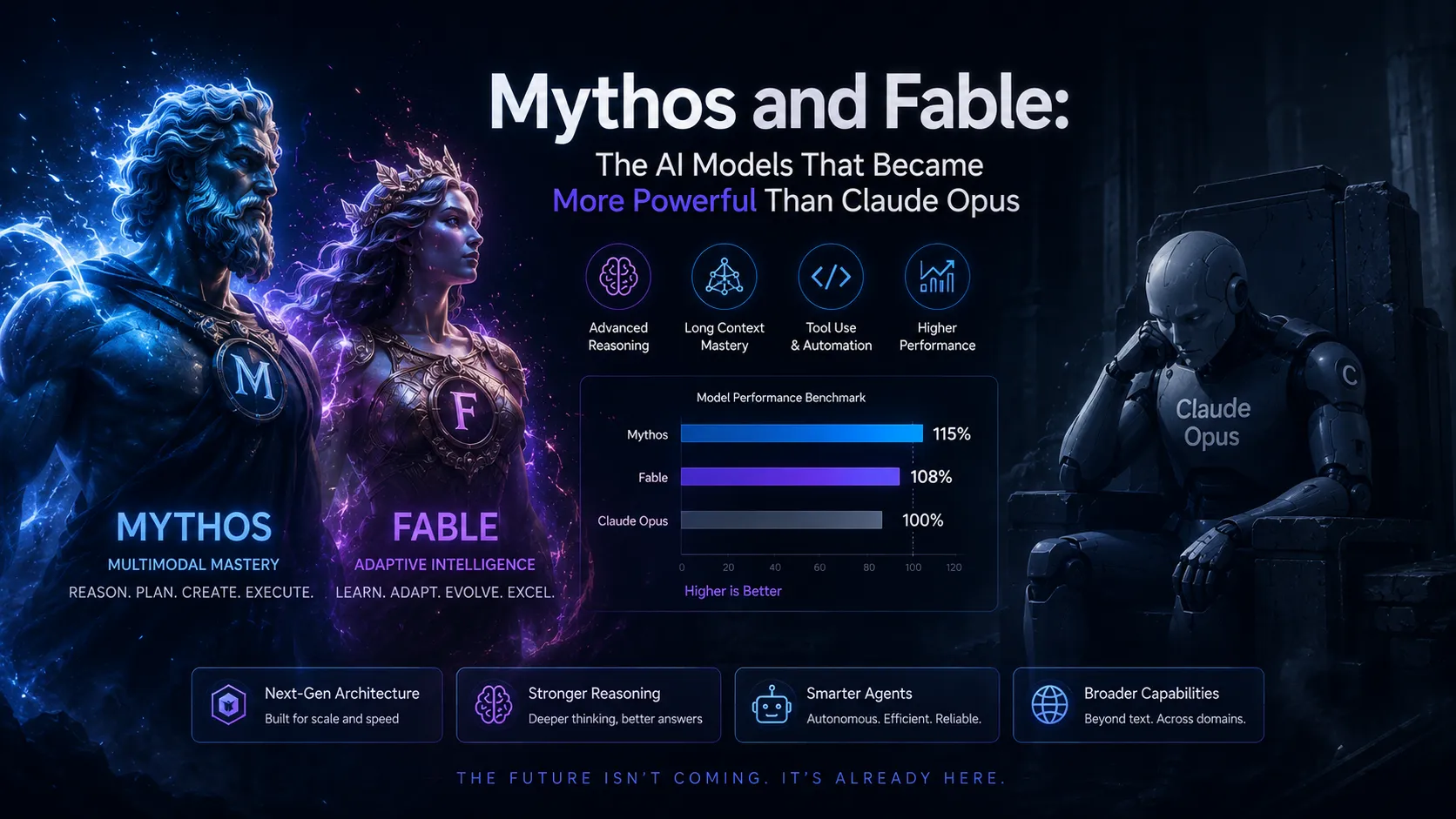
Until just a few months ago, when people talked about Anthropic's most powerful AI models, Claude Opus held the top spot. But that story changed this year. Anthropic introduced two new models called Mythos and Fable, which didn't just sit one step above Opus — they created an entirely new category in the AI world known as "Mythos-class models." These two models, especially in cybersecurity and complex code analysis, demonstrated abilities that were previously expected only from elite human experts. In this article, we'll break down in simple terms with relatable examples what Mythos and Fable actually are, how they differ, why access to them has been so restricted, and what impact they're likely to have on the future of security and software development.
What Is Mythos, and Why Didn't Anthropic Release It Publicly?
Claude Mythos Preview was the first model Anthropic introduced from this family. It's a general-purpose AI model, but it showed an unusual edge in one specific area: finding and exploiting software vulnerabilities. To understand this better, consider one real-world example: the model fully autonomously identified — and then exploited — a 17-year-old vulnerability in the FreeBSD operating system, one that allowed an unauthenticated user anywhere on the internet to gain complete root control over a server. No human was involved in either discovering or exploiting this bug.
This level of capability pushed Anthropic to skip a public release entirely and instead make Mythos available only through a program called
Project Glasswing, granting access to select companies like Microsoft, Apple, Google, Amazon, Cisco, and Nvidia. The results of this collaboration were striking: just two weeks after limited access began, Mozilla announced it had used Mythos to find and patch
271 security vulnerabilities in the Firefox browser. If you're curious to dig deeper into AI's role in cybersecurity, check out our article on
the impact of artificial intelligence on cybersecurity systems for a fuller picture of this shift.
From Mythos to Fable: A Safe Version for Everyone
Anthropic's core concern was simple: a model this skilled at finding vulnerabilities could become a weapon instead of a shield if it fell into the wrong hands. So in the next phase, Anthropic released two models simultaneously:
- Claude Mythos 5: An advanced version of Mythos, with restricted access limited to trusted organizations in cybersecurity.
- Claude Fable 5: A version of the same powerful model, but with added safety guardrails that make it safe for general use.
The name Fable comes from the Latin word fabula, meaning "that which is told" — sharing roots with the Greek word mythos. This means the two models come from the same family but with different goals. The key difference lies in their safety guardrails: if a user asks Fable a question in a high-risk area like cybersecurity or biology, the response is routed instead through the weaker Claude Opus 4.8 model. In other words, Fable has the same raw power as Mythos, but with active safety brakes.
To better understand this difference, take a look at the table below:
| Feature | Claude Fable 5 | Claude Mythos 5 |
| Access | Subscribers and general organizations | Limited, trusted access only |
| Safety guardrails | Active in high-risk domains | Lifted in certain domains |
| Input/Output pricing | $10 / $50 per million tokens | $10 / $50 per million tokens |
| Strongest domain | Software engineering, scientific research, vision | Vulnerability discovery and remediation |
| Current status | Limited due to export restrictions | Gradually being restored |
Examples That Show the Real Power of These Models
Numbers alone don't always tell the full story, but when you see these capabilities in real-world examples, the picture becomes much clearer.
Employees at Calif.io used Mythos to build a memory corruption exploit targeting Apple's M5 chips — a task that would normally take a professional team months to complete. In tests run by the UK's AI Security Institute (AISI), Mythos succeeded at advanced Capture the Flag challenges at a 73% success rate, far outperforming competing models at this level of difficulty. In a competitive evaluation by the UK's cybersecurity institute, Mythos ranked first, with Claude Opus 4.6 coming in second, while GPT-5.4 and GPT-5.3 Codex tied for third place.
This means that for a small security team — or even a solo developer — Fable can effectively act like a senior security analyst available around the clock, something that used to be feasible only for large corporations. If you want to explore the broader landscape of AI language models, our article on
AI language models: opportunities and challenges is a great next read.
Why Has Access to Mythos Been So Turbulent?
The access story behind these models has been more dramatic than most thrillers. The existence of a model called Mythos first leaked through draft versions of a blog post, which described it as "far ahead of any other AI model in cyber capabilities" — news serious enough to send cybersecurity stocks tumbling. The US Treasury Department, the European Central Bank, and even financial regulators in Japan and Australia held emergency meetings to assess the risks posed by this model.
But the story didn't stop there. In one of the more complicated chapters, the US government, citing national security concerns, ordered a halt to access for Mythos-class models for foreign nationals — including Anthropic's own employees. For a time, even some of the company's own staff couldn't access the model they built. Fortunately, this restriction was temporary, and Anthropic gradually began restoring access to Mythos, though Fable has not yet made it back onto that restoration list.
These swings show just how complicated regulation and policy become once AI reaches a level of power where it can serve as both a defensive tool and an offensive weapon at the same time. For a deeper look into these tensions, check out our article on
ethics in artificial intelligence: challenges and solutions.
What Do These Models Mean for Everyday Users?
You might assume this story only matters to big tech companies and governments, but the truth is that Fable's capabilities are gradually trickling down to everyday users — following the same logic already at work in tools like Claude Code and AI coding assistants, just at a much more powerful level. Consider a few examples:
An independent developer who used to spend hours hunting for a security bug in their own code can now do the same task in minutes with a tool like
Claude Code, the intelligent AI coding assistant. A small business that can't afford to hire a professional security team can use a Fable-level model to scan its website and servers for common vulnerabilities before launch. Even someone simply learning about cybersecurity can use these models as a private tutor that explains why a piece of code is vulnerable and how to fix it.
How This Compares to Other AI Models on the Market
To put Mythos and Fable in context, it's worth remembering that this level of competition isn't unique to Anthropic. Companies like OpenAI have released their own powerful models, and this rivalry is pushing pricing and quality to shift rapidly. For a broader sense of how leading models stack up against each other, take a look at our
complete comparison of Gemini and ChatGPT or our
comparison between Gemini and Claude. Interestingly, even major financial institutions like the European Central Bank reacted directly to these models — a clear sign of how strategically important this technology has become on a global scale.
Real-World Applications of Fable and Mythos
To round out the picture, let's look at a few more real-world use cases.
Cloudflare, which manages one of the largest security networks on the internet, tested Mythos Preview and found that it produced significantly cleaner and more accurate vulnerability reports than typical coding tools — though it still requires human review for final validation. In another case, security teams across more than 150 organizations in over 15 countries gained expanded access to Mythos, allowing them to simultaneously work on identifying critical vulnerabilities across essential infrastructure. This scale of global collaboration is unprecedented in cybersecurity history.
Concerns and Challenges Ahead
Of course, no powerful technology comes without its share of concerns. Critics, including writers at The New York Times, have warned that models like this could put individuals and small teams at a "cybersecurity disadvantage" compared to organizations with full access. Some researchers have also raised concerns about the impact of such capabilities on nuclear deterrence and national security. On top of that, reports surfaced showing that on the very day Mythos was announced, a handful of unauthorized users in a private channel managed to gain access using leaked credentials — a clear sign that even the most tightly controlled access programs can have cracks.
Putting This Technology to Work Today
The good news is you don't need access to Mythos or Fable to start benefiting from powerful AI right now. If you want to experience a taste of advanced AI capabilities for chatting, content creation, or coding, tools like our
AI chat assistant or
AI coding tool give you a similar feel of advanced model power — without needing to navigate complicated, restricted access programs.
Conclusion
The story of Mythos and Fable is one of the most fascinating chapters in the short history of artificial intelligence: a model so powerful that it became a global policy and security crisis all on its own. From cybersecurity stocks crashing to emergency meetings at the European Central Bank, from 271 vulnerabilities patched in Firefox to memory exploits on Apple's newest chips — all of it shows just how thin the line has become between a "defensive tool" and a "cyber weapon" in the world of AI. Fable, as the safeguarded version of this power, marks the start of a new chapter where these extraordinary capabilities are gradually moving beyond a handful of major corporations and into the hands of a much broader range of users and organizations — a shift that will undoubtedly have a profound impact on the future of digital security for all of us.



 LLMs & AI Agents
 LLMs & AI Agents
 LLMs & AI Agents
 LLMs & AI Agents
 LLMs & AI Agents
 LLMs & AI Agents