Introduction
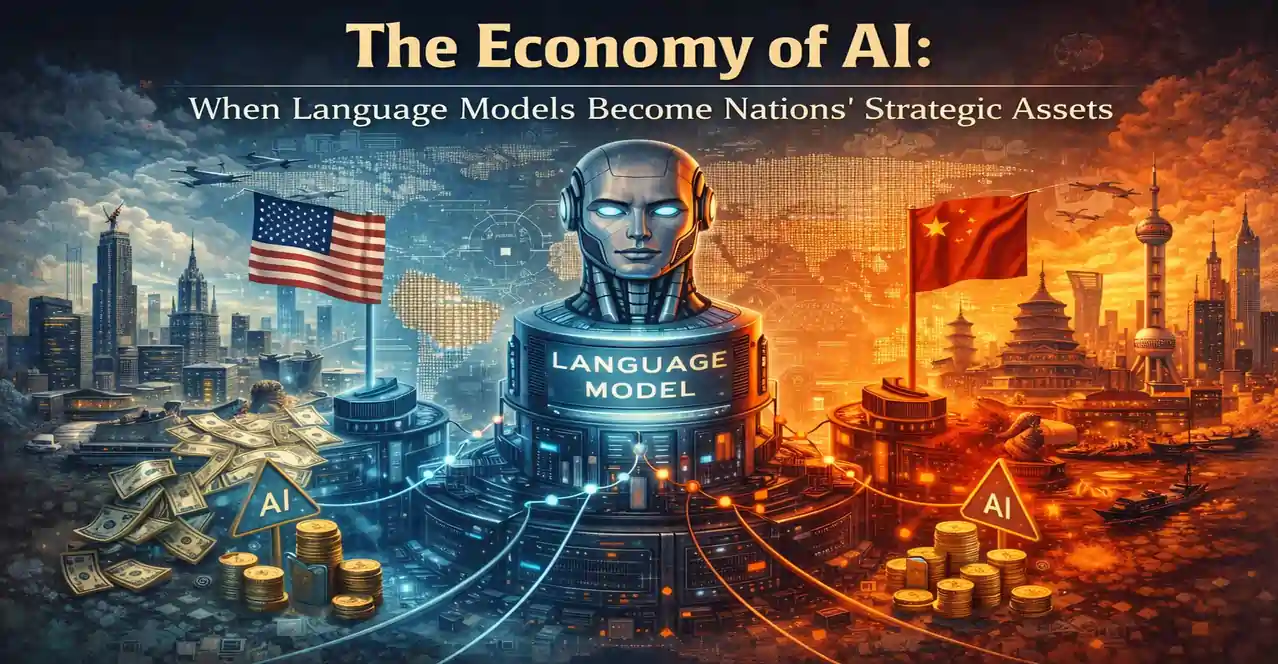
Imagine a small country with no oil wells, no gold mines, and no large military suddenly becoming one of the world's most powerful economic players — simply because it built an advanced artificial intelligence model. This is no longer science fiction. This is exactly what is happening before our eyes.
January 2025 was historic. Chinese company DeepSeek unveiled a model that, at a fraction of the cost OpenAI spent building GPT-4, delivered comparable performance. Within days, stocks of American AI-related companies lost hundreds of billions of dollars in value. One artificial intelligence model — not a bomb, not a sanction, not a war — shook global markets to their core.
This event screamed a new reality in the most jarring way possible: AI models are no longer just technological tools. They are strategic national assets. Just like oil in the twentieth century, any country that falls behind in this race today may spend decades paying the price of that delay.
Why Can an AI Model Be a "National Asset"?
To make this concept tangible, let's start with a simple example.
Suppose a country makes its entire healthcare, financial, judicial, and educational system dependent on an AI platform owned by a foreign company. Now imagine that foreign company decides to cut access, multiply prices tenfold, or use user data for its own purposes. This is no longer a technical problem — this is a national security crisis.
The strategic asset status of AI models can be examined from three angles:
1. Economic dependency: Every industry that uses AI — from agriculture to banking — becomes dependent on the underlying model infrastructure. The country that owns these models benefits from this dependency; the country that doesn't is placed in a position of weakness.
2. Data power: Large models are trained on data. Every time a citizen uses a foreign model, valuable data — from behavioral patterns to sensitive information — is transferred outside the country.
3. Cultural and cognitive influence: Models like ChatGPT define what a "correct answer" is, which perspectives are reasonable, and what values are considered normal. This power to shape collective thinking is the deepest form of strategic influence.
The Great Race: Which Countries Are Leading?
Global competition over AI models has become one of the hottest geopolitical arenas. The following table shows the current state of play:
| Country / Region | Key Models | Government Investment | Strategic Approach |
| 🇺🇸 USA | GPT-5, Gemini, Claude | $500B (Stargate) | Private sector-led with government support |
| 🇨🇳 China | DeepSeek, Qwen, Ernie | $150B+ | Direct state-led, full localization |
| 🇪🇺 Europe | Mistral, BLOOM | €200B+ (AI Continent) | Data sovereignty and regulation focus |
| 🇬🇧 UK | DeepMind / Gemini | £14B | European research hub |
| 🇦🇪 UAE | Falcon 3, Jais | $100B+ | Leadership in Arabic-language AI |
| 🇸🇦 Saudi Arabia | Allam | $40B (Alat) | Diversifying from oil to AI |
One strikingly notable point in this table: Middle Eastern countries — whose power yesterday came from oil — are today consciously transferring that power to AI models. This is a historic shift in the very nature of national wealth.
Stunning Examples: When Models Demonstrate Power
Let's step back from abstraction and see what these models can actually do that makes them strategic assets:
1. Defense and Security: Models That Fight Wars
Palantir — an American company — has sold its AI models to the US and Israeli militaries. These models can instantly extract operational intelligence from millions of scattered data points (satellite imagery, intercepted communications, field reports). Work that previously took weeks now takes minutes.
A country without access to such a model — or worse, dependent on models controlled by its rivals — has already lost in a modern war before it begins.
2. Economy: Models That Read Markets
AI models in financial markets now manage more than 70% of trading volume on major world exchanges. Hedge funds like Renaissance Technologies use AI algorithms to generate annual returns that no human trader can replicate.
But even more striking: a country with a powerful
macroeconomic model can predict financial crises weeks before they occur.
AI-powered predictive financial modeling holds the capacity to fundamentally transform national economic policymaking.
3. Public Health: Models That Save Lives
Google's AlphaFold discovered the three-dimensional structure of nearly all known human proteins — work that would have taken thousands of years using traditional methods. This breakthrough alone could reshape the next wave of drug discovery.
AI in drug discovery is not the future — it is now.
A country with these models can design a vaccine in less than a year after a new disease emerges. A country without them must wait for others' generosity.
4. Education: Models That Build Knowledge Economies
Imagine a personal tutor available 24 hours a day for every student — a tutor that speaks their native language, understands their knowledge level, and adjusts instruction precisely to their needs. This is no longer a dream.
AI in education has made this possible, but only for countries with models that have native language capabilities.
The Economics of Models: Where Is the Real Value?
AI models generate economic value through several channels that transform them into strategic assets:
Direct revenue from subscriptions and API: OpenAI earned more than $3.7 billion in revenue in 2024, with estimates suggesting this figure could reach hundreds of billions by the end of the decade. This revenue flows directly back to the model's home country economy.
Value chain control: Every business using an API — from a small startup to a large bank — pays a portion of its revenue for that access. This is a hidden tax that accrues to the model's home country.
Standardization influence: The country that owns dominant models defines the security, ethical, and technical standards of AI. This institutional power places its value beyond any financial calculation.
Global talent attraction: The world's best AI researchers and engineers gravitate toward countries leading in this field. This "talent migration" has a compounding effect that deepens the gap between countries over time.
AI Models as Diplomatic Tools
Consider this narrative: China, by offering free or cheap AI models to African and Central Asian countries, collects valuable data, creates technological dependency, and builds strategic relationships — all in one package. This "digital diplomacy" will play a far larger role in the coming decade than traditional financial aid.
On the other side, America, by pressuring its allies to ban Chinese AI technology — similar to what happened with Huawei — tries to keep the global AI ecosystem within its own orbit.
Interestingly,
open-source models play a complex role in this equation. When Meta open-sourced Llama, many saw it as a weakness. But another interpretation is that Meta thereby created an international standard that developers worldwide are familiar with and dependent on American infrastructure for.
The AI Gap: Which Countries Are at Risk?
A troubling reality exists: the majority of the world's countries have no native AI model. This means their entire digital economy, information infrastructure, and even governance systems are dependent on models built and controlled by the United States or China.
This situation can become problematic in multiple ways:
- Digital sanctions: Just like economic sanctions, a country can restrict others' access to its models. This is a new weapon in modern diplomacy.
- Data dependency: Sensitive government, commercial, and personal information is processed through these models and stored on foreign servers.
- Neutrality is impossible: Language models inherently reflect the perspectives embedded in their training data. A model trained on English-centric data sees the world from a particular angle.
National Responses: From DeepSeek to Falcon
Interestingly, some countries have entered this competition with entirely different strategies:
China's strategy — efficiency over cost: DeepSeek proved that competitive models can be built with fewer resources. This "cost optimization" approach has been particularly inspiring for countries with less computational capacity.
DeepSeek as an advanced NLP tool showed that the game is far from over.
UAE's strategy — linguistic specialization: The UAE, by building Falcon and Jais — models optimized for the Arabic language — has carved out a special position in this ecosystem. This shows that direct competition with ChatGPT is unnecessary; superiority in one specific domain is enough.
Europe's strategy — data sovereignty: The EU, through the passage of the AI Act, has chosen a different path: rather than focusing on building more powerful models, it focuses on controlling how models are used. This approach carries its own risks, but is defensible from a citizen rights protection standpoint.
The Hidden Infrastructure: Racing for Chips
Another layer of this competition is less visible:
computational hardware. Custom AI chips — especially NVIDIA GPUs — have become instruments of sanction. The US has restricted exports of advanced chips to China, while China has mobilized all its resources to build domestic chips.
This competition shows that "strategic AI assets" aren't limited to models — they encompass a complete chain of data, algorithms, hardware, and human talent. Any country truly seeking independence must invest across all these layers.
Ethics and Risk: When Strategic Assets Become Uncontrolled
The strategic asset status of AI models is a double-edged sword. The same power that can advance a nation can, in the hands of an authoritarian government, become a tool of oppression.
Ethics in artificial intelligence is not a decorative subject — these ethical constraints determine the direction a powerful model takes. Facial recognition systems used in China for mass surveillance use the same underlying technology employed in Europe to locate missing persons.
This means the competition over AI models is not one measured only by economic or military criteria. The value framework governing a model is one of the most important determinants of its impact on society.
Conclusion: From the Age of Oil to the Age of Models
In the twentieth century, countries with oil had power. Those without were forced to buy it — and in that purchase, they paid not only money but also a portion of their independence.
In the twenty-first century, AI models are the new oil. With one crucial difference: oil is non-renewable and models are not. Every country — at any point on the development curve — can enter this competition through smart investment, native data, and human talent.
The central question is not "Will AI change the future?" — because that has already happened. The question is: How quickly will nations realize that this race has already begun?
Those who understand sooner will lead. Those who realize later will be forced to play by rules written by others.



 Industry & Business
 Industry & Business
 Industry & Business
 Industry & Business
 Industry & Business
 Industry & Business