Introduction
You wake up and the first thing you do is check your ChatGPT messages. On your way to work, you ask your voice assistant to play music. At the office, you ask Gemini to summarize your emails. You order lunch using an AI app. In the evening, you use Claude to write a report. Before bed, you ask Midjourney to create an image for you.
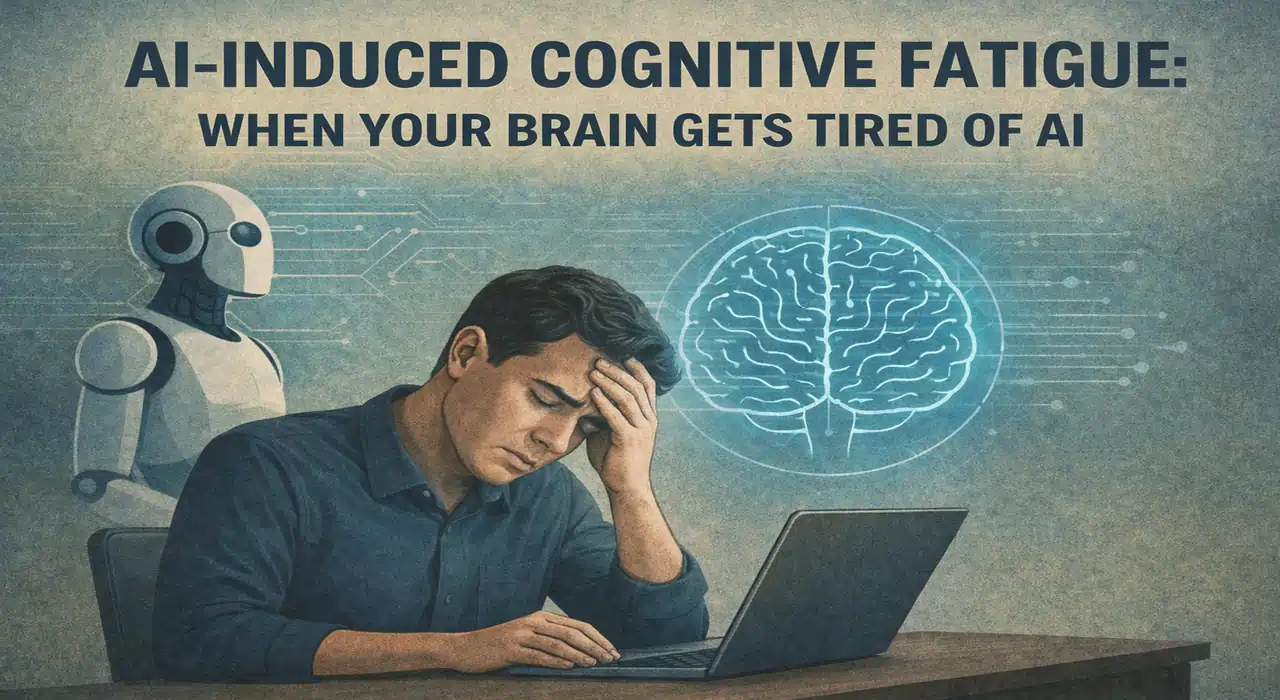
Now imagine repeating all these interactions every day. And tomorrow again. And next week once more. Gradually, you feel something has changed. Not physical fatigue, but a deep mental exhaustion that doesn't go away even with rest. This is the phenomenon now known as AI-Induced Cognitive Fatigue.
In today's world where artificial intelligence has become an inseparable part of daily life, our brain faces an unprecedented challenge: continuous interaction with artificial minds that never get tired, never make mistakes, and always have answers. This article deeply examines this phenomenon, its neural mechanisms, and practical solutions for managing it.
The Human Brain vs. Machine: An Unequal Battle
The human brain is a biological marvel that has evolved over millions of years. But this evolution wasn't designed for today's world. Our brain is optimized for survival in nature, hunting, escaping danger, and limited social interactions - not for daily interaction with hundreds of language models and intelligent systems.
Why is Interacting with AI More Exhausting Than With Humans?
1. Absence of Natural Delays
When you talk to a human, there are pauses, delays, and thinking time. These gaps allow your brain to process information, rest, and prepare for the next response. But AI? Instant response. Always. Without pause.
Imagine working on a project with ChatGPT. Every question you ask gets a detailed response within seconds. Sounds good? But your brain must:
- Read and understand the text
- Compare it with prior knowledge
- Decide which parts are useful
- Formulate the next question
- Receive and process the response again
This endless cycle keeps the prefrontal cortex - responsible for decision-making and attention - continuously active. Studies show that continuous activity of this area without rest leads to decreased brain glucose levels and severe fatigue.
2. Cognitive Load of Continuous Decision-Making
With AI, you're always evaluating, choosing, and deciding:
- Is this answer correct?
- Should I change my prompt?
- Should I use a different model?
- Is this information up-to-date?
- Is AI hallucinating?
This metacognition - thinking about thinking - is very energy-intensive. In human interactions, you usually automatically trust the conversation. But with AI, there's always a level of doubt and verification.
3. Absence of Social and Emotional Signals
The human brain is designed to read faces, voice tones, body language, and emotions. When you interact with AI, all these communication channels are deactivated. But your brain still searches for these signals.
This is called Social Cognitive Deficit. Your brain spends energy trying to find something that doesn't exist. It's like searching for keys in a dark room that aren't there at all.
Neural Mechanisms of Cognitive Fatigue
To understand this phenomenon more deeply, we need to look at the neural level. What happens in the brain that causes this fatigue?
1. Depletion of Brain Energy Reserves
The brain comprises only 2% of body weight but consumes 20% of total body energy. This energy is mainly supplied by glucose. When the brain is continuously engaged in processing complex information, its glucose reserves are depleted faster.
Research shows that continuous use of AI for heavy cognitive tasks (like writing, programming, data analysis) can reduce glucose levels in the prefrontal cortex by up to 30%. This reduction is directly related to the feeling of brain fog, decreased focus, and increased errors.
2. Attention System Fatigue
The human brain has two attention systems:
- Selective Attention: Focus on one specific thing
- Sustained Attention: Maintaining focus over time
Using AI requires simultaneous activity of both systems. You must focus on AI-generated text (selective attention) while maintaining this attention for extended periods (sustained attention). This dual use is very energy-intensive.
Additionally, AI often produces excessive information. A simple GPT-4 response can be 500 words. Your brain must filter, sort, and select the most relevant parts of all this information. This continuous filtering process severely exhausts the attention system.
3. Working Memory Overload
Working memory is a limited space in the brain that holds current information for processing. Its capacity is limited - about 4 to 7 items simultaneously.
When working with AI, your working memory must:
- Hold the main question
- Check the AI response
- Compare with previous information
- Identify weaknesses
- Formulate the next question
- Maintain overall conversation context
This cognitive overload leads to decreased performance, increased errors, and feelings of exhaustion.
4. Disruption of Natural Brain Rest Cycles
The brain has a Default Mode Network - a neural system that activates during rest. This network is essential for:
- Information integration
- Creativity
- Introspection
- Memory consolidation
But continuous AI use keeps the brain in active mode and doesn't allow this network to activate. The result? Reduced creativity, problem-solving difficulties, and feeling "mentally empty".
Warning Signs: How to Know If You're Experiencing Cognitive Fatigue?
| Symptom Type | Signs | Severity |
| Cognitive Symptoms | Difficulty focusing, forgetfulness, slower decision-making, brain fog | Moderate to Severe |
| Emotional Symptoms | Apathy, anxiety, feeling worthless, decreased motivation | Mild to Moderate |
| Behavioral Symptoms | Over-reliance on AI, avoiding deep thinking, procrastination | Moderate |
| Physical Symptoms | Headaches, eye strain, muscle tension, sleep disturbances | Mild to Moderate |
Advanced Symptoms That Should Be Taken Seriously
1. Changes in Thinking Patterns
If you notice that:
- You can no longer think without AI help
- You're always waiting for immediate answers
- Your patience has decreased
- You can't deal with ambiguity
2. Decreased Creativity Ability
Creativity requires:
Excessive AI use can disrupt these processes. If you feel you no longer get original ideas, this is a warning sign.
3. Emotional Exhaustion
Some users report that after hours of working with AI, they feel:
- Empty
- Emotionally numb
- Weaker human connections
- Gradually losing social skills
Real-World Scenarios: Cognitive Fatigue in Practice
Scenario 1: Professional Programmer
Ali is a full-stack developer who uses
Claude Code for coding. Initially, he was amazed - AI could generate code in seconds that would take him hours to write.
But after 3 months:
- He worked 8 hours daily with AI
- Constantly reviewed generated code
- Had to find subtle bugs
- Was forced to understand code logic
The result? At the end of the day, he felt severe mental fatigue. Even at night, he couldn't sleep properly. His brain was still busy "reviewing code".
Scenario 2: Content Writer
- 20 social media posts
- 5 blog articles
- 10 promotional emails
All with ChatGPT and Gemini's help. Initially, it was amazing - content creation was no longer time-consuming.
But the problem was:
- She had to read and edit each text
- Make sure the tone was appropriate
- Check that information was correct
- Ensure AI wasn't hallucinating
After a few months, Sara felt
she could no longer write on her own. When she tried to write without AI, her mind was blank. She had developed
cognitive dependency.
Scenario 3: Master's Student
- Summarizing research papers
- Writing different thesis sections
- Data analysis
- Translating English sources
But the problem is: he can no longer read and understand papers himself. His brain has become accustomed to AI's quick and summarized responses. When he wants to read a 30-page paper, his focus fades after a few pages.
Special Challenges of Large Language Models
1. The Power Paradox
You must decide when to use them.
This "meta-decision making" is itself very energy-intensive. Every time you want to do something, you must think:
- Should I get AI help?
- Which model is better?
- How should I write the prompt?
- Is the response sufficient or should I ask more?
This continuous decision-making process creates decision fatigue.
2. Trust and Validation Challenge
With humans, you usually know when you can trust. But with AI? You must always be in review and verification mode. This means:
- Check every claim
- Review sources
- Evaluate logic
- Compare with your information
This is
additional cognitive load that doesn't exist in human interactions. Even when using
advanced search tools claiming high accuracy, this concern remains.
3. Context and Memory Problem
One of the major challenges in working with AI is
managing conversation context.
AI models have context window limitations. You must:
- Remember what you've said before
- Make sure AI hasn't lost context
- If needed, reconstruct context
This additional working memory load leads to fatigue.
Difference Between Natural and AI-Induced Fatigue
How can we distinguish whether our fatigue is natural or AI-induced?
| Feature | Natural Fatigue | AI-Induced Fatigue |
| Recovery with Rest | Resolved with sleep and rest | Not resolved even with complete rest |
| Type of Fatigue Feeling | Physical and general fatigue | Deep mental fatigue and brain fog |
| Impact on Creativity | Temporary decrease | Long-term and structural decrease |
| Reliance on External Tools | Natural and balanced | Severe and abnormal dependency |
| Feeling After Activity | Satisfaction and accomplishment | Emptiness and lack of real achievement |
Scientific and Practical Solutions: How to Manage Cognitive Fatigue?
Strategy 1: Modified Pomodoro Technique for AI
Classic Pomodoro technique: 25 minutes of work, 5 minutes rest. But working with AI requires specific adjustments:
20-20-20 Rule for AI:
- Every 20 minutes of AI work
- Look at something 20 feet away for 20 seconds
- Do 20 deep breathing movements
Active Cognitive Rest:
- Instead of wasting time on social media (which are also AI-powered)
- Do something completely different: walk, pick up a pencil and draw, talk to a real human
Strategy 2: The 60-30-10 Rule
To prevent complete dependence on AI:
- Do 60% of the work yourself (initial thinking, ideation, overall design)
- 30% with AI help (acceleration, improvement, optimization)
- 10% for reviewing and critiquing AI output (ensuring quality)
This ratio ensures your brain remains engaged in the creative process and doesn't become merely a passive consumer of AI content.
Strategy 3: "Analog Draft" Technique
Before using AI:
- Write your thoughts on paper
- Draw an initial hand-drawn sketch
- Record your ideas without filtering
Why is this important?
- Puts your brain in "creative mode"
- Prevents immediate AI dependence
- Gives you ownership of the work
- Keeps the brain's default mode network active
Strategy 4: Conscious Prompt Engineering
How you write prompts can significantly impact cognitive fatigue. Instead of short, vague prompts requiring continuous interaction:
Before:
"Write an article about AI"
→ Poor result
→ You must repeat several times
→ High fatigue
After:
"Write a 1500-word article about AI's impact on education.
Include: introduction, 3 real examples, challenges, and conclusion.
Tone: professional but understandable.
Audience: high school teachers."
→ Better result on first attempt
→ Less interaction
→ Less fatigue
Strategy 5: Method Combination Instead of Complete Reliance
Example: Writing an Analytical Report
❌ Exhausting Method:
- Ask ChatGPT for everything
- Receive pages of text
- Edit for hours
- Feel tired and worn out
✅ Smart Method:
- Write the outline yourself (10 minutes)
- Use AI data analysis tools to extract insights (15 minutes)
- Write key sections yourself (30 minutes)
- Use AI for polish and improvement (10 minutes)
- Do final editing yourself (15 minutes)
Result: Better work, less fatigue, more sense of ownership.
Strategy 6: Tool Diversity
Continuous use of one AI model can be exhausting. Diversity helps:
This diversity activates different parts of the brain and prevents monotonous fatigue.
Strategy 7: "AI-Free Days"
One day a week (or even a few hours a day) work completely without AI:
- Use your memory
- Take manual notes
- Solve problems without AI help
- Read physical books
This is like a diet for the brain. It allows your brain to strengthen its cognitive muscles again.
Brain Recovery Exercises
1. Focused Attention Meditation
- Focus on your breath for 10 minutes
- Every time your mind wanders, gently bring it back
- This exercise strengthens the prefrontal cortex
2. Working Memory Exercise
- Memory games like "matching pairs"
- Memorizing numbers and reverse repetition
- Solving Sudoku without help
3. Analog Creative Thinking
- Painting or drawing
- Handwriting in a notebook
- Building something by hand
4. Real Social Interaction
- Face-to-face conversation
- Group games
- Teamwork without digital intermediaries
Role of Companies and Organizations
AI-induced cognitive fatigue isn't just an individual responsibility. Companies and organizations must also take action:
Recommended Organizational Policies:
1. Time Limitations:
- Maximum 4-6 hours of direct AI work per day
- Mandatory breaks every 90 minutes
- "AI-free hours" during the workday
2. Employee Training:
3. Workplace Design:
- Digital-free spaces for deep thinking
- Ability to work analog (whiteboards, paper, markers)
- Support for skills AI cannot replace
The Future: Cognitive Fatigue Outlook
With the advancement of more powerful AIs like
GPT-5,
Gemini 3, and potentially
AGI, this problem could
worsen or be solved. Which one?
Pessimistic Scenario:
Optimistic Scenario:
- Development of emotionally aware AI that understands human cognitive needs
- User interface design that reduces fatigue
- Interpretable AI that doesn't require constant review
- More natural AI integration with human cognitive processes
What's Likely:
We'll probably see a combination of both. Part of society that learns how to live healthily with AI, and part that develops serious problems.
Special Challenges for Generation Alpha
Cognitive Development Issues:
- Their developing brain is shaped by AI
- They may never fully learn basic cognitive skills
- Risk of declining social skills during development
Solutions:
Crisis of Meaning and Purpose
Existential Questions:
- If AI can do everything better, what's the value of human effort?
- If my work is done by AI, what is my identity?
- If my creativity is AI-assisted, is it really my creativity?
These questions are deeper than physical or mental fatigue. They're about purpose and meaning in life.
Solution:
- Focus on the process not just the result
- Value the learning experience even if AI is faster
- Find meaning in human connections that AI cannot replace
- Understanding that human consciousness and awareness is something beyond computational abilities
Conclusion: Living in Balance with AI
AI-induced cognitive fatigue is a serious reality, not a passing trend. But it's manageable - if we're aware and take action.
Key Points:
- AI is a powerful tool, not a complete replacement for the human mind
- The brain needs rest, variety, and healthy challenges
- Balance between AI use and analog activities is essential
- Recognizing early symptoms can prevent serious problems
- True creativity comes from mental space and free thinking time
Final Practical Guide:
- At least 2 hours of deep work without AI daily
- One digital detox day weekly
- One completely analog project monthly
- Real face-to-face interactions daily
The future belongs to those who learn to collaborate with AI without losing their identity. Not those who completely reject it, nor those who become completely dependent on it.
The choice is yours: Do you want to preserve your brain, or gradually surrender it to AI?



 Social Impact & Future
 Social Impact & Future
 Social Impact & Future
 Social Impact & Future
 Social Impact & Future
 Social Impact & Future