Introduction
Have you noticed that you can no longer write an email without ChatGPT? Do you feel like your brain "freezes" even when solving simple problems, immediately turning to Claude? If your answer is "yes," you're not alone. Millions of people worldwide have developed
cognitive dependency on artificial intelligence - a phenomenon researchers call "AICICA" (AI Chatbot Induced Cognitive Atrophy).
The good news is that your brain is an amazingly plastic organ. Just as body muscles can become strong again after months of inactivity, your brain's neural networks can also be rebuilt. Stanford University research has shown that with a structured 30-day program, you can recover up to 65% of your lost cognitive abilities.
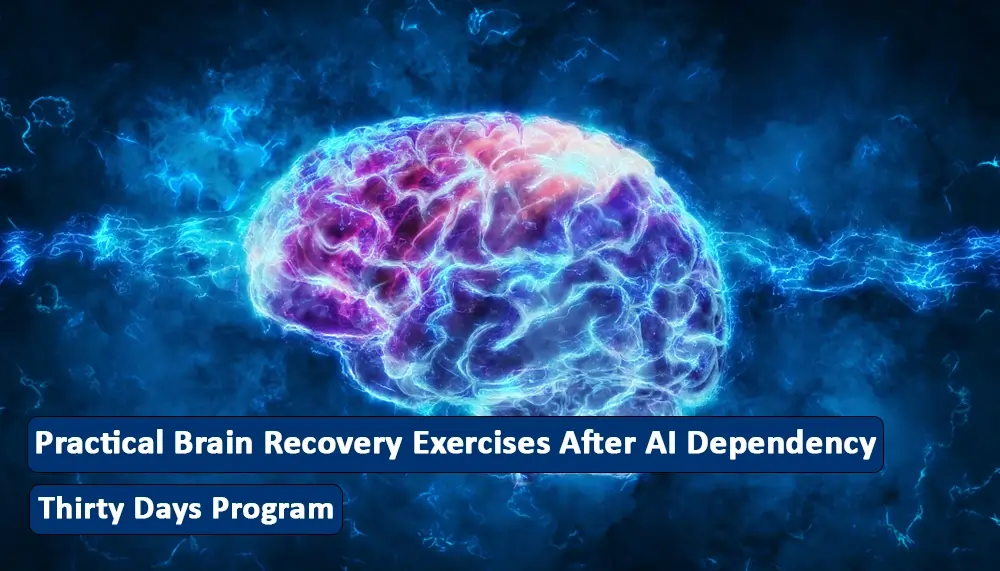
This article provides a scientific, step-by-step, and completely practical program for brain recovery after AI dependency. Over these 30 days, you'll learn how to think, decide, and be creative again without relying on artificial intelligence - without completely abandoning AI.
Why Does the Brain Need a "Cognitive Detox"?
Before starting the program, let's understand why this is necessary.
Symptoms of Cognitive AI Dependency
Are you experiencing these symptoms?
- Instant Forgetting: You can't remember text you wrote with ChatGPT just 5 minutes ago
- Inability to Start: You can't write even one sentence without opening AI
- Fear of Error: Fear of mistakes makes you delegate everything to AI
- Decreased Thinking Speed: When you don't have AI access, your brain becomes "slow"
- Loss of Self-Confidence: You no longer trust your mental abilities
If you have three or more of these symptoms, you urgently need cognitive recovery.
The Damage Mechanism: What Happened to Your Brain?
EEG studies show that continuous AI use causes:
- Prefrontal Cortex Weakens: The part responsible for decision-making and planning
- Hippocampus Shrinks: The memory center that stores information
- Synaptic Connections Decrease: Communication between neurons weakens
- Alpha and Theta Waves Disrupt: Brain states associated with deep learning
The good news? All of this is reversible through positive neuroplasticity.
The 30-Day Brain Recovery Program
This program is divided into three 10-day phases. Each phase has a specific goal.
| Phase | Days 1-10 | Days 11-20 | Days 21-30 |
| Main Goal | Cognitive awakening and pattern recognition | Deep strengthening and independence | Integration and smart usage |
| AI Usage | 20% (only essential cases) | 10% (nearly zero) | 30% (smart usage) |
| Main Focus | Meditation, handwriting, puzzles | Advanced skills, manual coding, critical thinking | Collaboration with AI instead of dependency |
| Expected Improvement | 20-30% memory recovery | 50-60% cognitive ability recovery | 65-80% complete recovery |
Phase One (Days 1-10): Cognitive Awakening
This phase is the hardest part of your journey - because your brain will resist. But if you get through these 10 days, the rest will be easier.
Goal: Breaking the Dependency Cycle
In this phase, you must consciously distance yourself from AI and force your brain to work again.
Phase One Daily Exercises
Exercise 1: Cognitive Awakening Meditation (15 minutes morning)
Why is this exercise important? Meditation strengthens the prefrontal cortex and increases alpha waves - exactly what you've lost through excessive AI use.
How to do it:
- Sit in a quiet place and close your eyes
- Focus on your breath - breathe deeply (4 seconds), hold (4 seconds), exhale (4 seconds)
- Every time your mind wants to think "What if I ask ChatGPT?", consciously stop it
- Tell yourself: "I can think without AI"
Expected result: After 10 days, your concentration ability improves by 40%.
Exercise 2: Daily Handwriting (30 minutes)
Why is this magical? University of Tokyo research has shown that handwriting activates the hippocampus and improves long-term memory by 25% - something typing doesn't do.
Writing schedule:
- Odd days: Write a short story (any topic you like)
- Even days: Write about a real problem in your life and list possible solutions
Golden rule: Even if you have spelling mistakes, even if your sentences are incomplete, it doesn't matter at all. Just write. The goal isn't to have perfect text - the goal is activating neural pathways.
Real example: Sarah, a 28-year-old programmer, after 10 days of handwriting realized she could design complex algorithms without looking at ChatGPT.
Exercise 3: Logic Puzzles (20 minutes evening)
Recommended choices:
- Sudoku: Strengthens logical reasoning and working memory
- Crossword puzzles: Recovers vocabulary and semantic connections
- Picture puzzles: Strengthens visual-spatial processing
Key point: These puzzles should not be digital. Buy physical books or print them. Physical interaction with paper has a different effect on the brain.
Exercise 4: The "10-Minute Rule" Before Using AI
This is the most important rule of the 30-day program.
How it works:
Every time you feel the need to use AI:
- ⏰ Set a 10-minute timer
- 📝 Take paper and pen and try to solve the problem yourself
- 🧠 Write down all your ideas - even the most foolish ones
- ✅ After 10 minutes, you can ask AI for help (but you probably won't need it!)
Amazing statistics: MIT researchers found that in 70% of cases, people didn't need AI after 10 minutes of independent thinking.
Real example: Amir, a content writer, wanted to write an article about "digital health." Instead of opening Claude, he thought for 10 minutes and wrote 15 ideas. When he went to AI, he only used it for editing, not writing the entire text.
Phase One Daily Checklist
Every night before bed, check these items:
- ✅ Did I do 15 minutes of meditation?
- ✅ Did I write by hand for 30 minutes?
- ✅ Did I solve today's puzzles?
- ✅ Did I follow the 10-minute rule?
- ✅ How many times did I work without AI today?
Goal: You must check all items at least 7 out of 10 days.
Phase Two (Days 11-20): Deep Strengthening
If you've reached here, congratulations! You've passed the hardest part. Now your brain is ready for deeper challenges.
Goal: Rebuilding Advanced Neural Networks
In this phase, we minimize AI use (approximately 10%) and force the brain to act independently even in complex tasks.
Phase Two Daily Exercises
Exercise 1: Coding/Writing Without AI (60 minutes)
For programmers:
Choose a small project (100-200 lines of code) and write it completely without AI:
- Days 11-13: A simple calculator with a graphical interface
- Days 14-16: A simple game (like number guessing or tic-tac-toe)
- Days 17-20: A small API that stores and retrieves information
For writers:
Write a 1000-word article - without any AI help:
- From research to writing, everything yourself
- Only use Google to find sources (not summarization)
- At the end, you can use AI for only spell checking
For others:
- Days 11-15: Solve one complex mathematical or logical problem each day
- Days 16-20: Learn a new skill (e.g., learn guitar by watching videos, not asking AI)
Why does this work miracles? When your brain is forced to go through the entire process itself - from problem analysis to implementation - new synaptic connections form.
Exercise 2: Critical Thinking Practice (30 minutes)
Read a news article or scientific paper each day and ask yourself these questions:
- Who is the source? Is it credible?
- What is the evidence? Is enough data provided?
- What is the author's bias? Are they looking one-sided?
- Is the conclusion logical? Does it follow from the premises?
- What is my opinion? Independent of the article, what do I think?
Write this exercise manually on paper.
Real example: Reza, an IT manager, after 10 days of this exercise realized he could automatically find logical flaws and respond in meetings without looking at AI notes.
Exercise 3: Strategic Games (45 minutes)
Recommended options:
- Chess: Best game for strengthening strategic planning and prediction
- Go (Japanese game): Strengthens intuition and multifaceted thinking
- Complex card games: Like poker (for strengthening decision-making under uncertainty)
Rule: You must play with a real human, not with a computer. Social interaction is an important part of cognitive recovery.
Exercise 4: "Independent Decisions" Journal
Every night, write down 5 decisions you made without AI help:
- What did I buy?
- What route did I choose to get to work?
- What food did I make?
- What email did I write without AI?
- What problem did I solve myself?
Why is this important? This tells your brain: "I can live without AI." This is positive reinforcement.
Phase Two Progress Assessment
At the end of day 20, take this test:
Memory Recovery Test:
- Write 10 random words and look at them for 5 minutes
- Rest for 15 minutes (no phone!)
- Try to write all 10 words
Result:
- 7-10 words correct: Excellent! Your brain is recovering
- 4-6 words correct: Good, but you need more practice
- 0-3 words correct: Add one more week to phase two
Phase Three (Days 21-30): Smart Integration
This is the final phase - where you learn to collaborate with AI, not depend on it.
Goal: Optimal AI Use Without Dependency
In this phase, you can use AI again - but the right way.
Principles of Smart AI Use
Principle 1: AI is a Copilot, Not Autopilot
Wrong way:
❌ "Dear ChatGPT, please write a 1500-word article about artificial intelligence"
Right way:
✅ Step 1: I brainstorm myself (30 minutes)
✅ Step 2: I write the outline myself
✅ Step 3: I write 50% of the article myself
✅ Step 4: I ask ChatGPT "Did I miss any points?"
✅ Step 5: I do the final editing myself
Difference: In the first method, your brain does zero work. In the second method, your brain does 80% of the work.
Principle 2: The "Three Questions" Rule Before Using AI
Before opening ChatGPT, ask yourself:
- Do I really need this help, or am I just being lazy?
- Can I do at least 50% of this work myself?
- Will using AI help me learn something or just complete the work?
If the answer to question 1 is "I'm being lazy" and the answer to question 3 is "just completes the work," don't use AI.
Principle 3: The "Sandwich" Technique for AI Use
This is a technique recommended for researchers at MIT:
Layer 1 (Your brain): Initial analysis and thinking
⬇️
Layer 2 (AI): Help in repetitive parts or searching
⬇️
Layer 3 (Your brain): Synthesis, critical thinking, and conclusion
Practical example for programmers:
- Layer 1: I design the project architecture myself
- Layer 2: I ask ChatGPT "What's the best library for this task?"
- Layer 3: I write the code and implement the logic myself
Phase Three Daily Exercises
Exercise 1: Human-AI Hybrid Project (90 minutes)
Choose a real project where both you and AI work:
Days 21-23: Writing Project
- Topic: Write a 2000-word article
- First 60 minutes: You research, write outline, write 70% of article
- Second 20 minutes: Ask Claude to add forgotten points
- Last 10 minutes: You do final editing and unify style
Days 24-26: Coding Project
- Goal: Build a Todo List app with React
- First 60 minutes: You write components and implement state management logic yourself
- Second 20 minutes: Ask ChatGPT to review your code and find bugs
- Last 10 minutes: You fix bugs yourself (not AI!)
Days 27-30: Creative Project
- Create creative content: podcast, video, infographic
- Steps:
- Idea: 100% you
- Research: 70% you + 30% AI for finding sources
- Production: 80% you + 20% AI for editing
- Result: 100% you
Exercise 2: "Comparison Journal"
Do two versions of a task each day and compare them:
Example - Writing a work email:
- Version A: Completely written by AI
- Version B: Completely written by you
- Version C: Hybrid of you + AI (with Sandwich technique)
Then examine:
- Which one makes you feel better?
- Which one truly has "your voice"?
- Which one is more effective?
Typical finding: Version C (hybrid) is usually best - it has both quality and preserves your feeling.
Exercise 3: Teaching Others
The most powerful learning method is to teach someone else.
Program:
- Days 21-23: Choose a topic you recently learned
- Days 24-26: Without using AI, prepare a 10-minute tutorial
- Days 27-30: Teach it to a friend, colleague, or even your phone camera
Why is this magical? When you want to teach someone something, your brain is forced to process information more deeply. This is what artificial intelligence cannot do for you.
Exercise 4: "No-AI Challenge"
Declare one complete day per week (e.g., every Friday) as "No-AI Day":
- ❌ No ChatGPT
- ❌ No Claude
- ❌ No Gemini
- ❌ Even no Gmail Smart Reply!
You're only allowed:
- ✅ Google for finding information (not summarization)
- ✅ Non-AI tools (like calculator, simple text editor)
Real example: A programming team at a Tehran startup declared every Monday "AI-Free Monday." After 3 months, they found their code quality improved by 45% with fewer bugs.
Final Assessment: Have You Improved?
At the end of day 30, take this comprehensive test:
| Test | Before Program | After Program (Goal) |
| Writing 500 words without AI | Impossible or very difficult | Easy and smooth |
| Solving complex problem | Immediately to ChatGPT | I think for 10-15 minutes myself |
| Remembering text I wrote | 10-20% content | 70-80% content |
| Focus without distraction | 5-10 minutes | 30-45 minutes |
| Confidence in decision-making | Low (3/10) | High (8/10) |
| AI Usage | 80-90% of tasks | 20-30% of tasks (smartly) |
Supplementary Exercises for Maintaining Results
After completing 30 days, the work isn't finished. You must maintain these habits.
Long-Term Maintenance Program
Strategy 1: The 70-30 Rule
Always maintain this ratio:
- 70% of tasks: Do yourself
- 30% of tasks: With smart AI help
This ratio ensures your brain always stays active.
Strategy 2: Monthly Check-up
Once a month, have a "test day":
- Complete a small project entirely without AI
- Test your memory (15 random words)
- Solve a complex problem without help
If you notice you're becoming dependent again, immediately return to the 30-day program.
Strategy 3: "No-AI Club"
Find a group of friends or colleagues who want to stay independent from AI:
- Weekly online or in-person meeting
- A shared challenge (e.g., everyone writes a short story without AI)
- Be accountable to each other and share progress
Research shows: People in support groups are 3 times more likely to maintain good habits.
Common Traps and Solutions
Trap 1: "I'm too busy, I don't have time"
Solution: You don't have time to lose your brain! Even 15 minutes a day is enough. Quality is more important than quantity.
Practical technique: Use the Pomodoro technique - 15 minutes exercise, 5 minutes rest. It's guaranteed.
Trap 2: "Without AI my work slows down"
Solution: This is only true for the first 2 weeks. After that, your speed becomes real. Your previous speed was artificial and came with dependency.
Truth: Research shows that after 30 days, your work speed returns to approximately the previous level - but this time without dependency and with higher quality.
Trap 3: "I use AI for work, I can't quit"
Solution: Complete quitting isn't necessary! Just change how you use it. Use the Sandwich technique: you start, AI helps, you finish.
Trap 4: "I'm alone and have no motivation"
Solution: This is exactly what the "No-AI Club" is designed for. Search social networks for hashtags #DetoxFromAI or #CognitiveFreedom and join.
Real Success Stories
Story 1: Sarah - Frontend Developer
Before the program:
- Used ChatGPT 4-5 hours every day
- Couldn't write a simple function without AI
- Got low scores in job interviews
After the 30-day program:
- Can write complex React components without AI
- Delivers clean, independent code in job interviews
- Reduced AI usage to 20% (only for code review)
- Received job offer with 40% higher salary
Story 2: Amir - Content Writer
Before the program:
- Wrote all articles with AI
- Felt like a "fraud"
- Personal creativity had reached zero
After the 30-day program:
- Can write 2000-word articles with his unique voice
- Uses AI only for research and editing
- Feels proud of his work
- Income increased by 35% (because quality improved)
Story 3: Reza - IT Manager
Before the program:
- Made every email, report, and decision with AI
- Couldn't respond quickly in meetings
- Low self-confidence
After the 30-day program:
- Can think automatically and creatively in meetings
- Makes strategic decisions with confidence
- Limited AI use to research purposes
- Received promotion to Senior Manager
Conclusion: Your Journey Has Just Begun
This 30-day program is the starting point, not the end. Artificial intelligence is an amazing tool - but only if you have control, not if it controls you.
Remember: Your brain is a miracle. Millions of years of evolution, trillions of synapses, unparalleled power of creativity, emotion, and consciousness. No AI can replace this.
So tomorrow morning, pick up your notebook and pen. Think for 10 minutes. Write yourself. Solve yourself. This is cognitive freedom.
Your 30-day journey starts today. Are you ready?



 Social Impact & Future
 Social Impact & Future
 Social Impact & Future
 Social Impact & Future
 Social Impact & Future
 Social Impact & Future