Introduction
Imagine if someone in 1950 told you: "In the future, humans won't be able to live without an electronic device and intelligent systems. They won't be able to find directions, calculate, remember information, or even make decisions without AI assistance." You'd laugh and say: "That's dystopian!"
But today, this is reality.
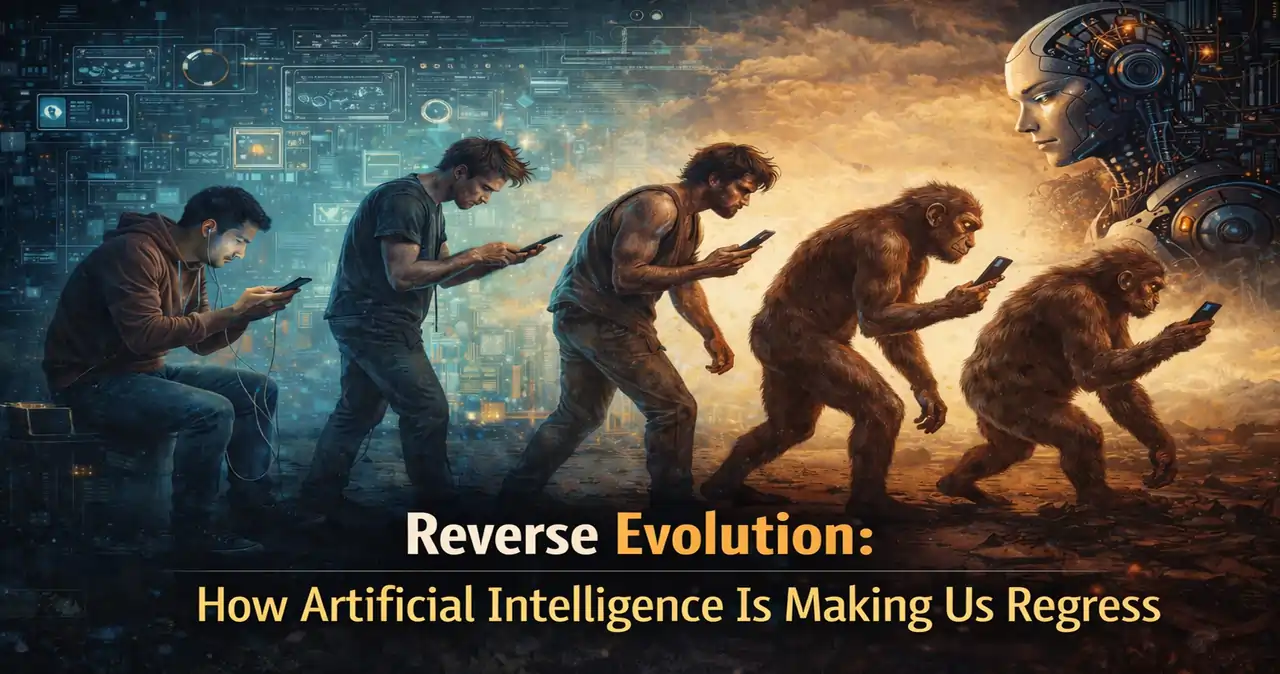
This is a paradox: the more advanced AI becomes, the weaker humans become. We call this phenomenon Reverse Evolution - a process where instead of progressing, we're regressing.
This article deeply explores this phenomenon: what skills have we lost? Why did this happen? What price are we paying for this "progress"? And the fundamental question: are we becoming a weaker version of ourselves?
The Concept of Reverse Evolution
Natural Evolution: Use It or Lose It
In nature, there's a simple law: Use it or lose it.
Natural examples:
Cave fish: Fish living in dark caves have gradually lost their eyes. Why? Because in complete darkness, eyes are useless and maintaining them costs energy. So over generations, their eyes became smaller and eventually disappeared.
Flightless birds: Birds like ostriches and penguins have lost the ability to fly. Why? Because in their living environment, flight was no longer necessary. Ostriches live in open plains with fewer predators, and penguins hunt in water, not air.
Modern humans: The same law is being applied to us. We're losing abilities we no longer use.
Difference Between Reverse Evolution and Natural Evolution
Natural evolution: Happens over thousands of years
Technological reverse evolution: Happens over a few decades
This speed is unprecedented. Within 50 years, we've lost basic cognitive and physical abilities that our ancestors acquired over millions of years.
Lost Skills: What Can't We Do Anymore?
1. Memory: We No Longer Memorize Anything
Before smartphones: People could:
- Recite dozens of phone numbers from memory
- Remember precise addresses
- Keep important information in mind
Today: Most people don't even know their own phone number by heart!
Shocking statistics: A 2023 study showed:
- 91% of people under 30 can't recite more than 3 phone numbers
- 71% of people can't say their phone number without looking at their phone
- Average memorized numbers dropped from 20+ in 1990s to less than 3 today
Science behind this: This is called Digital Amnesia or Google Effect. The human brain is an optimizer - if it knows information can be found elsewhere (phone, Google), it won't bother memorizing.
Neuroscience study: Columbia University researchers found that when people know information is saved on computer, their memory is 40% weaker. The brain memorizes the location instead of the information itself.
Consequence: We're becoming external memory - our brain only keeps an index of information, not the information itself. If servers go down one day, we'll have collective amnesia.
2. Navigation: We Can No Longer Find Our Way
Before GPS: People could:
- Read paper maps
- Find direction using sun and stars
- Memorize routes
- Have strong sense of direction
Today: Without GPS, most people get lost even in their own neighborhood!
Important scientific research: A 2017 UCL (London) study showed that London taxi drivers who work without GPS have larger hippocampus - the part of brain responsible for spatial memory.
But Uber drivers who depend on GPS don't have this brain growth. Constant GPS use causes hippocampus to shrink - meaning the brain is atrophying.
Practical experiment: Norwegian researchers left 30 people in forest and asked them to find their way without GPS:
- Generation 1950-1960: 87% could find their way
- Generation 1990-2000: Only 23% could find their way
- Generation 2000-2010: Only 9% could - rest got lost and needed help
Consequence: We're losing our spatial sense. This is a basic biological ability that was essential for survival for millions of years - and we've lost it in 20 years.
3. Mental Calculations: We Can No Longer Think
Before calculators: People could:
- Do quick addition and subtraction mentally
- Calculate two-digit multiplication in head
- Quickly calculate percentages
- Do division without calculator
Today: Many people need their phone to calculate 15% tip!
Horrifying statistics:
- 53% of university students can't calculate 15 × 12 without calculator
- 67% of adults use phone to calculate 10% discount
- Generation Alpha children (born 2010+) don't even memorize multiplication tables - because "calculator is always available"
MIT study: Researchers found constant calculator use causes weakening of prefrontal cortex - part of brain responsible for mathematical reasoning.
Real story: A math teacher in America reported: "I asked my students what 50 + 50 is? One of them took out their phone and said: 'Wait, let me check!' This is for a calculation a 6-year-old should know!"
Consequence: We're losing analytical thinking and logical reasoning. Mental math isn't just about numbers - it's about strengthening neural pathways essential for problem-solving.
4. Deep Reading: We Can No Longer Focus
Before internet: People could:
- Read a book for hours
- Understand complex texts
- Have deep focus
- Analyze information
Today: Most people can't read a long paragraph without distraction!
Stanford University research: Average attention span:
- Year 2000: 12 seconds
- Year 2013: 8 seconds
- Year 2024: 5.7 seconds (less than goldfish!)
"F-Pattern Reading" phenomenon: Using eye-tracking, researchers found people no longer read text line by line. They only:
- Read first line
- Read start of next few lines (F shape)
- Ignore the rest
Result: We miss 93% of information and think we've read it!
Neuroscience study: Deep reading rewires the brain and causes growth in areas like prefrontal cortex and hippocampus. But superficial reading (scrolling feeds) doesn't create this growth.
Long-term consequence:
Studies show new generation has
weaker critical thinking ability because they never learned
deep reading.
5. Social Skills: We Can No Longer Talk
Before social media: People could:
- Have deep face-to-face conversations
- Read body language
- Show empathy
- Have real social interaction
Today: Many people, especially
Gen Z and Alpha, are
incapable in face-to-face interactions.
Concerning statistics:
- 48% of Gen Z report feeling anxious at parties
- 61% prefer texting over calling
- 72% can't make proper eye contact
UCLA research: Teenagers who lived 5 days without digital devices were 50% better at recognizing emotions from faces. This shows technology reduces natural social skills.
Consequence: Social skills aren't just for "being nice." They're essential for collaboration, leadership, negotiation, and building relationships. A generation without these skills will struggle in work world and personal life.
6. Patience: We Can No Longer Wait
Before high-speed internet: People could:
- Wait
- Have patience
- Tolerate delay
Today: If a web page takes more than 3 seconds, we get stressed!
Microsoft study: People can no longer wait more than 8 seconds without clicking again or closing page.
Psychological consequence: Impatience isn't just about "annoyance." Research shows people who lack patience:
- Have less success in life
- Make poorer decisions
- Have more unstable relationships
Famous Marshmallow experiment: Children who could wait 15 minutes (to receive 2 marshmallows instead of 1) were more successful in adulthood. But new generation doesn't have this patience.
7. Creativity: We Can No Longer Create
Before AI: People had to:
- Come up with ideas themselves
- Be creative
- Solve problems
Problem: When you constantly use AI for ideation, your brain loses the creativity muscle.
Research: Students who constantly used AI for writing became 34% weaker in independent creativity after 6 months.
Consequence: We're becoming consumers, not creators. And in a world where AI can produce, the only valuable thing is truly human creativity - the very thing we're losing.
Table: Human 1950 vs. Human 2026
| Skill | Human 1950 | Human 2026 |
| Memory | 20+ phone numbers memorized | Less than 3 numbers (91% of people) |
| Navigation | Map reading, navigation by stars | Get lost without GPS (77% of people) |
| Mental math | Two-digit multiplication, percentages | Need calculator for simple calculations |
| Focus | 12 seconds (year 2000) | 5.7 seconds (less than goldfish!) |
| Reading | Deep reading, hours of books | Surface scanning, F-Pattern (93% info lost) |
| Social skills | Face-to-face conversation, body language | Social anxiety (48% Gen Z), no eye contact |
| Patience | Wait days/weeks for letter | Stress after 3 seconds waiting |
| Creativity | Independent ideation, problem solving | AI dependency, 34% weaker creativity |
This table shows a bitter reality: we've become weaker in all cognitive aspects.
Why Did This Happen? Causes of Reverse Evolution
1. Law of Minimum Effort: Brain Is Lazy
Human brain consumes 20% of body's energy, but is only 2% of body weight. This is very expensive!
Therefore, brain always tries to save energy. If a task can be done an easier way (like using GPS), brain avoids the harder way (learning the route).
Result: Every time you use technology instead of your brain, your brain becomes weaker.
2. Addictive Design: Technology Deliberately Addicts Us
Tech companies have entire teams whose job is to make products addictive:
Addiction techniques:
- Variable reward: You don't know when you'll see interesting post → like gambling
- Infinite scroll: Never "end" of page → can never stop
- Notifications: Instant dopamine → addiction
- FOMO (Fear of Missing Out): Fear of missing out → constant checking
3. Quick Replacement: Easy Way Always Available
In the past: If you didn't know something, you had to:
- Go to library
- Find book
- Study
This effort made you learn better and understand information more deeply.
Today: Just Google it and have answer in 2 seconds. This is easy, but creates superficial learning.
4. No Necessity: We No Longer Need These Skills
Question: Why memorize multiplication tables when we have calculator?
Answer: Because learning process is more important than final result.
Learning math creates neural pathways essential for logical thinking, problem-solving, and reasoning. When these pathways aren't built, brain remains weaker.
Long-term Consequences: What Will Happen?
1. Irreparable Generational Gap
Generation 1950-1980: Strong cognitive abilities, but less tech familiarity
Generation 1990-2010: Mix of traditional and digital skills
Generation 2010-2030: Complete technology dependency, weak basic skills
Problem: These generations don't share common language. Old generation says: "Why can't you read a map?" and new generation says: "Why should I when I have GPS?"
2. Vulnerability to Crises
Imagine tomorrow all servers shut down (cyber attack, natural disaster, war). What happens?
- People get lost (without GPS)
- Can't make calls (don't know numbers)
- Can't calculate (without calculator)
- Can't work (without internet)
We've become dependent on single point of failure. This is dangerous.
3. New Natural Selection: Survival of the Most Technological
In future, people with access to technology will be much more powerful than those without.
This creates new class divide:
- Upper class: Access to best AI, education, technology
- Lower class: No access, weaker, more dependent
4. Collapse of Basic Skills
Some skills are becoming extinct:
Skills becoming extinct:
- Handwriting (many children can't read cursive)
- Reading analog clocks
- Reading paper maps
- Mental calculations
- Face-to-face conversation without mediation
Question: Should we allow these skills to disappear?
Is This Bad? Two Perspectives
Perspective 1: This Is Progress, Not Regression
Argument: Tools have always been part of human evolution:
- When knife was invented, our teeth became weaker
- When writing was invented, our oral memory became weaker
- When car was invented, our legs were used less
Conclusion: Now it's brain's turn. We're outsourcing brain to AI, just like we outsourced legs to cars.
Question: Is this a problem? We no longer need strong legs for running - why should we need strong brain for calculation?
Perspective 2: This Is Dangerous
Argument: There's fundamental difference:
- When legs weakened, we could still walk
- But when brain weakens, we're less human
Conclusion: Human identity is in thinking, creativity, and reasoning. If we lose these, what remains?
Danger: We become
dependent on
AI systems outside our control. If one day these systems
aren't there or
act against us, we're
defenseless.
Solutions: How to Stop Reverse Evolution?
1. Teaching Basic Skills: Back to Basics
Schools should:
- Teach memorization again
- Make mental math mandatory
- Teach map reading
- Practice face-to-face conversation
Some countries have already started:
- Sweden: Tablet ban in elementary schools
- France: Phone ban in schools
- Japan: Emphasis on traditional handwriting
2. Conscious Technology Use: Optional, Not Mandatory
Principle: Use technology when necessary, not always.
Example:
- Use GPS for unfamiliar routes, not your neighborhood
- Use calculator for complex calculations, not 15+12
- Google for deep information, not things you can think about
3. Digital Detox: Regular Technology Breaks
Practical suggestions:
- One day per week without phone
- 2 hours in mornings without screens
- 2 hours before bed without digital
- Technology-free vacations: Trip without GPS, mobile, laptop
4. Brain Recovery Exercises
Your brain is plastic - meaning it can strengthen again. But needs practice:
Exercise 1: Memory
- Memorize 1 new phone number daily
- Memorize a poem or short text
- Remember important info without writing
Exercise 2: Navigation
- Find route without GPS once a week
- Use paper map
- Memorize neighborhood routes
Exercise 3: Calculations
- Do simple calculations mentally
- Calculate tip at restaurant without phone
- Review multiplication tables
Exercise 4: Focus
- 30 minutes deep reading daily without distraction
- 10-minute meditation
- One long task without checking phone
5. Raising New Generation: Teaching Balance
Children should be taught:
- Technology is tool, not brain replacement
- Basic skills are essential, even if technology exists
- Cognitive independence is valuable
6. Designing Healthier Technology
Tech companies should:
- Stop addictive design
- Build tools that strengthen, not replace
- Add health warnings
- Provide better parental controls
The Future: Three Scenarios
Scenario 1: Complete Reverse Evolution
In this scenario, current trend continues:
- Future generation has no basic skills
- Complete dependency on technology
- Severe vulnerability to crises
Result: Humans who can't function without technology - like biological robots waiting for commands.
Scenario 2: Awakening and Return
In this scenario, society realizes danger:
- Anti-digital movements
- Return to traditional skills
- Strict limitations on technology
Result: Healthier balance between technology and human abilities.
Scenario 3: Smart Integration
In this scenario, we find balanced combination:
- Use technology for enhancement, not replacement
- Preserve basic skills, but with advanced tools
- Teaching balance from childhood
This is probably the best and most realistic scenario.
Conclusion: We're at a Historic Turning Point
After deeply examining seven fundamental skills we're losing, a bitter reality becomes clear: we're becoming a weaker version of ourselves. AI, which was supposed to be our tool, is slowly becoming our replacement. But it's not too late - because unlike natural evolution that takes millions of years, technological reverse evolution is reversible, if we act today.
We're the first generation in human history deliberately losing our abilities.
This is not an accident, not a necessity - but a choice.
Question: Do we want future generation to be weaker or stronger?
Answer depends on our choices today:
- Do we teach children to think or just Google?
- Do we practice skills ourselves or just rely on technology?
- Do we preserve cognitive independence or accept digital slavery?
Remember: Reverse evolution is reversible - but only if we act now.
Technology should be our tool, not our replacement. And we must consciously choose which abilities to preserve and what to outsource.
Because ultimately, what makes us human isn't the technology we use - but the abilities we have.



 Social Impact & Future
 Social Impact & Future
 Social Impact & Future
 Social Impact & Future
 Social Impact & Future
 Social Impact & Future