Introduction
How many times have you checked your phone today? Ten times? Twenty? Fifty? If you don't know the exact number - and you probably don't - that itself is a sign. Research shows that on average, people check their phones 96 times a day - that's once every 10 minutes. Some up to 300 times a day!
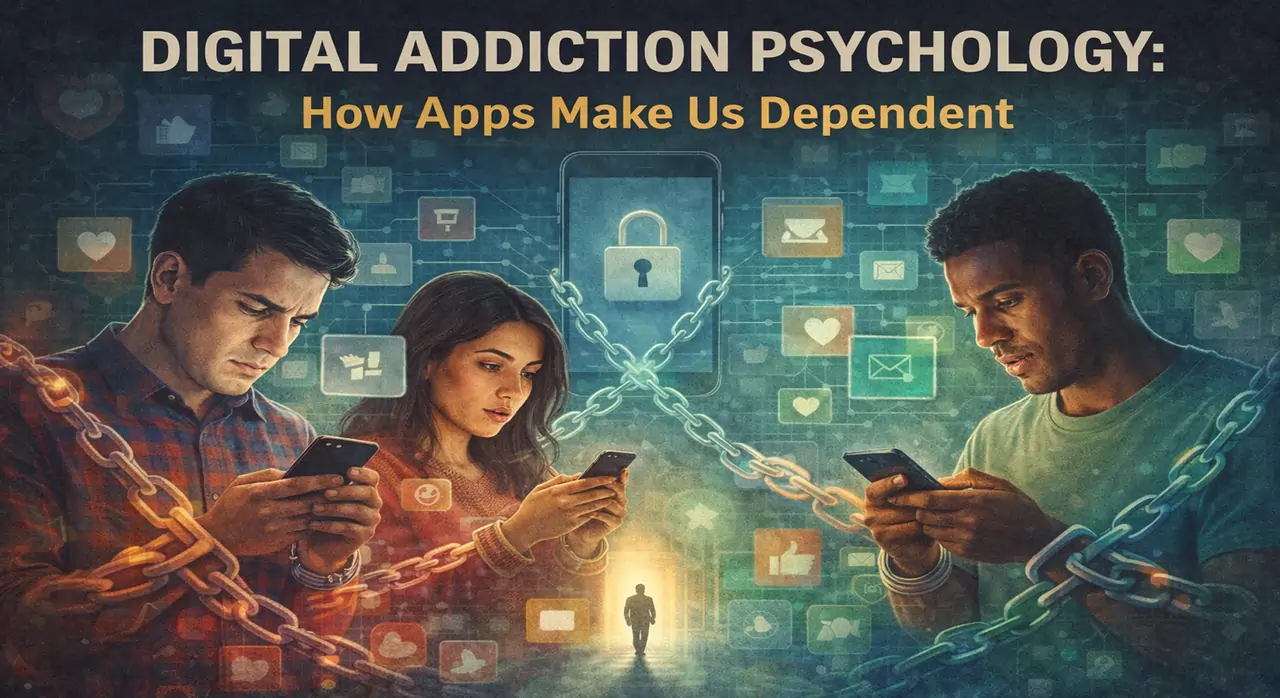
But this isn't just a harmless habit. It's a designed addiction. Tech companies spend billions hiring psychologists, UX designers, and neuroscientists to build apps that make you dependent. Every notification, color, sound, and animation is carefully designed to hack your brain.
This article not only explains how this addiction works but provides practical, scientific solutions for regaining control and treating this dependency. If you feel your phone has taken control of your life, this article is for you.
The Science of Addiction: How Our Brain Works
The Brain's Reward System and Dopamine
To understand how apps addict us, we first need to understand how addiction works in the brain. The key is a chemical called dopamine.
Dopamine is a neurotransmitter that plays a role in the brain's reward system. When you do something beneficial for survival - like eating food, drinking water, or social interaction - your brain releases dopamine. This good feeling makes you want to repeat that action.
But here's the interesting part: dopamine is released more in anticipation of reward than the reward itself. In other words, expecting something good is even better than the thing itself! This is exactly what apps exploit.
Variable Reinforcement: The Slot Machine Trick
In the 1930s, famous psychologist B.F. Skinner discovered that the most powerful type of learning is "Variable Reinforcement". He found that if you randomly reward a pigeon - sometimes it gets rewarded, sometimes not - the animal tries harder than when it always gets rewarded.
This is exactly what slot machines use. You don't know when you'll win, and this uncertainty addicts you. Now let's see how apps use this same trick:
- Instagram: When you refresh, you don't know what post you'll see - maybe a friend's photo, maybe a funny meme, maybe nothing. This uncertainty makes you refresh again and again.
- Tinder: Every swipe, you don't know if you'll Match or not. It's the same slot machine mechanism!
- YouTube: The algorithm can make the next video super interesting or boring - you don't know. So you keep watching.
- Notifications: Every time you hear a notification sound, you don't know what it is - maybe a like, maybe an important comment, maybe worthless spam. But this uncertainty makes you check.
This mechanism is more powerful than any other method and makes your brain dependent. Research shows variable reinforcement can be even more powerful than drugs!
The Habit Loop: Trigger → Action → Reward
Nir Eyal, author of the famous book "Hooked," provided a model for building habit-forming products that almost all successful apps use:
1. Trigger: A notification, a specific feeling (like boredom or loneliness), or a situation (like morning after waking up)
2. Action: Opening the app, scrolling, posting
3. Reward: Likes, comments, new content, social validation
4. Investment: The more time and energy you invest (posting, gaining followers, building playlists), the more likely you'll return
This loop becomes stronger each time it repeats until it becomes automatic. You no longer think - you just instinctively pick up the phone.
Manipulation Techniques: Dark Patterns and Harmful UX
1. Infinite Scroll
One of the most destructive techniques is Infinite Scroll. Previously, websites had pagination - you'd see page 1, then click "next." This was a natural stopping point.
But now the feed is infinite. There's no end. You keep scrolling and new content loads. This means removing the stop cue. Your brain never receives the "it's finished" signal.
This technique was invented by Aza Raskin, former Firefox designer. He later regretted this invention, saying: "I feel responsible for wasting millions of hours of human life."
2. Autoplay
YouTube, Netflix, and most video platforms use Autoplay. When one video ends, the next automatically starts - even if you don't want it.
Why do they do this? Because behavioral inertia - stopping an action is harder than continuing it. When a video autoplays, you must actively decide to stop it. Most people don't.
Netflix even shows a countdown - "Next video in 5... 4... 3..." - creating urgency and pressuring you.
3. Strategic Notifications
Notifications aren't sent randomly. They're carefully timed for maximum impact:
- Low-activity times: If you haven't opened the app for hours, you get a notification - "Mimi mentioned you!" or "New posts waiting for you!"
- Dopamine peaks: When a post is popular, the app sends notifications one by one (not all at once) so you receive multiple dopamine hits
- FOMO (Fear of Missing Out): "5 people are watching your live!" or "Your friends are chatting!"
Even notification color matters. Most apps use red - a color the human brain recognizes as "urgent" and "important." This is an evolutionary signal in our genes since caveman days (red = danger = immediate attention).
4. Social Validation and FOMO
Humans are social creatures. We deeply care about others' opinions. Apps have weaponized this fundamental need:
- Likes and hearts: Each like is a dopamine dose. Research shows receiving likes activates the same brain regions as money and chocolate!
- Seen/Read receipts: Showing "seen" creates anxiety - why haven't they replied?
- Online/Offline status: Seeing who's online makes you check more
- Stories with timers: "This story disappears in 24 hours!" - creating FOMO
- Streaks on Snapchat: "You have a 50-day Streak! Don't lose it!" - creating commitment
5. Addictive UI Design
Even the visual design of apps is optimized for addiction:
- Bright colors: Red, orange, bright blue - colors that grab attention
- Satisfying animations: When you like, you see a beautiful animation - visual reward
- Pull-to-Refresh: The pulling motion to refresh is similar to pulling a slot machine lever - same feeling!
- Notification sound: Specific sounds your brain learns to associate with dopamine
- Badge numbers: Red number on icon - "47 unread notifications" - creating compulsion to clear
All these elements are carefully designed and A/B tested by
UX teams to maximize addiction.
Real Impacts of Digital Addiction
1. Neural and Cognitive Effects
Digital addiction isn't just a "bad habit" - it physically changes your brain:
Gray matter reduction: Research shows excessive phone use can reduce gray matter volume in specific brain areas - the same areas damaged in drug addiction.
Impulsivity control disorder: Continuous phone use weakens the Prefrontal Cortex (brain area responsible for decision-making, impulse control, and planning). This is the same area weakened in drug addicts.
Memory and focus reduction: University of Texas studies show that just the presence of a phone in the room - even if turned off - reduces your cognitive ability. This is called "Cognitive Drain."
Deep thinking ability reduction: Nicholas Carr in his famous book "The Shallows" explains how the internet rewires our brains for "surface reading" and "scattered attention." We can no longer think deeply and focused.
2. Psychological and Emotional Effects
Increased depression and anxiety: Multiple studies show excessive social media use is linked to increased depression and anxiety rates - especially in teenagers and young adults.
Social comparison: Social media only shows the best moments of others' lives. This makes your own life seem lacking. This is called "Social Comparison."
Loneliness: Paradoxically, social media that's supposed to connect us actually increases loneliness. Online interactions are superficial and don't replace real interactions.
FOMO (Fear of Missing Out): Constant fear of missing something important. This ongoing anxiety can be paralyzing.
Nomophobia: Fear of being without phone (NO MObile PHOne phoBIA). This has become an official phobia!
The psychological effects of digital addiction are being studied by
AI in psychology.
3. Social and Relationship Effects
Phubbing: Combination of "Phone" + "Snubbing" - ignoring someone with you because of your phone. This can seriously damage relationships.
Conversation quality reduction: Even when the phone is on the table (without being used), conversation quality decreases. People talk less deeply.
Impact on children: Children whose parents constantly hold phones have more behavioral and emotional problems. They feel their parents aren't "present."
Empathy reduction: Excessive digital space use causes reduced ability to empathize and understand others' feelings. This is related to
declining social skills.
4. Physical Effects
Sleep disorders: Screen blue light disrupts melatonin (sleep hormone) production. Phone use before bed severely reduces sleep quality.
Text Neck: Constantly bending the neck to look at the phone can cause serious neck and spine damage.
Eye problems: Constant screen staring can cause eye fatigue, dryness, and vision problems.
Reduced physical activity: Every hour you scroll is an hour you can't exercise or be physically active.
Signs of Digital Addiction: Are You Addicted?
How can you tell if your use has gone from normal to addiction? Here are key signs:
Digital Addiction Self-Assessment Test
Answer "Yes" or "No" to each question:
- Is the first thing you do in the morning check your phone?
- Do you always keep your phone accessible - even in the bathroom or while sleeping?
- When you forget your phone, do you feel anxious or panicked?
- Do you spend more than 3 hours a day on social media?
- Have you ever had or nearly had an accident because of phone use?
- Do people close to you complain you're on your phone too much?
- Do you check your phone at restaurants, movies, or while talking to others?
- Have you tried many times to reduce phone use but failed?
- Do you feel you must constantly be "in the loop" and check news?
- Do you check your phone before bed and immediately after waking?
- When you receive a notification, can't you resist checking immediately?
- Even when you have important work, do you repeatedly check your phone?
Results:
- 0-3 Yes: Relatively healthy use
- 4-6 Yes: Early signs of dependency - be cautious
- 7-9 Yes: Moderate dependency - need serious changes
- 10+ Yes: Severe addiction - need professional help
Behavioral Signs
- Phantom Vibration Syndrome: You feel your phone vibrated but it didn't
- Anxiety without phone: Severe worry when phone isn't nearby
- Compulsive checking: Checking phone for no specific reason, just habit
- Multi-screening: Using multiple devices simultaneously (phone + laptop + tablet)
- Ignoring responsibilities: Delaying tasks because of phone use
Practical Solutions: How to Break Free from Digital Addiction
Level One: Immediate Simple Changes
1. Turn Off Notifications
This is the simplest and most effective step. Turn off all notifications - except truly necessary ones (calls, messages from important people).
How:
- iOS: Settings > Notifications > Each app > Turn off Allow Notifications
- Android: Settings > Apps > Each app > Notifications > Off
Or better, only turn on important notifications and disable the rest. Good rule: if it's not truly important, it shouldn't notify.
2. Remove Badge Numbers
Turn off those red numbers on icons. They only create stress.
iOS: Settings > Notifications > Each app > Turn off Badges
Android: Settings > Apps > Notifications > Turn off Notification dots
3. Convert Screen to Grayscale
Colors excite the brain. Converting the screen to black and white makes it more boring and you'll be less addicted.
iOS: Settings > Accessibility > Display & Text Size > Color Filters > Grayscale
Android: Settings > Accessibility > Color & motion > Color correction > Grayscale
4. Delete Addictive Apps
The most ruthless but most effective way: completely delete apps that take the most time. If you can't completely delete, remove them from the home screen to make access harder.
You can use the web version (which is usually less addictive) or set specific times for use.
Level Two: Tools and Technology
5. Use Screen Time / Digital Wellbeing
Both operating systems have built-in time management tools:
iOS - Screen Time:
- Settings > Screen Time > Enable
- Set App Limits (e.g., 30 minutes per day for Instagram)
- Enable Downtime (times when only essential apps work)
- Communication Limits to restrict calls
Android - Digital Wellbeing:
- Settings > Digital Wellbeing > Enable
- App timers to limit time
- Focus mode to block distracting apps
- Bedtime mode for better sleep
6. Third-Party Tools
More powerful tools for greater control:
- Freedom: Block websites and apps on all devices
- Forest: Gamification - a virtual tree grows when you don't use your phone
- Opal: Smart blocking based on location and time
- One Sec: Take a deep breath before opening an app - this small "pause" breaks compulsion
- Flipd: Lock phone for specified time
7. Change App Settings
Within apps themselves:
- YouTube: Turn off Autoplay
- Instagram: Enable "You're All Caught Up"
- Facebook: News Feed Preferences > Prioritize who to see first (only close friends)
- Twitter: Make Timeline Chronological instead of algorithmic
Level Three: Behavioral and Environmental Changes
8. "Time and Place" Rules
Set strict rules for phone use:
- No Phone Zones: Bedroom, dining table, bathroom
- No Phone Times: 1 hour before bed, 1 hour after waking, while talking to others
- Phone-Free Mornings: Don't check phone until 10 AM
- Weekend Detox: Only 30 minutes per day on weekends
9. Healthy Alternatives
When you'd normally pick up your phone, instead:
- Read a physical book
- Meditate
- Exercise
- Talk to real people
- Offline hobbies (painting, music, puzzles)
The key is to fill the void. If you just put down the phone without replacement, you'll likely return.
10. Change Physical Environment
- Keep phone away: In another room, in drawer, in bag
- Remove charger from bedroom: You'll have to charge outside
- Buy a real alarm clock: No need for phone by your bed
- Put book by bed: Instead of phone
Level Four: Mental and Philosophical Changes
11. Mindfulness and Awareness
Practice conscious use: Before opening phone, ask yourself:
- Why do I want to open my phone now?
- What specific purpose do I have?
- Is this truly important or just habit?
This small pause breaks compulsion.
12. Redefining Relationship with Technology
Technology is a tool, not a goal. Ask yourself:
- Does this tool help or hinder me?
- Does this app add value to my life?
- If this app didn't exist, how would my life be?
13. Understanding "Real Cost"
Every hour you spend on social media is an hour you could have:
- Learned a new skill
- Read a book
- Spent time with loved ones
- Worked on real goals
Digital Detox: 30-Day Recovery Program
Here's a step-by-step 30-day program for recovering from digital addiction:
Week 1: Awareness and Measurement
- Days 1-3: Just observe. Use Screen Time and see exactly how much time and where you spend it. Make no changes - just be aware.
- Days 4-7: Turn off all notifications (except essentials). Make screen Grayscale.
Week 2: Initial Limits
- Days 8-10: Set App Limits: 30 minutes for social media
- Days 11-14: Implement No Phone Zones: bedroom and dining table
Week 3: Major Changes
- Days 15-17: Delete addictive apps or move to other pages
- Days 18-21: Phone-Free Mornings: No phone until 10 AM
Week 4: Building New Habits
- Days 22-25: Find healthy alternatives - books, exercise, hobbies
- Days 26-30: One full day Digital Detox - no phone for 24 hours
After 30 Days
Long-term commitment: Set permanent sustainable rules. The goal isn't "zero use" - the goal is conscious and controlled use.
Professional Help: When Do You Need It?
Sometimes addiction is so severe it requires professional help. Take these signs seriously:
- Phone addiction has caused job loss, relationship damage, or missed important opportunities
- You have severe depression or anxiety related to phone use
- You've tried multiple times to control it but failed
- Digital addiction is combined with other addictions (substances, alcohol, gambling)
- You have self-harm or suicidal thoughts
Where to get help:
- Addiction specialist psychologists: CBT (Cognitive Behavioral Therapy) for behavioral addictions is very effective
- 12-step programs: Groups like "Internet & Technology Addicts Anonymous"
- Specialized clinics: Some countries have specialized clinics for digital addiction
- Teletherapy: Online sessions with psychologist
The Future: Will It Get Worse?
Emerging Technologies That Intensify Addiction
Unfortunately, technology is advancing, and so is addiction:
- AR/VR glasses: When technology attaches to your eyes, escape becomes harder
- Personalized AI: Language models that know you better than yourself
- Brain-Computer Interface: Direct brain-technology connection
- Metaverse: Virtual worlds more attractive than reality
But There's Hope Too
The good news is awareness is increasing:
- Time Well Spent movement: Pressure on companies for more ethical design
- New laws: Some countries are passing laws to limit addictive techniques
- Education: Schools are starting to teach "digital literacy" and AI education to children
- Better tools: More apps and tools to help with control
Conclusion: Taking Back Control
Digital addiction is a designed disease. Tech companies deliberately built products to make you dependent - because their business model is based on your attention. Every second you stay in an app is money for them.
But you have the power of choice. By understanding the mechanisms of this addiction - dopamine, variable reinforcement, Dark Patterns - you can consciously resist.
Key points:
- Digital addiction is real and physically changes your brain
- Notifications, infinite scroll, and autoplay are deliberately designed for addiction
- Effects on mental health, relationships, and cognitive performance are serious
- Practical solutions exist - from simple (turning off notifications) to complex (30-day detox)
- Sometimes professional help is needed - and that's not a flaw
Remember: the goal isn't "zero technology." Technology is a powerful tool that can improve life. The goal is for you to have control, not technology.
All three articles share one common message: awareness, conscious choice, and action. By understanding how systems work, you can make better decisions. By acting, you can take back your life.
Life outside the screen awaits you. Are you ready to experience it?



 Social Impact & Future
 Social Impact & Future
 Social Impact & Future
 Social Impact & Future
 Social Impact & Future
 Social Impact & Future