Introduction
It's 5 AM. Your phone rings. The Uber app has found a ride. You must immediately wake up, get in your car, and go to coordinates determined by the AI system. The route is determined by the algorithm. The price is determined by the algorithm. Whether you earn enough money today depends on AI algorithms. And if a customer gives you a low rating, the system might fire you.
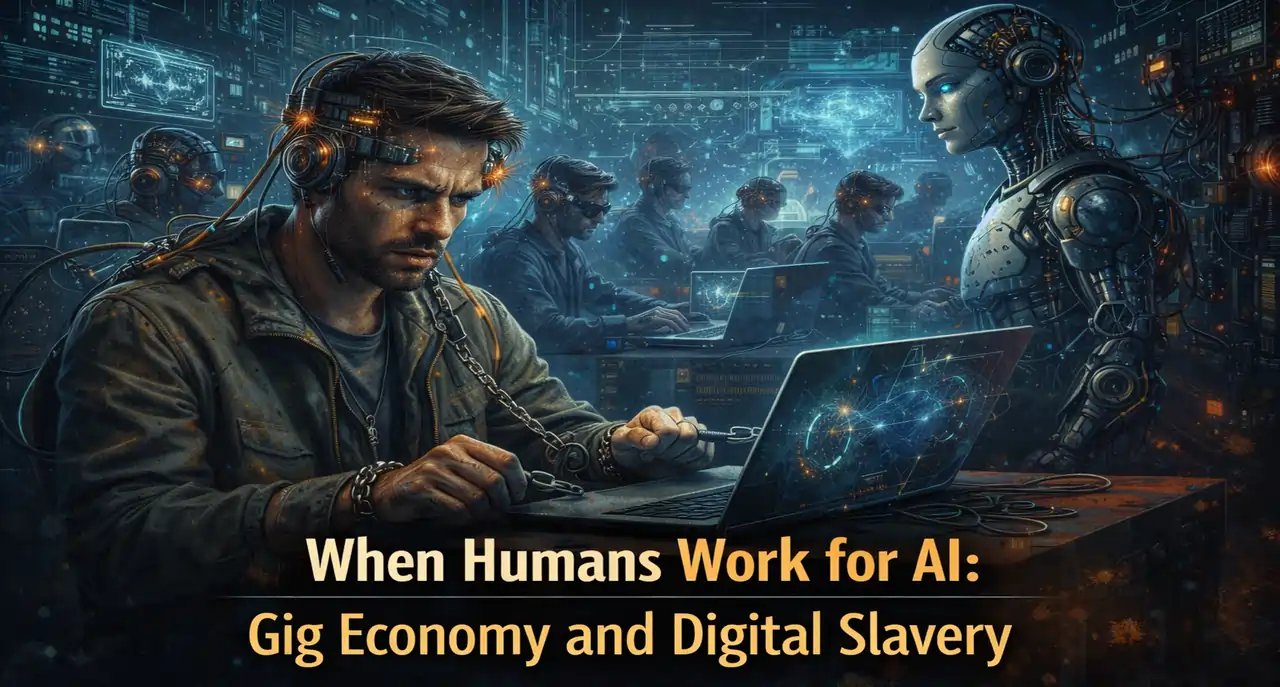
Welcome to the Gig Economy - a world where humans no longer work for other humans, but work for artificial intelligence systems. A world where you're called an "independent contractor," but in reality you have less control over your life than a regular employee.
This article deeply explores this phenomenon: how have AI and algorithms become the new managers of the workforce? Why has the gig economy, which was supposed to bring "freedom," actually created a new form of slavery? And the fundamental question: are we building a world where humans work for intelligent machines?
What is the Gig Economy?
Definition: Work Without Job Security
Gig Economy refers to an economy where instead of having full-time jobs with permanent contracts, people do temporary, project-based, or freelance work.
Famous examples:
- Uber and Lyft: Driving
- Delivery: Food delivery (Uber Eats, DoorDash)
- Amazon Flex: Package delivery
- TaskRabbit: Odd jobs
- Fiverr and Upwork: Online work
- Instacart: Grocery shopping and delivery
Global statistics: By end of 2024, over 1.5 billion people worldwide are somehow active in the gig economy - about 20% of global workforce.
Initial Promise: Freedom, Flexibility, Independence
When Uber launched in 2009, it made attractive promises:
✨ "Be your own boss" - No more manager yelling at you
✨ "Work whenever you want" - Complete flexibility in hours
✨ "Unlimited income" - The more you work, the more you earn
✨ "Financial freedom" - Choose your own path
These promises attracted millions of people. People tired of traditional jobs, people needing extra income, and people seeking a freer lifestyle.
Bitter Reality: Digital Slavery
But a few years later, reality was something else:
❌ "Be your own boss" → AI is your boss
❌ "Work whenever you want" → If you don't work, income is zero
❌ "Unlimited income" → Most gig workers are below poverty line
❌ "Financial freedom" → Complete financial insecurity
AI: The New Invisible Manager
In traditional economy, your manager was human - you could talk to them, negotiate, and ask for explanations of their decisions. But in gig economy, your manager is an AI system that never sleeps, never feels, and never explains. This invisible manager controls every aspect of your work - from pricing to performance evaluation - without ever seeing you even once.
Complete Control Without Physical Presence
The fundamental difference between gig economy and traditional work is that your manager is AI systems, not a human. These systems:
✓ Decide what work to give you
✓ Determine how much you get paid
✓ Design your route
✓ Evaluate your performance
✓ Can fire you
And the worst part: You cannot negotiate with AI. You can't ask it to give you better conditions. You can't ask it to explain why you were fired. AI systems are a black box ruling over your fate.
Real Example: Uber Driver
Let's see an ordinary day in the life of an Uber driver:
6:00 AM: Phone rings. Uber's algorithm found a ride with surge pricing (higher price due to high demand). You must accept quickly, or it goes to another driver.
6:15 AM: The AI system determines the route. If you deviate from the suggested route, your rating decreases.
7:00 AM: Passenger gives you 4 stars (instead of 5). Reason? Unclear. But this rating affects your overall rank.
12:00 PM: The pricing algorithm detects demand has decreased. Surge pricing removed. Your income suddenly halves.
6:00 PM: Your rating dropped from 4.7 to 4.6. The system warns: "If your rating falls below 4.5, your account will be deactivated."
10:00 PM: After 16 hours of work, your income is $120. After deducting gas, car depreciation, and Uber commission, your net income is $40. That's $2.5 per hour.
Was this freedom? Or digital slavery?
Characteristics of Digital Slavery
Digital slavery is a new form of exploitation that comes dressed in "freedom" and "flexibility." In this system, you're apparently "your own boss," but in reality every move, every decision, and every moment of your life is controlled by algorithms. This section examines five key characteristics of this modern form of slavery - from control without responsibility to algorithmic exploitation.
1. Control Without Responsibility
Gig economy companies have complete control over workers, but no responsibility toward them:
Controls (via AI):
- Price setting
- Route determination
- Performance evaluation
- Automated firing
No Responsibility:
- No insurance
- No leave
- No retirement
- No job security
Smart legislation: These companies call workers "independent contractors" to avoid paying benefits. But in practice, these people are employees working under complete control of intelligent systems.
2. 24/7 Surveillance: Digital Big Brother
At Uber:
- GPS location continuously
- Driving speed
- Sudden braking
- How fast you answer calls
- How fast you accept rides
At Amazon:
- How fast you collect packages
- How many steps per hour you take
- How many times you go to bathroom
- How much time you spend resting
Result: Constant feeling of being watched. Chronic stress. Mental burnout.
3. Endless Competition: Never Enough
The gig economy is a ruthless competitive system managed by AI:
- If your rating is 4.6, someone with 4.8 gets the ride
- If you don't accept the request, another driver will
- If you get sick, your replacement is ready
Result: You can never rest. You can never say "no". Because if you do, your income becomes zero.
4. Economic Insecurity: Today Work, Tomorrow Bread
One of the worst aspects of the gig economy is unpredictability:
- Today you might earn $200, tomorrow $20
- Today you have many rides, tomorrow none
- Today the system is kind to you, tomorrow it deactivates you
Real example: Many Uber drivers report that without prior warning their account was deactivated and they received no explanation. They don't know why they were fired and have no way to appeal.
5. Algorithmic Exploitation: Hidden Commissions
Interesting note: When Uber started in 2009, its commission was 20%. Today Uber's commission is between 25% to 40% - and in some cases up to 50%!
Calculation example:
- Passenger pays $30
- Uber takes $12 commission (40%)
- Driver receives $18
- After deducting gas and depreciation ($5), driver has $13 net income
Meaning the driver receives only 43% of passenger's money. The rest goes to the company and AI system.
Comparison Table: Traditional Work vs. Gig Economy
| Feature | Traditional Work | Gig Economy |
| Contract | Permanent or fixed-term | Temporary, project-based, no security |
| Salary | Fixed monthly, predictable | Variable, unpredictable, AI-dependent |
| Insurance | Health, accident, unemployment insurance | No insurance |
| Leave | Annual, sick, maternity leave | No leave - no work, zero income |
| Working hours | Fixed (8 hours per day) | Unlimited - the more you work |
| Manager | Human - negotiable | AI - non-negotiable |
| Job security | High - termination laws | Zero - automated AI firing |
| Retirement | Retirement fund, pension | No retirement plan |
| Right to appeal | Unions, labor court | Almost none - only request review |
This table clearly shows that the gig economy has eliminated all labor rights, but maintained all control.
Real Examples from Different Industries
1. Amazon Warehouse Workers: Humans as Robots
Amazon warehouse workers are one of the most vivid examples of slavery by AI:
How AI systems control?
- Rate (work rate): Algorithm determines you must collect how many packages per hour. Usually this number is 300+ packages per hour.
- Time Off Task: If you're inactive for more than 6 minutes (even for bathroom!), the system gives a warning.
- Smart routing: AI system determines exactly your path in the warehouse. If you deviate, your score decreases.
Real report: An Amazon worker said: "I feel like a robot. AI tells me where to go, what to do, how fast to be. I'm just a piece in the machine."
Shocking statistic: Injury rate in Amazon warehouses is double the industry average. Why? Because the algorithm demands workers work at inhuman speed.
2. YouTubers: Slaves of YouTube Algorithm
Many think being a YouTuber is free and creative work. But reality is something else:
Algorithm control:
- What content to create: Algorithm determines what content is "recommendable"
- How long should it be: 8-15 minute videos get most views
- What title to use: Must be "clickbait" for algorithm to promote
- What thumbnail to use: Must be shocked or exciting face
Result: YouTubers no longer create content for audience, but for algorithm. Real creativity has given way to "AI optimization".
Real story: A famous YouTuber said: "I no longer know what I want to create. I only know what the algorithm wants. I'm an algorithm slave."
3. Instagram Influencers: Golden Cage
Influencers appear free and successful. But they're prisoners of the algorithm:
Instagram algorithm control:
- What posts to make: "Engagement-worthy" content - usually controversial, emotional, or polarizing
- When to post: Algorithm prefers specific hours
- How often: Must post daily for algorithm to consider you "active"
- Who to interact with: Must constantly comment and reply
Psychological pressure: Many influencers suffer from burnout, anxiety, and depression. Because they can never rest. If they don't post for one day, the algorithm marks them "inactive" and their views plummet.
Real example: An influencer with 2 million followers said: "I'm living in a golden cage. From outside everyone thinks I'm free, but I'm an algorithm slave."
4. Uber Eats and Deliveroo Drivers: Cycling in a Storm
Food delivery drivers perhaps have the worst gig economy conditions:
Challenges:
- Very low pay: Usually $3-5 per delivery
- High costs: Gas, vehicle depreciation, repairs
- Hard physical work: Cycling or motorcycling in all weather
- Accident risk: Without insurance
Real story: In 2020, a Deliveroo driver in London had a heart attack while working and died. The company accepted no responsibility and told his family: "He was an independent contractor, not our employee."
Real income calculation:
- 10 trips per day × $4 = $40
- 8 hours of work
- After deducting expenses (gas, depreciation): $25
- Hourly income: $3
This is less than legal minimum wage!
Social Consequences: Polarized Society
Gig economy is creating a deep class divide that splits society into two completely different groups: those who control algorithms, and those who are controlled by algorithms. This division is becoming the biggest social challenge of the 21st century - from increasing inequality to middle class collapse and collective mental health crisis.
Increasing Inequality
The gig economy is creating a deep class divide:
Upper class: People who control AI systems
- Tech company executives
- AI developers
- Investors
Lower class: People who are controlled by AI
- Drivers
- Warehouse workers
- Delivery workers
- Freelancers
Statistics: In America, the wealthiest 10% control 70% of country's wealth. This gap is increasing.
Collapse of Middle Class
The gig economy is destroying the middle class:
Before: People with one full-time job could buy a house, have a car, raise children, and save for retirement.
Now: People with 2-3 gig jobs simultaneously can barely pay rent and daily expenses.
Shocking statistic: Over 50% of gig economy workers cannot save $400 for an emergency expense.
Mental Health Crisis
Working in the gig economy has destructive effects on mental health:
Chronic stress: Constant worry about income
Anxiety: Job insecurity
Depression: Feeling worthless and lack of control
Burnout: Overwork without rest
Study: Gig economy workers are twice as likely as traditional employees to suffer from depression and anxiety.
Is There a Solution?
The good news is it's not too late. Around the world, workers, activists, and legislators are searching for solutions to this crisis. From EU protective laws to digital labor unions and cooperative platforms - there is hope for a better future. This section examines six practical solutions that can restore the balance of power between humans and AI.
1. Protective Laws: Recognizing Worker Rights
European Union is passing laws that:
- Recognize gig workers as employees
- Mandate minimum wage payment
- Provide insurance and benefits
- Algorithm transparency
California - AB5 law: This law tried to recognize gig workers as employees, but Uber and Lyft, by spending $200 million on advertising campaign, managed to get an exemption.
2. Transparent and Interpretable Algorithms
Workers have the right to know:
- How algorithm makes decisions
- Why their rating decreased
- How they can improve
3. Digital Labor Unions
Gig economy workers are organizing:
Examples:
- Rideshare Drivers United (USA)
- Independent Workers Union of Great Britain (UK)
- Riders Union (Australia)
These unions fight for:
- Minimum wage
- Insurance
- AI transparency
4. Cooperative Platforms: Worker Ownership
A radical solution: Platforms owned by workers, not capitalist companies.
Examples:
- Stocksy: A photography platform owned by photographers
- Fairmondo: A cooperative marketplace
- Up&Go: A home cleaning platform owned by workers
In this model, profits are distributed among workers, not going to shareholders.
5. Universal Basic Income (UBI)
Some economists suggest universal basic income as solution:
Idea: Every citizen receives a fixed monthly amount, regardless of working or not.
Advantages:
- Economic security
- Negotiating power with employers
- Ability to choose work
Challenge: How to finance it?
6. Education and Skills Training
To survive in the gig economy era, you need new skills:
Essential skills:
- Digital skills
- Financial literacy
- Negotiation
- Time management
- Mental health
The Future: Where Are We Going?
The future of gig economy is in our hands, not in algorithms' hands. Three different scenarios lie ahead: increased AI control and transformation into dystopian society, digital labor revolution and overthrow of current system, or finding smart balance between technology and humanity. The choice is ours - and the time to decide is now.
Scenario 1: Increased AI Control
In this scenario, AI systems become more powerful:
- More advanced AI that can control all aspects of work
- Robotics replacing human workers
- Widespread unemployment
Danger: A dystopian society where the majority of people are unemployed and dependent on government assistance.
Scenario 2: Digital Labor Revolution
In this scenario, workers rise up:
- Widespread strikes
- Passage of strong protective laws
- Overthrow of current gig economy model
Possibility: If workers unite, they can seize power.
Scenario 3: New Balance
In this scenario, a balance forms:
- Protective laws but not too strict
- More transparent algorithms
- Cooperative platforms alongside capitalist platforms
- Limited basic income
This is probably the most realistic scenario.
Conclusion: Should We Work for AI?
Short answer: No.
But long answer: Unfortunately, we're moving toward a world where humans work for AI systems, not for other humans.
This isn't a choice that happened randomly. This is the result of an economic system that prefers profit over humanity.
But it's not too late. We can:
- Become aware: Understand how AI controls us
- Unite: Workers must cooperate, not compete
- Legislate: Pressure governments to pass protective laws
- Build alternatives: Create cooperative and ethical platforms
Final question: Do we want to build a world where humans work for intelligent machines? Or a world where intelligent machines work for humans?
The choice is ours - while we can still choose.
Remember: Technology is not neutral. Technology is a tool of power. And the question is who holds this power - humans or AI?


 Social Impact & Future
 Social Impact & Future
 Social Impact & Future
 Social Impact & Future
 Social Impact & Future
 Social Impact & Future