Introduction
Imagine standing on a vast mountain range. In one direction, the ground slopes downward, and in another, it slopes upward. You're standing precisely on a saddle point - a place that's simultaneously a valley and a peak! If you only look in one direction, you think you've reached an optimum, but if you turn your head, you see there's another path for descending.
This is exactly the challenge that
deep learning models face. In our previous article about
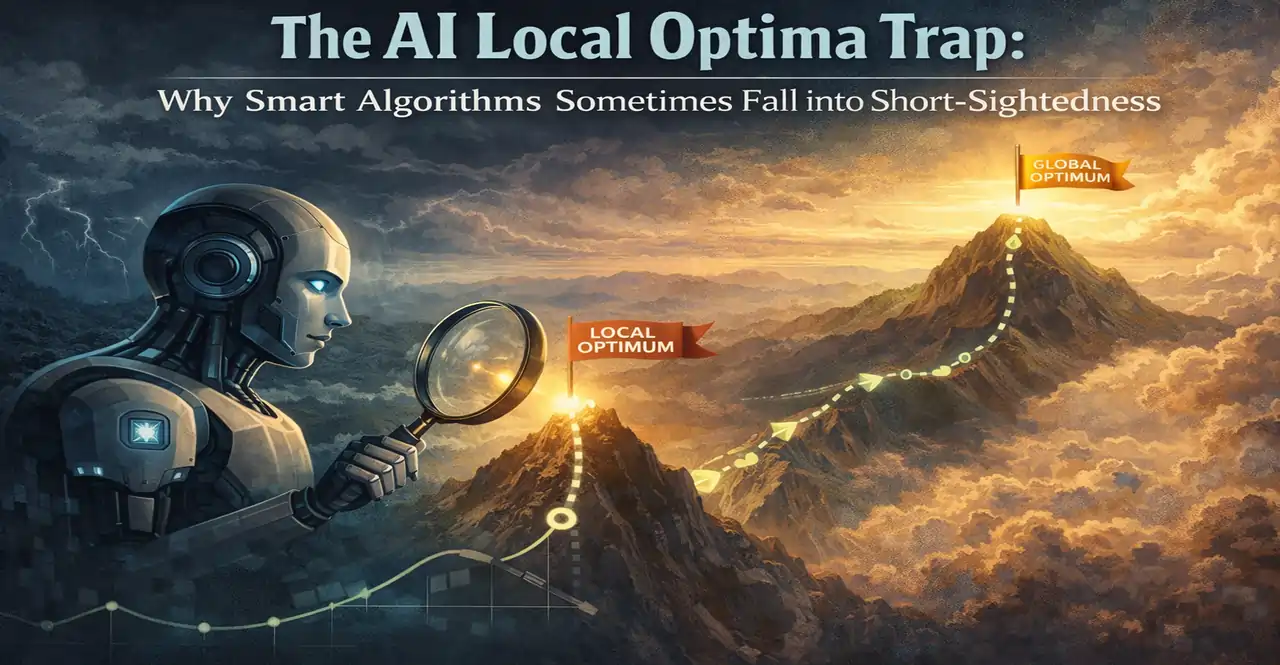
the local optima trap, we discussed one challenge, but today we want to reveal a more hidden secret:
saddle points.
Recent research has shown that in modern
deep neural networks, saddle points are a bigger problem than local optima! This discovery has completely changed our understanding of optimization challenges in
artificial intelligence.
What is a Saddle Point and Why Does It Matter in Deep Learning?
Mathematical and Intuitive Definition
A saddle point is a point that's a minimum in some directions and a maximum in others. Simply put: you're standing in a valley, but if you rotate 90 degrees, you're on a peak!
Real Example: Imagine you have a Pringles chip. If you move your finger from the center to the edges, you go down (minimum), but if you go from one side to the other, you go up (maximum). The center of the chip is a perfect saddle point!
Fundamental Difference from Local Optima
| Feature | Local Optimum | Saddle Point |
| Gradient Behavior | Gradient is zero | Gradient is zero |
| Movement Direction | All directions go up | Some directions down, some up |
| Escaping It | Very difficult | Easier with proper techniques |
| Count in Deep Networks | Few (relatively rare) | Very many (common) |
| Hessian Matrix | Positive definite | Indefinite (positive and negative eigenvalues) |
| Effect of Dimensionality | Decrease with increasing dimensions | Exponentially increase with dimensions |
Why Are Saddle Points Everywhere in High Dimensions?
This is one of the most amazing discoveries in deep learning theory! Mathematical research has shown that:
Theorem: In an N-dimensional space, the probability that a random critical point (where gradient is zero) is a saddle point exponentially increases with N.
Computational Example:
- In 10 dimensions: about 90% of critical points are saddle points
- In 100 dimensions: over 99.9% of critical points are saddle points
- In GPT-3 with 175 billion parameters: virtually all critical points are saddle points!
This means in real
deep neural networks, you almost never encounter a true local optimum - but rather an ocean of saddle points!
Why Are Saddle Points Problematic?
1. Severe Training Slowdown (Training Plateaus)
When an algorithm approaches a saddle point, gradients become very small (near zero). This causes:
- Learning speed drastically decreases: The model might stay in an area for hours or even days without significant progress
- Wasted computational resources: Expensive GPUs are busy computing but the model makes no progress
- Early stopping errors: Monitoring systems might think the model has converged and stop training
Real Example: In training
Transformer models like BERT, Google researchers observed that in early layers, the model stayed in plateaus for thousands of iterations. This was due to saddle points, not local optima.
2. Vanishing Gradients Problem
Near saddle points, gradients not only become small but cancel out in different directions. This in
recurrent neural networks and deep networks causes:
- Learning signal doesn't reach early layers
- Model only learns the final layers
- Complex and long-term patterns aren't learned
3. Training Oscillation and Instability
Near saddle points, the model may exhibit oscillatory behavior:
- Loss irregularly goes up and down
- Model gets worse in some epochs, not better
- Validation accuracy shows unpredictable behavior
How to Detect Being Stuck in a Saddle Point?
Warning Signs
- Flat Learning Curve: Loss doesn't change for many iterations
- Small Gradient Norm: Gradient norms are close to zero but loss is still high
- Eigenvalue Analysis: If you compute the Hessian matrix, it has both positive and negative eigenvalues
- Validation Oscillation: Accuracy on validation set is unstable
Detection Tools
Loss Landscape Visualization: One modern method is drawing a 3D surface of the loss. These tools show you whether you're in a valley, peak, or saddle point.
Practical Example: The loss-landscape library in Python allows you to see the optimization path on a 3D map and identify saddle points.
Professional Strategies for Passing Through Saddle Points
1. Using Momentum
Momentum is one of the most effective techniques for escaping saddle points. Main idea: use previous movement to pass through the saddle point.
Physical Analogy: Like a ball approaching a saddle point with speed - instead of stopping, it uses kinetic energy to pass through.
Formula:
v(t) = β * v(t-1) + ∇L(θ)
θ(t) = θ(t-1) - α * v(t)
Recommended Parameters: β is usually set between 0.9 to 0.99.
Real Example: DeepMind's team used Momentum with β=0.9 when training AlphaGo, which helped them pass through long plateaus.
2. Adam and RMSprop Algorithms
Adam (Adaptive Moment Estimation) and RMSprop are two advanced algorithms that not only have momentum but also adapt the learning rate for each parameter independently.
Why Are They Effective?
- In directions where gradient is small, they increase learning rate
- In directions where gradient is large, they decrease learning rate
- This causes movement at different speeds in different directions of the saddle point
Industrial Application: Over 80% of large language models like
GPT,
Claude, and
Gemini use Adam.
3. Learning Rate Scheduling
Changing the learning rate during training can help pass through saddle points:
Different Strategies:
| Method | How It Works | Application |
| Step Decay | Every N epochs, halve the LR | Convolutional networks |
| Cosine Annealing | Decrease in cosine pattern | Transformers and NLP |
| Warm Restarts | Periodically increase LR | Escaping deep saddle points |
| ReduceLROnPlateau | If loss doesn't improve, reduce LR | Adaptive approach |
| Warmup | Start with small LR, then increase | Large language models |
Advanced Example: In training
BERT, Google used a combination of Warmup (4000 steps) and Cosine Decay which significantly improved efficiency.
4. Batch Normalization and Layer Normalization
These techniques smooth the loss surface and reduce the number of saddle points by normalizing layer inputs.
How They Work?
- Keep activation distributions stable during training
- Improve gradient flow
- Allow using higher learning rates
Application in Vision Transformers:
ViT uses Layer Normalization, which is one reason for its success in escaping saddle points.
5. Second-Order Methods (Newton's Method and Variants)
These advanced methods use second derivative information (Hessian matrix):
Advantages:
- Can directly detect the direction to escape from saddle point
- Faster convergence near optimum
Disadvantages:
- Very heavy computations (computing Hessian for billions of parameters is impossible)
- Requires lots of memory
More Practical Methods:
- L-BFGS: Hessian approximation with limited memory
- Hessian-Free Optimization: Computing Hessian-vector product without storing full Hessian
- Natural Gradient: Using Fisher Information Matrix
Research Application: DeepMind has used Hessian-Free methods for training deep recurrent networks.
6. Gradient Noise Injection
Adding random noise to gradients can help pass through saddle points.
Theory: Noise causes the algorithm to explore different directions and discover the saddle point.
Implementation:
gradient = gradient + noise * np.random.randn()
Important Note: Noise should decrease during training (similar to Simulated Annealing).
7. Adding Noise to Weights or Activations
Dropout: Although initially designed to prevent overfitting, it indirectly prevents getting stuck in saddle points by adding randomness.
DropConnect: Adds noise directly to weights, not activations.
Saddle Points in Different Architectures
Transformers and Attention Mechanism
Problems:
- Self-attention can create deep saddle points
- In early layers, attention weights can become uniform (all equal)
- Position encoding can add saddle points
Effective Solutions:
- Warmup: Using small learning rate initially
- Pre-normalization: Layer Norm before attention instead of after
- Residual connections: Help gradient flow
Success Example:
GPT-4 effectively passed through saddle points using these techniques.
GANs (Generative Adversarial Networks)
Unique Challenge: Two networks (Generator and Discriminator) train simultaneously and can get stuck in an equilibrium point that's a saddle point.
Mode Collapse: One result of getting stuck in a saddle point, where the generator produces only a few repetitive samples.
Solutions:
- Spectral Normalization: Controlling Lipschitz constant
- Self-Attention GAN: Improving information flow
- Progressive Growing: Starting with small images and gradually getting larger
Recurrent Neural Networks
Problem: Vanishing gradients over long times, which is exacerbated by saddle points.
LSTM Solution: Gate architecture that partially solves the gradient problem.
Case Studies: Failures and Successes
Success: ResNet and Skip Connections
Initial Problem: Very deep networks (100+ layers) got severely stuck in saddle points and the paradox "deeper network = worse performance" occurred.
Solution: Microsoft Research solved this problem by introducing Residual Connections.
How It Works?: Instead of learning f(x), the network learns f(x) - x. This causes:
- Gradient easily returns to previous layers
- Number of saddle points decreases
- Network can become much deeper (1000+ layers)
Failure: Training GANs Before Spectral Normalization
Before 2018, training GANs was very difficult:
- Mode collapse was common
- Generator and Discriminator often remained in unstable saddle points
- Quality of generated images was low
Turning Point: Introduction of Spectral Normalization and Self-Attention which smoothed the loss landscape.
Success: BERT and Warmup Strategy
Challenge: Training
BERT with millions of parameters on billions of words.
Discovery: Using Warmup (starting with very small learning rate and gradually increasing it) dramatically improved convergence.
Reason: Warmup allows the model to move cautiously in early stages when the loss landscape is very rough, preventing falling into deep saddle points.
Practical Tools and Libraries
For Visualization
1. TensorBoard: TensorFlow's official tool for monitoring:
- Learning curves
- Gradient distributions
- Weight histograms
2. Weights & Biases (wandb): Powerful platform for:
- Tracking experiments
- Comparing hyperparameters
- Detecting saddle points with interactive charts
3. Loss Landscape: Specialized library for visualizing loss surface
For Optimization
1. PyTorch Optimizers:
python
# Adam with recommended settings
optimizer = torch.optim.Adam(model.parameters(),
lr=1e-3,
betas=(0.9, 0.999))
# With learning rate scheduler
scheduler = torch.optim.lr_scheduler.CosineAnnealingLR(optimizer, T_max=100)
2. TensorFlow/Keras:
python
# Adam
optimizer = tf.keras.optimizers.Adam(learning_rate=0.001)
# With warmup
lr_schedule = tf.keras.optimizers.schedules.CosineDecay(
initial_learning_rate=1e-4,
decay_steps=10000,
alpha=0.1)
Research Packages
1. Hessian-Free Optimization: For second-order methods
2. NGD (Natural Gradient Descent): Natural Gradient implementation
3. KFAC: Kronecker-Factored Approximate Curvature for faster optimization
Practical Guide: When to Use Which Technique?
Scenario 1: Training Convolutional Network for Image Recognition
Recommended Techniques:
✅ Adam or SGD with Momentum (0.9)
✅ Batch Normalization
✅ Learning rate decay (Step or Cosine)
✅ Residual connections if network is deep (>20 layers)
Code Example:
python
model = ResNet50() # with residual connections
optimizer = torch.optim.Adam(model.parameters(), lr=0.001)
scheduler = StepLR(optimizer, step_size=30, gamma=0.1)
Scenario 2: Fine-tuning a Language Model
Recommended Techniques:
✅ AdamW (improved version of Adam)
✅ Warmup in first 5-10% of training
✅ Gradient clipping for stability
✅ Small learning rate (1e-5 to 5e-5)
Example:
python
from transformers import AdamW, get_linear_schedule_with_warmup
optimizer = AdamW(model.parameters(), lr=2e-5)
scheduler = get_linear_schedule_with_warmup(
optimizer,
num_warmup_steps=500,
num_training_steps=10000
)
Scenario 3: Training GAN
Recommended Techniques:
✅ Adam with β1=0.5, β2=0.999 (GAN-specific settings)
✅ Spectral Normalization
✅ Different learning rates for G and D
✅ Careful monitoring and manual intervention
Scenario 4: Recurrent Network for Time Series Prediction
Recommended Techniques:
✅ Adam or RMSprop
✅ Gradient clipping (important!)
✅ Layer Normalization
✅ Or better: Use Transformer instead of RNN!
The Future: AI and Automatic Solution to Saddle Point Problem
Self-Improving Models
Emerging Approaches:
- Meta-Optimization: An AI that learns how to optimize
- Neural Architecture Search: Automatically designing networks that are less prone to saddle points
- Adaptive Optimizers: Optimizers that learn their own parameters
New Architectures
Role of Quantum Computing
- Simultaneous search in large spaces
- Quantum optimization algorithms
- Solving optimization problems impossible on classical computers
Conclusion: Mastering the Art of Passing Through Saddle Points
Saddle points are one of the fundamental and complex challenges in
deep learning that can make the difference between an average and exceptional model. Unlike
local optima, saddle points are much more common in very deep networks and require their own specific strategies.
Key Points to Remember:
- Saddle Points Are Everywhere: In deep networks, over 99% of critical points are saddle points, not local optima
- Momentum Is the Most Powerful Weapon: Combining momentum with adaptive learning rate (Adam) is effective in most cases
- Learning Rate Scheduling Is Essential: Without adjusting learning rate over time, the probability of getting stuck is high
- Architecture Matters: Using Residual connections, Normalization, and modern architectures reduces the probability of getting stuck
- Smart Monitoring: Using visualization tools for timely detection of saddle points
- Experimentation and Tuning: Each problem is unique - you must tune hyperparameters
With a deep understanding of these concepts and using appropriate techniques, you can build models that not only converge faster but also achieve better results. In today's competitive world, those succeed who not only know how algorithms work but understand why they sometimes don't work and how to make them better.
The future belongs to AI that can rescue itself from these traps. Until then, a deep understanding of saddle points and ways to pass through them is one of the key skills of every machine learning expert.




 AI Fundamentals & Algorithms
 AI Fundamentals & Algorithms
 AI Fundamentals & Algorithms
 AI Fundamentals & Algorithms
 AI Fundamentals & Algorithms
 AI Fundamentals & Algorithms