Introduction
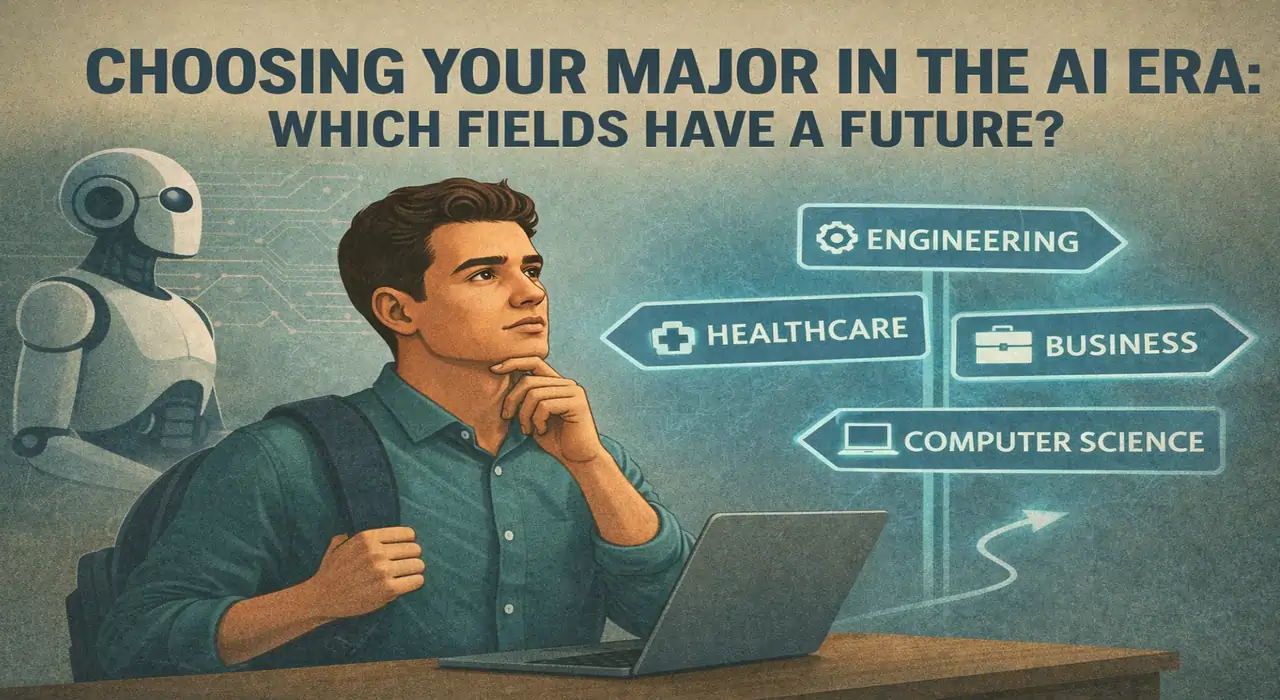
It's your final year of high school. You must make one of life's most important decisions:
choosing your university major. But in a world where
artificial intelligence is changing daily, this decision has become harder than ever.
Parents say: "Go to medical school, there's always a need." Your friends say: "Study computer science, there's work everywhere." But deep in your mind, one question persists: Will this major still be valuable in 4-6 years when I graduate?
This concern is completely valid. We're witnessing:
So which major should we choose? This article is your comprehensive roadmap - with deep analysis of majors, future predictions, and practical strategies for making smart decisions.
Understanding the Problem: Why Has Choosing a Major Become Harder?
In the past, choosing an academic major was a relatively simple decision. You looked at your interests and abilities, examined available jobs, and chose a major that would likely lead you to that job. But today, the rules of the game have completely changed.
The reason for this complexity isn't just AI - it's the speed of change. We live in an era where technology evolves every 6 months, new jobs emerge and old jobs disappear. This means the decision you make today must predict the next 10-20 years - something even experts struggle with.
Let's see why this decision has become so difficult:
Rapid Labor Market Changes
In the past, an academic major almost guaranteed a specific job:
- Electrical engineering → Electrical engineer
- Accounting → Accountant
- Nursing → Nurse
But today this equation is broken. The job market changes so rapidly that:
- Jobs that exist today may not exist tomorrow
- Jobs created tomorrow don't have names today
- Required skills completely change every 3-5 years
The Challenge of Predicting the Future
When an 18-year-old student chooses a major:
- 4 years until bachelor's graduation
- 2-3 years to find suitable employment
- 30-40 years working in that field
This means you must predict the world 40 years from now - something even experts cannot do with certainty.
Social and Family Pressure
Many students face various pressures:
- Parents: "Study top majors - medicine, engineering"
- Society: "This major has prestige, that one doesn't"
- Friends: "Let's choose the same major"
- Themselves: "What do I really want?"
These pressures cause many to make wrong decisions.
Major Analysis: Which Are at Risk and Which Are Safe?
Now that we understand why choosing a major has become difficult, it's time for real analysis. In this section, we evaluate each major with specific criteria: automation potential, need for human skills, work complexity, and future outlook.
It's important to know that no major is 100% safe or 100% dangerous. But some majors carry more risk and others offer better opportunities. Our goal here is to provide a realistic roadmap - not to scare you, but to inform you so you can make smart decisions.
In the tables and explanations below, we've calculated automation risk percentages based on credible research and current labor market trends. Let's begin:
Evaluation Criteria
Before examining majors, we must know the evaluation criteria:
1. Automation Potential: Can AI do this work?
2. Need for Human Skills: Is empathy, creativity, leadership required?
3. Complexity and Uncertainty: Is the work algorithmizable?
4. Social Value: Is society willing to pay for this work?
5. Growth and Evolution: Is this field growing or declining?
| Major Category | Automation Risk | 10-Year Outlook | Recommendation |
| Traditional Accounting | 🔴 Very High (80%) | Sharp demand decline | ❌ Not recommended |
| Simple Programming | 🟡 High (60%) | Work nature changing | ⚠️ With caution |
| Basic Graphic Design | 🟡 High (70%) | Need high specialization | ⚠️ With caution |
| Medicine (Clinical) | 🟢 Low (25%) | Growth with AI | ✅ Safe |
| Clinical Psychology | 🟢 Very Low (10%) | Strong growth | ✅✅ Very Safe |
| Architecture | 🟢 Low (30%) | Collaboration with AI | ✅ Safe |
| AI and Data Science | 🟢 Low (20%) | Explosive growth | ✅✅ Excellent |
At-Risk Majors (Not Recommended or With Caution)
1. Traditional Accounting and Finance
Risk: 🔴 Very High
Why at Risk:
- AI can automatically prepare financial statements
- Financial analysis with AI is more accurate and faster
- Smart accounting software is replacing jobs
Real Example:
Large companies are reducing their accounting teams, keeping only 2-3 specialists instead of 10 to manage AI software.
If You're Really Interested:
- Move toward strategic financial analysis
- Learn machine learning skills
- Focus on financial consulting (requires human interaction)
2. Translation and Foreign Languages (Applied)
Risk: 🔴 High
Why at Risk:
- Language models provide instant, accurate translation
- Machine translation quality approaches human level
- Translation cost with AI is near zero
Exceptions:
- Literary and artistic translation: Requires deep cultural understanding
- Sign language interpretation: Requires physical presence
- Diplomacy and negotiation: Requires human skills
3. Data Entry and Administrative Work
Risk: 🔴 Very High
These jobs are almost completely automated or will be soon.
4. Simple Programming and Basic Web Development
Risk: 🟡 Medium to High
Reality:
But:
- System architecture: Still needs humans
- Cybersecurity: Growing field
- Complex UX design: Requires deep human understanding
Recommendation:
If studying programming:
- Focus on architecture and system design
- Learn security and AI
- Build team leadership skills
Relatively Safe Majors (With Changes)
1. Engineering (Most Branches)
Risk: 🟢 Low to Medium
Why Safe:
- Requires complex systems thinking
- Combines technical knowledge with creativity
- Decision-making under uncertainty
But:
Top Fields:
- Artificial Intelligence Engineering
- Biotechnology Engineering
- Sustainable Energy Engineering
- Nano Engineering
2. Medical Sciences (With Emphasis on Human Interaction)
Risk: 🟢 Low
Why Safe:
But:
- AI becomes powerful assistive tool
- Doctors must work with AI
Top Fields:
- Surgery: Still requires manual skill
- Psychiatry: Requires deep human understanding
- Personalized Medicine: Combines medicine with genetics
3. Law (With Specialization)
Risk: 🟢 Low to Medium
Why Safe:
But:
- Legal research becomes faster with AI
- Simple lawyers will be replaced
Top Specializations:
- Technology and AI Law
- Intellectual Property Law
- Trial Law (persuasion skills)
Very Safe and Growing Majors
1. Psychology and Counseling
Risk: 🟢 Very Low
Why Best Option:
Career Opportunities:
- Psychotherapist
- Family counselor
- Life coach
- Organizational mental health specialist
Potential Income:
- Average: $40k-100k/year
- High (with specialization): $150k-300k/year
2. Artificial Intelligence and Data Science
Risk: 🟢 Very Low
Why Best Option:
- Industry building itself
- Explosive demand
- Very high salaries
Subfields:
Income:
- Entry-level: $60k-120k/year
- Experienced: $150k-300k/year
- Expert: $300k+/year
3. Architecture and Urban Design
Risk: 🟢 Low
Why Safe:
- Requires creativity and unique perspective
- Deep understanding of culture and human needs
- Complex aesthetic decisions
But:
4. Education (With Specialization)
Risk: 🟢 Low
Why Safe:
Top Subfields:
Emerging and Future-Oriented Majors
In addition to traditional majors, new fields are emerging that didn't even exist 10 years ago. These majors typically sit at the intersection of multiple disciplines and precisely for this reason, offer exceptional opportunities.
If you're young and want to ride the wave of change (rather than be crushed under it), these majors can be excellent choices. Higher risk, but higher reward too - because you're building a future that hasn't fully formed yet.
Important note: These majors typically require continuous learning and high flexibility. But if you're interested in innovation and discovery, they can be incredibly exciting career paths:
1. Biotechnology and Genetics
Outlook: 🚀 Excellent
Combining biology with AI:
Potential Salary: Very High
2. Sustainable Energy
Outlook: 🚀 Good
3. Cybersecurity
Outlook: 🚀 Excellent
Salary: Very high and growing
4. User Experience Design (UX)
Outlook: 🚀 Good
Major Selection Strategy: Step by Step
Now that you have enough information about majors, it's time to learn the selection strategy. This is a 5-stage process that, if followed correctly, will significantly increase your chances of success.
Many students make the mistake of deciding without a plan - only based on momentary feelings, parental pressure, or friends' recommendations. But choosing a major is a 4-6 year investment that must be carefully planned.
This 5-step strategy is designed based on the experience of thousands of successful students and professional counselors. Time needed to complete this process? About 3-6 months. Yes, it's time-consuming - but it's worth it:
Step 1: Self-Knowledge (Very Important!)
Before looking at the job market, know yourself:
Key Questions:
- What truly excites me?
- What can I do for hours without getting tired?
- What are my natural strengths?
- Do I prefer working with people or systems?
- Am I ready to spend 4-6 years on this topic?
Helpful Tests:
- Myers-Briggs Type Indicator (MBTI)
- Holland Code Career Test
- CliftonStrengths
Step 2: Deep Research
For Each Major of Interest:
1. Talk to Professionals (at least 3-5 people)
- What do they love about their work?
- What is difficult?
- If choosing again, what would they do?
- How do they see the future of this field?
2. Practical Experience
- Internships
- Small projects
- Short online courses
3. Job Market Research
- How many jobs are available?
- What's the average salary?
- Is it growing or declining?
Step 3: Realistic Assessment
| Criterion | Importance Weight | Major 1 | Major 2 |
| Personal Interest | 30% | 8/10 | 6/10 |
| Career Outlook | 25% | 7/10 | 9/10 |
| AI-Proof Security | 20% | 6/10 | 8/10 |
| My Abilities | 15% | 9/10 | 7/10 |
| Income Potential | 10% | 7/10 | 8/10 |
| Final Score | 100% | 7.4/10 | 7.6/10 |
Step 4: Strategic Planning
T-Shaped Approach:
- Depth: Deep expertise in one field
- Breadth: General knowledge in related fields
Example:
- Depth: Clinical psychology
- Breadth: AI, neuroscience, UX design
This combination makes you unique.
Step 5: Continuous Learning
Reality:
University degree is just the beginning, not the end.
Be Ready:
- Learn new skills every 3-5 years
- Take online courses
- Have side projects
- Build professional network
Common Mistakes in Choosing Majors
Before we get to final recommendations, let's talk about mistakes you should avoid. Sometimes knowing what you shouldn't do is as important as knowing what you should do.
These mistakes are drawn from the real experiences of thousands of students who regretted their choices. Some changed majors, some dropped out, and some spent years in jobs they hated. You don't need to repeat these mistakes.
The good news is that if you recognize these mistakes before making your decision, you can avoid them. Let's see what the most common mistakes are:
Mistake 1: Choosing Based on "Rank and Prestige"
Problem:
Many choose medicine or computer engineering only due to social pressure.
Result:
- Depression and lack of motivation
- Dropping out
- Unsuccessful career
Solution:
Listen to your inner voice, not others.
Mistake 2: Only Thinking About Money
Problem:
"This major pays well, I'll go for it."
Result:
30-40 years doing work you hate.
Solution:
Balance between interest and income.
Mistake 3: Ignoring AI's Role
Problem:
"AI won't affect my major."
Result:
Big shock after graduation.
Mistake 4: Lack of Flexibility
Problem:
"I only want this one major, nothing else."
Result:
Missing good opportunities.
Solution:
Have multiple options, be flexible.
Final Recommendations: Practical Summary
After reading all the analyses, strategies, and warnings, you're probably confused and don't know where to start. This is completely natural! There was a lot of information, and now you need a practical, actionable summary.
In this section, we divide everything we've said into 4 simple categories - based on your main interests. You just need to know what you're interested in, and we'll tell you which majors are suitable for you.
These recommendations are realistic - not too pessimistic to scare you, not too optimistic to mislead you. Just simple, practical truth:
If You Like Working with People:
✅ Psychology and counseling
✅ Medicine (emphasis on connection)
✅ Education
✅ Law (trial law)
If You Like Technology:
✅ AI and data science
✅ Cybersecurity
✅ Software architecture
✅ Biotechnology
If You Like Creativity:
✅ Architecture
✅ User Experience (UX) Design
✅ Industrial design
✅ Digital art (with specialization)
If You Like Business:
✅ Tech entrepreneurship
✅ Strategic consulting
✅ Advanced digital marketing
⚠️ Traditional management (with caution)
Action Plan: Start Today
Knowledge without action is worthless. You now have all the necessary information - but if you don't do anything, nothing will change. Many students read articles, watch videos, and then... do nothing.
This 3-stage action plan is designed to guide you from today to your final decision. Each stage has specific, measurable goals. Just take one step at a time.
Important note: This is a flexible plan. If you feel you need more time, that's fine - quality is more important than speed. But at least get started:
This Week:
This Month:
Next 3 Months:
Conclusion: There's No "Perfect" Major, But There Is a "Right" One
After reading this article, you might still be a bit confused. This is natural - because making a perfect decision in this turbulent world is impossible. But the good news is you don't need a "perfect" decision - you just need a "right" decision.
What's the difference? A "perfect" decision means a major that: is 100% safe, has high income, makes you happy, pleases your parents, and has zero risk. Such a major doesn't exist.
But a "right" decision means a major that: aligns with your real interests, has reasonable success probability, offers growth space, and allows you to maintain your humanity. Such a major exists - and you can find it.
Simple Truth: No major is 100% safe or 100% dangerous.
More Important Truth: What matters is you:
Final Message:
In the AI era, the best major is one that:
- You're truly passionate about
- Aligns with your natural strengths
- Has space for learning and growth
- You can collaborate with AI, not compete
Choosing a major isn't choosing a life - it's just a starting point. What truly matters is the journey you build.
Good luck! 🎓✨



 Social Impact & Future
 Social Impact & Future
 Social Impact & Future
 Social Impact & Future
 Social Impact & Future
 Social Impact & Future