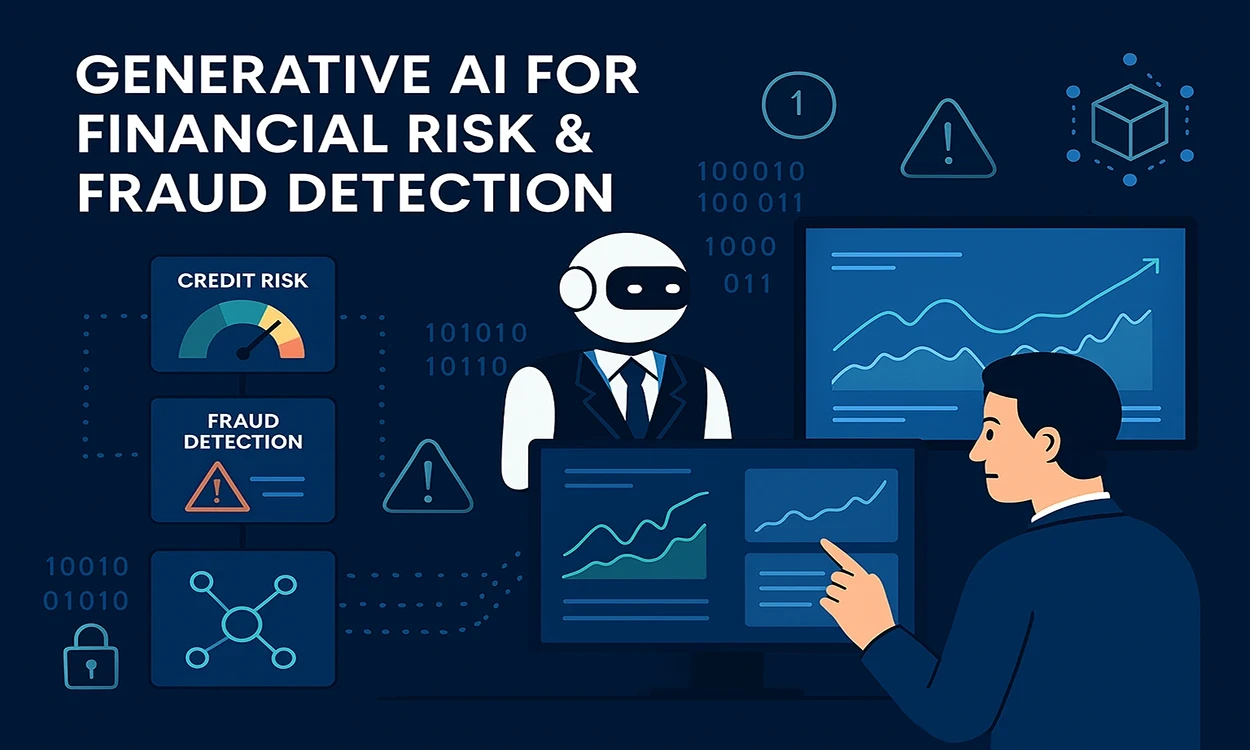
In today's complex financial world, investors and financial institutions face a wide range of risks. From severe market volatility to cybersecurity threats, from sudden interest rate changes to global economic crises - all these factors can lose or gain millions of dollars in a fraction of a second.
In such an environment, risk management is no longer a choice; it's a critical necessity. But traditional risk management methods - which primarily relied on historical analysis and human judgment - are no longer sufficient to deal with the complexity and speed of modern markets. This is where
artificial intelligence enters the scene and transforms financial risk management.
How Does AI Identify Financial Risks?
1. Analyzing Hidden Patterns in Big Data
One of the most powerful applications of AI in risk management is its ability to process and analyze enormous volumes of data that would be impossible for humans. Imagine a large bank with millions of daily financial transactions.
Machine learning algorithms can analyze these transactions in real-time and identify suspicious patterns that might indicate fraud or money laundering.
Real Example: JPMorgan Chase uses its AI system called COiN, which can review 12,000 commercial contracts in seconds - a task that previously required 360,000 hours of lawyers' work. This system has not only increased speed but also significantly reduced human errors that could lead to legal and financial risks.
2. Predicting Financial Crises with Neural Networks
Deep
neural networks can identify warning signs of future crises by learning from past financial crises. These models, instead of one-dimensional analysis, consider hundreds of variables simultaneously - from macroeconomic indicators to market sentiment on social media.
Practical Example: LSTM models, which are a type of recurrent neural network, can identify complex temporal patterns in financial data. An investment fund using this technology was able to receive warning signals 6 months before a major company's stock crash, avoiding millions in losses through timely exit.
3. Sentiment Analysis for Market Movement Prediction
Natural language processing and sentiment analysis allow AI to take the "pulse" of the market. These systems can analyze millions of news articles, tweets, financial reports, and even executive interviews to determine the prevailing market sentiment toward a particular stock or sector.
Tangible Example: When Elon Musk tweets about Bitcoin, sentiment analysis systems based on
large language models like BERT or GPT can predict the impact of this tweet on market sentiment in a fraction of a second, helping traders adjust their positions before severe volatility occurs.
Advanced Applications of AI in Risk Reduction
1. Real-Time Fraud Detection
Challenge: Every day, fraudsters invent new methods to bypass security systems. Traditional methods that rely on fixed rules cannot cope with these evolving threats.
AI Solution: Unsupervised machine learning models can identify abnormal behaviors without prior labeling. These models learn the behavioral profile of each customer and immediately alert when a transaction occurs outside this profile.
Practical Example: Mastercard uses neural networks for fraud detection, which has increased the correct detection rate by 50% and reduced thousands of false alerts. This means fewer card blocks for real customers while more effectively preventing fraud.
2. Credit Risk Management with Higher Accuracy
Credit risk assessment - the probability that a borrower will be unable to repay - is one of the most important tasks of banks and financial institutions.
Machine learning models can dramatically increase prediction accuracy by considering hundreds of non-traditional variables.
Non-traditional Variables: In addition to credit history and income, these models can analyze purchase patterns, online behavior, and even social media data (with user consent). For example, a person who regularly pays their bills, even with low income, may have lower credit risk than someone with high income but irregular payment history.
Result: Some Fintech startups have been able to use these methods to provide loans to people who were rejected by traditional systems while keeping the default rate at an acceptable level.
3. Portfolio Optimization with Advanced Algorithms
Traditional Challenge: Traditional diversification operates on simple rules like "60% stocks, 40% bonds," but this approach doesn't consider complex correlations between assets.
AI Solution: Reinforcement learning algorithms can dynamically adjust investment strategies. Like a chess player, these models simulate millions of different scenarios and select the best asset combination to reduce risk and increase returns.
Real Example: The investment fund Two Sigma uses machine learning algorithms to manage over $60 billion in assets. These algorithms rebalance the portfolio every night based on thousands of market signals and have achieved above-market returns with lower risk.
4. Liquidity Risk Management
Liquidity risk - the probability that an institution cannot meet its short-term obligations - can drive even profitable companies to bankruptcy. AI can help managers maintain adequate liquidity by predicting cash flows and simulating crisis scenarios.
Practical Application: Time series forecasting models can provide accurate predictions of future cash needs by analyzing seasonal patterns, long-term trends, and specific events. Some companies have been able to reduce their cash inventory by 20% (which has lower opportunity cost) while ensuring sufficient liquidity to handle unexpected fluctuations.
5. Identifying Systemic Risks
Systemic risks - like the 2008 financial crisis - arise from hidden correlations between different financial institutions.
Graph neural networks can model this complex network of relationships and identify vulnerable points in the system.
Imagine: A vast graph showing each bank, investment fund, and insurance company as a node, with lines between them representing loans, investments, and derivative contracts. GNN algorithms can simulate how many other institutions would be directly or indirectly affected if a large institution were to go bankrupt.
Practical AI Tools for Risk Management
1. Ready-Made Risk Management Platforms
Kensho (now part of S&P Global): This platform uses
natural language processing to analyze the impact of global events on financial markets. For example, it can answer "if oil prices drop 20%, which stock market sectors will see the most impact?"
Ayasdi: This tool uses machine learning techniques to identify hidden patterns of fraud and money laundering. HSBC Bank was able to save millions in compliance costs by using it.
2. Open-Source Libraries for Developers
TensorFlow and PyTorch: These deep learning frameworks allow developers to build custom risk management models. For example, you can build a
convolutional neural network for analyzing technical charts or a Transformer model for stock price prediction.
Prophet (by Meta): This
time series forecasting tool is particularly useful for data with strong seasonal patterns. Financial analysts can generate accurate predictions of sales, revenue, or market volatility with just a few lines of code.
3. Large Language Models for Financial Analysis
- Summarize complex financial reports
- Analyze news events and estimate their probable impact
- Answer specialized financial questions
- Even write Python code for financial data analysis
Practical Example: An analyst can ask
Claude Sonnet 4.5 to review a 100-page financial report and extract key risks. What used to take hours can now be done in minutes.
Challenges of Using AI in Risk Management
1. Black Box Nature of Models
Problem: Many complex
deep learning models operate like black boxes - they give good results but don't explain why. This is problematic for financial decisions that require justification.
Emerging Solutions:
- Explainable AI: Techniques like SHAP and LIME that can show how much each feature contributed to the model's final decision.
- Hybrid Models: Combining complex models with clear business rules to create a balance between accuracy and interpretability.
2. Data Quality and Bias
Real Danger: If training data contains bias, the AI model also learns and replicates these biases. For example, if a credit model is trained on historical data where certain demographic groups received fewer loans, it might continue this pattern.
Practical Solutions:
- Regular model audits to identify biases
- Using diverse and representative data
- Testing models in various scenarios before deployment
3. Cybersecurity Risks
AI in cybersecurity is a double-edged sword. While it can help detect threats, it can also be targeted by attacks:
Prompt Injection Attacks: Attackers can use specific inputs to trick language models into behaving unexpectedly. For more information about this threat, read the
prompt injection article.
Data Poisoning: Injecting malicious data into the training dataset to corrupt model performance.
4. Computational Costs
Training complex models like
Transformers can be very expensive. Training a large language model can cost millions of dollars in computational resources.
Efficient Solutions:
- Transfer Learning: Using pre-trained models and fine-tuning them for specific tasks
- Fine-tuning and LoRA: Techniques that adjust only small parts of the model instead of complete training
- Small Language Models: More efficient alternatives for specific tasks
5. Need for Combined Expertise
Challenge: AI-based financial risk management requires people who have both deep financial knowledge and AI technical skills - a rare combination.
Solution: Organizations must either invest in training existing staff or form interdisciplinary teams where financial experts and data scientists collaborate closely.
The Future of Financial Risk Management with AI
1. Self-Adjusting Systems
AI agents that not only identify risks but also automatically take corrective actions. Imagine a system that when it detects liquidity risk, automatically sells short-term bonds or activates credit lines.
2. Quantum AI
Quantum computing can solve complex optimization problems that are impossible for classical computers.
Quantum AI can perform risk simulations with unprecedented detail.
3. Advanced Multimodal Models
Multimodal models that can simultaneously process text, images, audio, and numerical data provide more comprehensive risk analysis. For example, they can simultaneously analyze financial reports, satellite images of company facilities, executive video interviews, and market data.
4. Federated Learning for Privacy
Federated learning allows financial institutions to collaborate on shared models without sharing sensitive data. Different banks can train a fraud detection model together while customer data remains on their own servers.
5. Complete Explainability
New techniques like
Chain of Thought and
reasoning models allow AI to explain not only the result but also its thinking process. This is essential for critical financial decisions that require auditing and justification.
Practical Tips to Get Started
For Financial Institutions
1. Start Small, Think Big: Instead of implementing a massive project, start with a pilot project in a specific area - for example, fraud detection in one department or default prediction for one type of loan.
2. Prioritize Data: Before investing heavily in models, ensure you have quality, clean, and organized data. "Garbage in, garbage out" is very serious in machine learning.
3. Build Hybrid Teams: Hire people who speak both financial and technical languages. Or create training programs for existing employees.
4. Governance and Ethics: From the beginning, establish governance frameworks for responsible AI use.
Ethics in artificial intelligence shouldn't be an afterthought.
For Individual Investors
1. Robo-Advisor Tools: Try platforms like Betterment or Wealthfront that use AI algorithms for portfolio management. They have lower costs than human advisors.
2. Continuous Learning: Familiarize yourself with new tools. Even a basic understanding of how these systems work can help with better decisions. The
chat with AI article can be a good starting point.
3. Combine with Human Judgment: Never rely entirely on algorithms. Use them as tools to enhance - not replace - your judgment.
Conclusion: Balance Between Opportunity and Caution
Artificial intelligence has undoubtedly transformed the future of financial risk management. From detecting fraud in fractions of a second to predicting financial crises months before occurrence, this technology has provided us with powerful tools.
But this power comes with responsibility. We must be aware of biases, privacy protection, security, and explainability. Real success lies in intelligently combining the computational power of machines with human judgment, creativity, and ethics.
The financial world has always been accompanied by uncertainty and risk. Now, with AI as a companion, we are better equipped than ever to understand, predict, and manage these risks. The future belongs to those who learn to use these tools wisely.